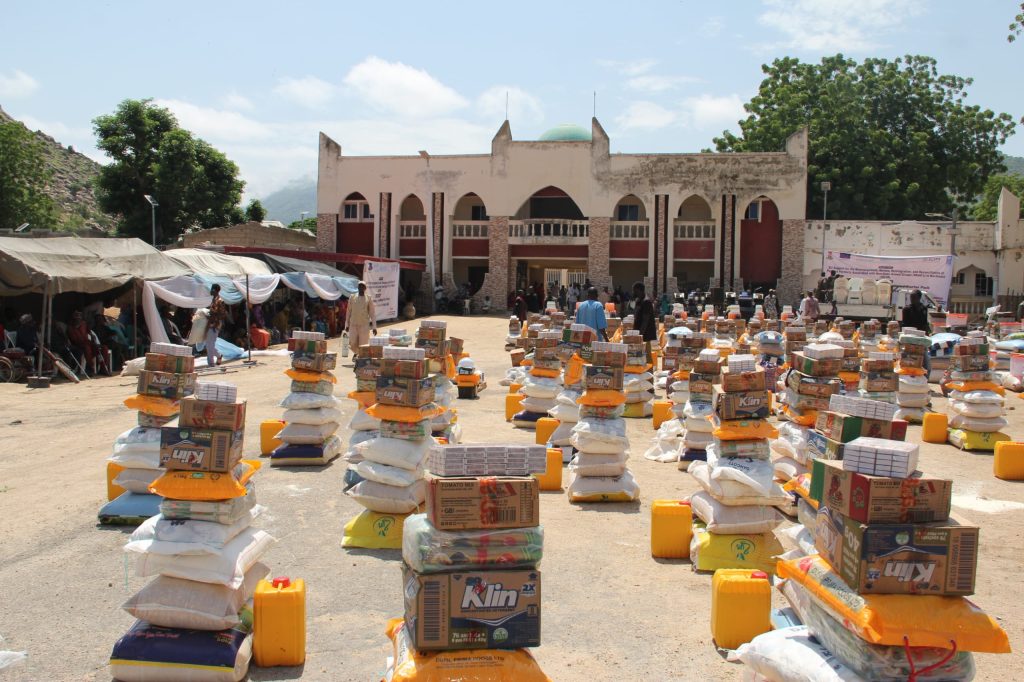
Livelihood starter-kits for 300 beneficiaries on display at Emir of Gwoza's Palace, Gwoza, Borno State, Nigeria. Courtesy: Allamin Foundation for Peace and Development. Date: 23/7/2026. Photo: Allamin Foundation.
Allamin Foundation for Peace and Development has provided livelihood starter kits to 300 beneficiaries in Gwoza Local Government Area of Borno State as part of efforts to strengthen reintegration, rehabilitation, reconciliation and sustainable peace in communities affected by insurgency.
The beneficiaries, who recently completed vocational skills training, received the support during a graduation ceremony and cultural festival held at the Emir of Gwoza’s Palace over the weekend.
The intervention was implemented under the European Union (EU) and United Nations Development Programme (UNDP)-funded Disengagement, Review, Reintegration and Reconciliation (DRRR) programme. The initiative targets persons formerly associated with non-state armed groups, internally displaced persons (IDPs), returnees and members of host communities to promote economic recovery and peaceful coexistence.
Speaking at the event, the Executive Director of the Allamin Foundation for Peace and Development, Hajiya Hamsatu Allamin, said the programme was designed to equip beneficiaries with sustainable sources of income while fostering reconciliation in communities devastated by years of conflict.
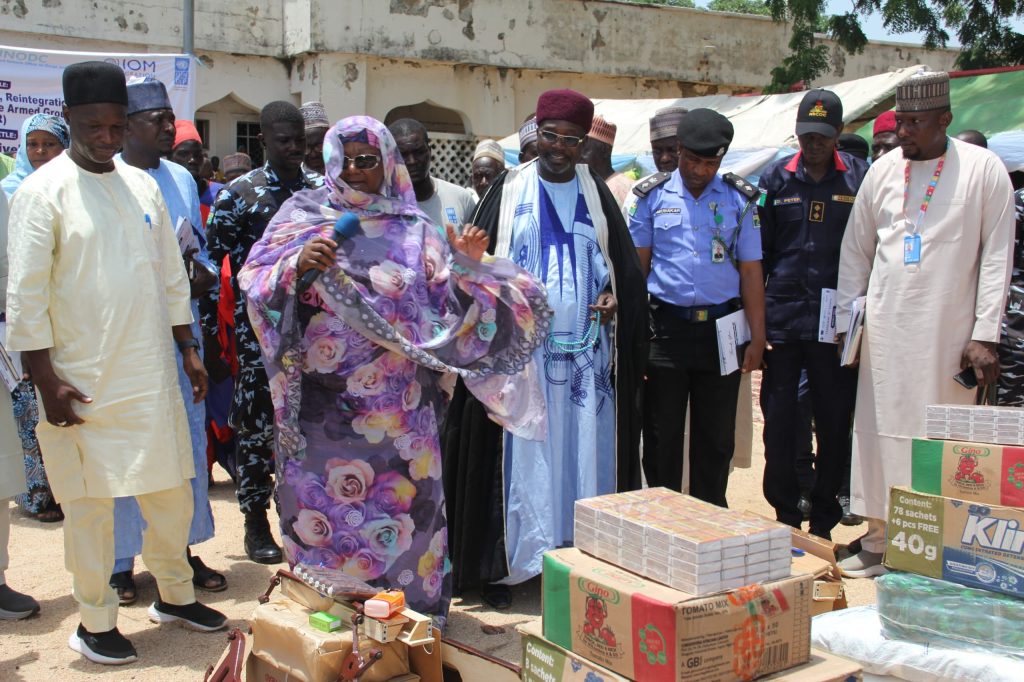
She explained that the starter packs were selected based on the vocational skills acquired by each participant to ensure they could establish viable businesses and achieve long-term economic independence.
According to her, the initiative demonstrates the foundation’s commitment to empowering vulnerable community members while rebuilding trust and strengthening social cohesion across conflict-affected areas.
Hamsatu also appreciated the Emir of Gwoza, Alhaji Mohammed Shehu Idrissa Timta, the Gwoza Local Government Council, traditional institutions, security agencies and other stakeholders for supporting the successful implementation of the project.
She noted that the current phase covers 300 beneficiaries, acknowledging that Gwoza and neighbouring Bama Local Government Area remain among the communities worst affected by more than 16 years of Boko Haram insurgency.
In his remarks, the Emir of Gwoza commended the Allamin Foundation, the European Union and UNDP for bringing the intervention to the area, while urging development partners to expand the programme to accommodate more vulnerable residents.
The traditional ruler appealed to community members to remain peaceful and patient, expressing confidence that additional interventions would reach more people over time.
He also advised beneficiaries to make productive use of the starter kits.
He praised the Borno State Government for its efforts in restoring peace and improving security in Gwoza, adding that the programme was implemented without discrimination based on religion, ethnicity or social background.
According to the monarch, many victims of the insurgency were forced into armed groups against their will, making rehabilitation and reintegration essential for achieving lasting peace.
Also speaking, Chairman of Gwoza Local Government Area, Alhaji Abba Kawu Idrissa Timta, commended the Allamin Foundation for its continued humanitarian interventions in conflict-affected communities.
He encouraged beneficiaries to use the support responsibly, describing economic empowerment as one of the most effective ways to reduce poverty, discourage criminal activities and promote self-reliance.
The Special Adviser to the Borno State Governor on Reintegration, Rehabilitation and Resettlement (RRR), Engineer Ali Goni, also praised the Borno State Government, Allamin Foundation, the European Union, UNDP and other partners for supporting victims of insurgency through sustainable development initiatives.
Representatives of the Borno State Ministry of Information and the Divisional Police Officer of Gwoza urged participants to transfer the skills they had acquired to younger members of their families and communities, stressing that entrepreneurship remains a critical tool for reducing youth unemployment and promoting peaceful coexistence.
Project Manager of the Allamin Foundation, Mallam Hamza Maigari, described the intervention as a significant step toward achieving transitional justice through community-based reintegration.
He said the programme combines vocational training, community engagement, reconciliation activities and livelihood support to accelerate recovery in communities affected by conflict.
Maigari disclosed that the beneficiaries comprised 100 returnees and 200 members of host communities, with 176 women and 124 men, reflecting the programme’s emphasis on gender inclusion and support for vulnerable households.
The event also featured colourful cultural displays by the Hambagda and Glavda clans, alongside performances by traditional warriors from different communities across the Gwoza Emirate. Organisers said the cultural festival was intended to reinforce peace, unity and reconciliation among diverse groups.
Several beneficiaries expressed gratitude to the Allamin Foundation, the European Union, UNDP and other development partners for the support, pledging to use the starter kits to establish businesses, improve their livelihoods and contribute to sustainable peace and development in their communities.