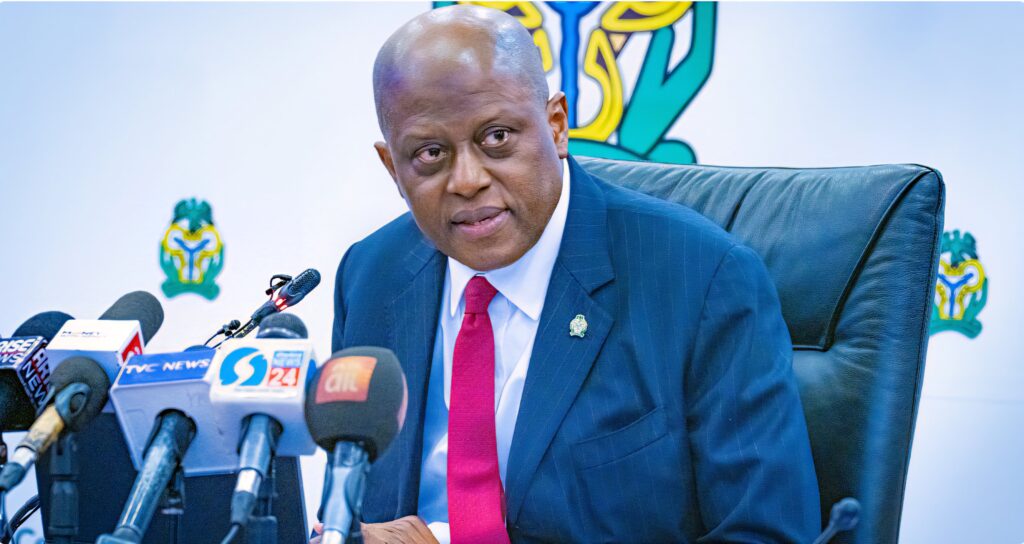
CBN Governor, Yemi Cardoso
Central Bank of Nigeria (CBN) on Wednesday July 22 defended its monetary and foreign exchange reforms before the Senate, insisting that recent policy measures are yielding positive results despite concerns over inflation, bank lending and the apex bank’s financial operations.
CBN Governor Olayemi Cardoso, accompanied by the four deputy governors, appeared before the Senate Committee on Banking, Insurance and Other Financial Institutions for the statutory half-year briefing required under the CBN Act.
Cardoso told lawmakers that reforms implemented over the past three years had helped stabilise the economy despite global economic shocks.
He noted that headline inflation rose from 15.06 per cent in February to 15.93 per cent in May due largely to geopolitical tensions in the Middle East, but moderated slightly to 15.91 per cent in June as tighter monetary policies began to take effect.
On the foreign exchange market, the CBN governor said reforms had improved transparency and reduced speculative activities. He disclosed that the average exchange rate during the first half of 2026 stood at N1,375.40 to the dollar.
Cardoso further revealed that diaspora remittances through official channels had increased significantly from about $200 million to more than $600 million monthly, with the apex bank targeting $1 billion in monthly inflows by the end of the year. He added that Nigeria’s external reserves stood at $52.73 billion as of July 9, 2026.
On banking sector reforms, Cardoso said lenders had raised N4.65 trillion under the ongoing recapitalisation exercise, with domestic investors accounting for 72.55 per cent of the funds and foreign investors contributing 27.45 per cent.
According to him, 33 banks have met the new capital requirements, while the CBN continues to engage institutions yet to comply in order to safeguard depositors and maintain financial system stability.
“We have moved from building bigger balance sheets to making sure that capital delivers better governance, stronger risk management and real support for productive activity,” Cardoso said.
Chairman of the committee, Senator Mukhail Adetokunbo Abiru, welcomed the improving macroeconomic indicators but stressed the need for reforms to translate into tangible benefits for businesses and households.
He said stronger banks should be able to mobilise savings and provide affordable credit to critical sectors, including agriculture, manufacturing, infrastructure, technology and small and medium enterprises.
Abiru expressed concern over the slowdown in private sector lending despite the increase in banks’ capital base.
“The expectation is that stronger capital should support more lending to the economy, not a tilt toward risk-free assets or short-term instruments,” he said.
Lawmakers also raised concerns over banks yet to meet recapitalisation requirements, rising bank charges, failed electronic transactions, cybersecurity challenges, financial inclusion, the quality of naira notes in circulation and proposals for a financial holding company framework.
The senators further queried the CBN’s 2025 audited financial statements, particularly the sharp increase in liquidity management through Open Market Operations, which rose from N24.3 trillion in 2024 to N48.7 trillion in 2025.
They demanded explanations on the cost of sterilising excess liquidity, rising operating expenses and the decision to apply the bank’s operating surplus to offset Federal Government Ways and Means advances instead of remitting the funds directly to the federation account.
Following the public hearing, the committee proceeded into a closed-door session with Cardoso and his team for further deliberations.