Kano Governor Abba Yusuf
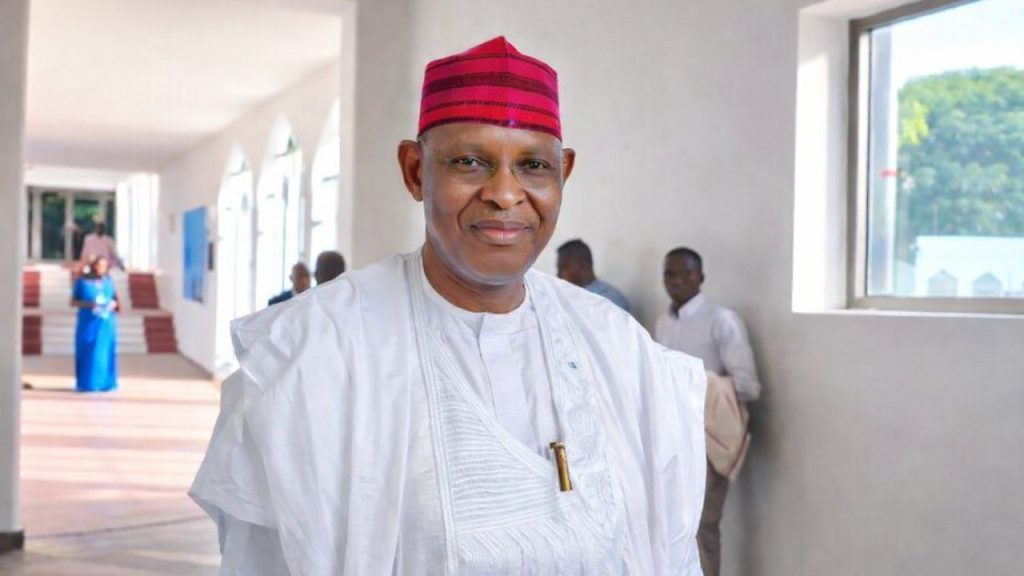
Kano State Commissioner for Information and Internal Affairs, Amb. Ibrahim Waiya, has said Governor Abba Kabir Yusuf is deeply committed to strengthening security governance and tackling insecurity in the state through a combination of kinetic and non-kinetic approaches.
Waiya, who represented the governor at the conferment of the prestigious Award of Excellence in Security Governance on Governor Yusuf by the Institute of Security and Strategic Studies (ISSS) in Kaduna, said the administration had introduced several initiatives aimed at complementing the efforts of conventional security agencies.
He said one of the major components of the government’s kinetic approach was the establishment of the Neighbourhood Watch, under which about 2,000 young men and women had been trained and deployed across the state’s 44 local government areas to support security agencies in combating crime and other social vices.
According to him, the administration has also established the Anti-Phone Snatching Corps, with trained youths deployed to communities to assist conventional security agencies in addressing phone snatching and related crimes.
The commissioner said the government had equally prioritised non-kinetic measures, particularly through the Safe Corridor Programme, which was designed to encourage young men involved in political thuggery and violence to surrender their weapons, embrace peace and abandon criminal activities.
He disclosed that about 340 youths had so far been registered and profiled under the programme, while the state government had committed more than N500 million to the initiative.
He added that plans were underway to prepare about 1,000 young men for a 40-day rehabilitation exercise, after which they would be empowered and reintegrated into society.
Waiya further said the government had strengthened community policing through the appointment of a Special Adviser dedicated to the programme, while also supporting independent citizens’ initiatives designed to complement the responsibilities of conventional security agencies.
He said the state was preparing to inaugurate a security forum comprising representatives from eight metropolitan local governments, describing the initiative as an independent citizens’ effort that would work in support of existing security structures.
The commissioner also highlighted the role of the Kano State Hisbah Board, saying the administration had strengthened its mandate and activities, particularly in addressing social conflicts, marital disputes and other issues capable of threatening peace and stability in communities.
According to him, the success of the various security initiatives was largely due to the governor’s political will and commitment, noting that the state government had continued to provide operational vehicles, logistics and timely funding support to security agencies operating in Kano.
He said the administration had also fostered a cordial working relationship with all security agencies in the state, adding that the government and the agencies were working in harmony towards a common objective of tackling insecurity and other security challenges.
Waiya said governing Kano, which he described as a cosmopolitan state and a “mini-Nigeria” because of its large population and diverse residents, required strong political will and massive investment in infrastructure and essential services.
He added that the government had therefore proposed a record N1.4 trillion budget, with more than N1 trillion earmarked for capital expenditure, as part of its commitment to improving the welfare and security of the people.
Also speaking, a lecturer and intelligence expert at the Nigerian Defence Academy (NDA), Kaduna, Abdullahi Bello, has warned that Nigeria risks sliding into deeper communal instability if government, security agencies and communities fail to strengthen collaboration in intelligence gathering and crime prevention.
Bello, of the Department of Intelligence and Security Science, Faculty of Military Science and Interdisciplinary Studies, gave the warning at the 2026 North West Conference on Community Security Management and Crime Prevention, organised by the Institute of Security and Strategic Studies in Kaduna.
Bello said the convergence of banditry, terrorism and other criminal activities had outpaced the intelligence capacity of conventional security forces, making community participation critical to tackling insecurity.
He stressed that effective crime prevention requires synergy among government, citizens and security agencies, warning that none of the three could successfully address the challenge in isolation.
He also cautioned against ethnic-based security arrangements, saying they could deepen suspicion, retaliation and communal tensions.
Drawing lessons from countries including Rwanda, Kenya, Colombia, South Africa and India, the NDA expert advocated the adoption of community-based intelligence systems capable of linking residents with security authorities.
He cited Kenya’s Nyumba Kumi initiative and other international models as examples of how local intelligence networks could help security agencies detect threats before they escalate.
Bello particularly warned Nigeria to learn from Rwanda’s experience of ethnic polarisation, saying, “We are on our way to Rwanda, but I hope, Insha Allah, we will not get there.”
Bello stressed that sustainable peace in the North-West would require preventive intelligence, responsible leadership and stronger partnerships between communities and security agencies, warning that instability in major states such as Kano and Kaduna would have consequences far beyond the region.