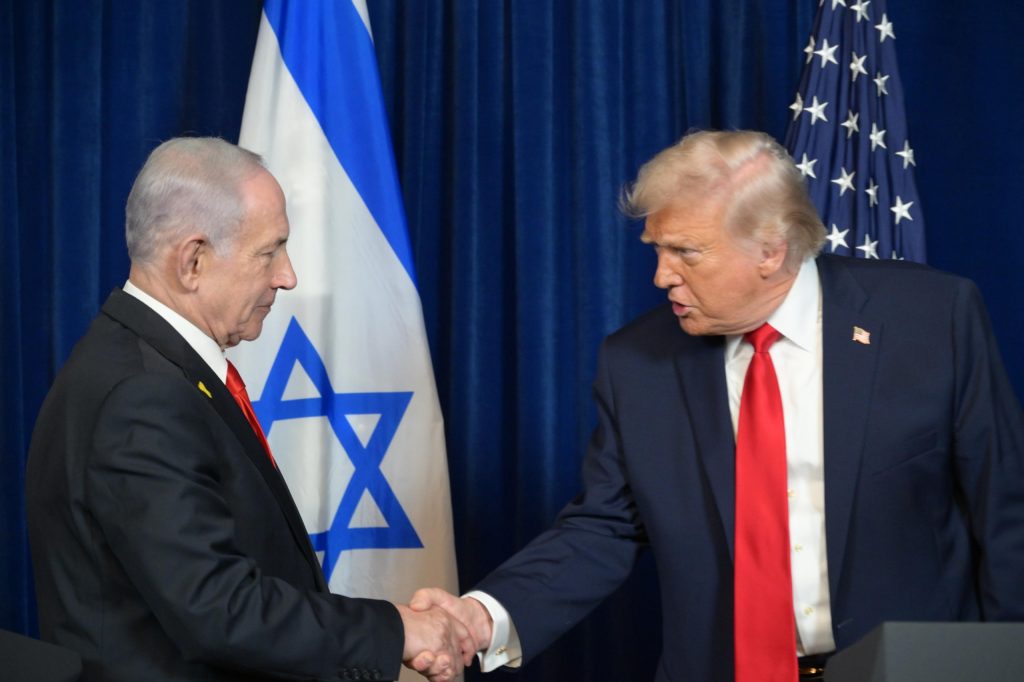
U.S President, Donald Trump and Israeli Prime Minister, Benjamin Netanyahu
Israeli Prime Minister Benjamin Netanyahu has formally rejected a United States-backed Gaza peace proposal endorsed by Hamas, marking a significant divergence from President Donald Trump as Israel heads toward a closely contested general election.
Speaking during a cabinet meeting on Sunday, Netanyahu dismissed the 15-point framework accepted by Hamas in late July, insisting that Israel would not agree to any arrangement requiring troop withdrawals before the militant group is completely disarmed.
“Israel rejects the 15-point document,” Netanyahu said.
He maintained that the Israeli military would continue its operations until Hamas no longer posed a security threat.
“The Israeli military will not carry out any withdrawal until Hamas is genuinely disarmed, and will continue to thwart threats against our forces and our citizens,” he told ministers.
Although Netanyahu described Trump as “our greatest friend in the White House,” he signalled that his government would not hesitate to oppose Washington on issues it considers vital to Israel’s security.
“They have ideas; some of them are acceptable to us and some are not, and we know how to stand our ground on these matters,” he said.
The disagreement comes as Netanyahu campaigns for re-election ahead of Israel’s October 27 general election. Recent opinion polls suggest the veteran leader is either tied with or trailing his political rivals, while the proposed Gaza agreement has faced strong resistance from his conservative support base. Several far-right members of his coalition have urged him to abandon the deal altogether.
Hamas, which recently named Khalil al-Hayya as its new leader, has thrown its support behind the proposal and called on Washington to persuade Israel to move forward with the agreement.
“We expect the mediators and the American guarantor to pressure Netanyahu and his government to adhere to the roadmap, and not obstruct the process for internal political and electoral reasons,” Bassem Naim, a member of Hamas’s political bureau, told AFP.
The Palestinian group also reaffirmed in a statement that it remains committed to implementing the agreement.
Until recently, Netanyahu had highlighted his close relationship with Trump, whose administration has consistently backed Israel on major policy issues, including relocating the US Embassy to Jerusalem.
However, differences between the two leaders have become more apparent in recent months. While Trump has promoted ceasefire efforts and broader regional settlements following the conflict with Iran, Netanyahu has continued to prioritise military objectives.
Addressing his cabinet, the Israeli leader reiterated his long-standing position on Iran’s nuclear ambitions.
“With an agreement or without an agreement, as long as I am prime minister, Iran will not have nuclear weapons,” he said.
The latest disagreement also follows renewed Israeli strikes on Lebanon last week after Israel accused the Iran-backed Hezbollah movement of violating a ceasefire, even as both sides participated in US-mediated negotiations.
The current Gaza proposal builds on a ceasefire framework announced in October, which has significantly reduced, but not completely halted, Israeli military operations in the territory.
Under the plan, Hamas would surrender its weapons to a newly established Palestinian governing authority, while Israel would gradually withdraw its forces alongside the disarmament process. Israel has objected to that sequence, insisting complete disarmament must occur before any withdrawal.
Following talks with Netanyahu last week, the US-backed Board of Peace revised its position, stating that Israeli forces would only withdraw after Hamas had been “completely” disarmed. Nevertheless, Netanyahu maintained that the revised language did not sufficiently address Israel’s concerns.
“We are talking about real disarmament, not fictitious disarmament,” he said.
Meanwhile, Egypt, one of the key mediators in the negotiations, urged all parties to honour their commitments and avoid actions that could derail the peace process. The appeal came during a conversation between Egyptian Foreign Minister Badr Abdelatty and Nickolay Mladenov, the Board of Peace’s high representative for Gaza.
Although Israeli military activity has reportedly declined since the ceasefire framework was announced, operations have continued. Gaza civil defence spokesman Mahmoud Bassal said Israeli gunfire on Sunday wounded a child in Khan Yunis, who was later taken to hospital for treatment.
According to Gaza’s health ministry, which operates under Hamas and whose casualty figures are regarded as reliable by the United Nations, 1,258 Palestinians have been killed since the ceasefire took effect.
The Israeli military, meanwhile, has reported the deaths of five of its personnel during the same period.