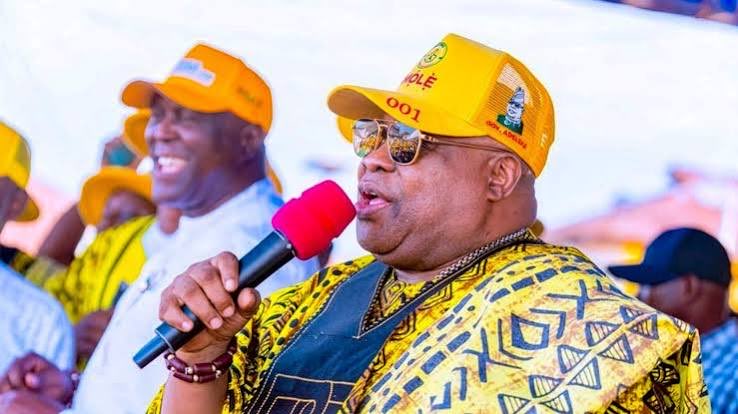
Osun State Governor, Ademola Adeleke
On Saturday, August 16, 2026, the big story was the governorship election in Osun state. And the incumbent, Sen. Ademola Jackson Nuruddeen Adeleke, of the Accord Party, was re-elected.
He polled 511,067 votes against his closest rival, Chief Bola Oyebamiji, of the APC, who netted 444,815.
It wasn’t exactly a landslide victory, but it was decisive. Over 66,000 votes difference is a big deal. The significance of this election goes beyond Osun state.
This piece takes a close-up on the outcome, draws parallels with the Benue political landscape and points out some insightful takeaways.
First, let us start with a simple or jocular takeaway i.e. the issue of names and/or letters of the alphabet.
Gov. Adeleke defeated his strongest rival, Chief Bola Oyebamiji, whose surname begins with O. And he proceeded to disappoint all of the big names who stood behind the latter, and whose names begin with Os.
The roll-call:
Oyebamiji Bola; Oyetola Adegboyega;
Odidika Hope Uzodinma; Omisore Ishiola;
Oyinlola Olagunsoye;
Opeyemi Bamidele;
Okpebholo Monday; Ododo Ahmed; Otu Bassey;
Onanuga Bayo;
Olufemi Gbajabiamila;
Oyedele Taiwo….
Adeleke didn’t just beat Oyebamiji – he equally beat all the Big Os who backed him!
In “Osun Decides 2026,” Adeleke descended on the Os with all vehemence, reducing the Os into letters of zero (0) electoral outcome.
So, Come 2027 – which letter of the alphabet will Gov. Alia singularly deconstruct, using advanced political math?
Takeaway: Let Alia work towards an electoral win so comprehensive it not only immobilises the strongest rival, but also reverberates across related letters of the alphabet. That’s the Adeleke Formula.
Second, Adeleke harvested the goodwill that flows from an organic connection with the masses. He, so to say, turned “People Power” into political capital and cashed it through a bumper harvest of votes.
Since his assumption of office, Adeleke has prioritised the people and their welfare over and above power-mongering and genuflections before human monuments.
The bond has been so strong that even when he dumped the PDP and pivoted to Accord Party, an unknown party in the state, the majority of the people thronged there with him.
They could tell the Man from the Party, and also weigh which side suited them better. In other words, Osun voters are very sophisticated; and, on the election day, they told Adeleke: “You are not only our Governor – You are also our Political Party”!
The Osun scenario poignantly parallels the Benue reality. The intra-party cleavage between “the Masses” and “the Anti-Masses” has ossified into something of an ideological divide i.e. those who want to make the state better, and those who are incorrigibly habituated to milking the state.
Put in sharp relief, there is a seeming contest for the soul of Benue: those who desire a functional state that works for all, and those who want a dysfunctional Benue – a dysfunctional Benue whose common-wealth is treated like a glorified vegetable garden somewhere in the backyard i.e. an unguarded space where the Okro, the Garden Eggs etc can be harvested, or even looted, with wanton relish and rapacious abandon.
The lesson for Fada Alia: He should remain connected to the people via his empathetic leadership. That way, on the D-Day “when come comes to become the come, the happen will happen.” (Apologies to late Chief Kingsley Ozumba Mbadiwe).
That is because, just as in Osun state, he’ll find Benue people faithful despite inducements, intimidation, mischief and distractions.
The third reason is connected to the second i.e. the over- hyped relevance of diaspora-politicians.
The Osun example has shown, once again, that “all politics is local.” There may be meetings in Abuja or elsewhere, but the real action must still be at home.
Abuja forces may parade heavy titles, carry big grudges, hog the headlines and wave “federal might” like magic wands, but when the chips are down, the votes are at the Ward Levels; and a “common” Ward Chairman, who controls a Ward, will invariably, guarantee a better votes-harvest than, say, an urbane ambassador-plenipotentiary to the Americas or a senior cabinet minister with a weak home-base!
What has happened in Osun is not new. Diaspora politicians like the Oyetolas, the Opeyemis, the Oyebamijis etc are powerful in their own rights, especially in Diaspora circles, but pitched against a firmly rooted home-based player, their combined political power became powder!
Takeaway for Alia:
He needs to study the Osun electoral outcome and its dynamics carefully, remembering that “All politics is local.”
But here is the backdrop. Since 1999, we have observed that power consistently flows from the Home-bases/the Government Houses out; and not from the diaspora power-centres in. So, Adeleke had the advantage of precedence. A few examples here will give us better illumination.
In the approaches of the 2003 general elections, President Olusegun Obasanjo saw the one-sided flow of power: From Government Houses out! And he quickly made the strategic adjustments.
In Abia, he shifted focus from his powerful Minister, Chief Ojo Maduekwe, to Gov. Orji Kalu. In Enugu, it was easy to keep Sen. Jim Nwobodo at bay, and work with Gov. Chimaroke Nnamani.
In Ebonyi state, he left the Abuja Big Boys, Sen. Anyim Pius Anyim, Amb. Franklyn Ugbuewu etc) and invigorated his ties with Gov. Sam Egwu; just as in nearby Nasarawa and Plateau states, Obasanjo let go of Chiefs Solomon Ewuga and Damishi Sango to support the re-election projects of Governors Abdullahi Adamu and Joshua Dariye respectively.
It was a similar story of re-aligned presidential engagements elsewhere. And it was mutually beneficial: the incumbents galvanised Obasanjo’s campaign efforts, and he, in turn, smoothened their second term ambitions by withdrawing support from his ambitious aides and other meddlesome “Abuja politicians”.
In our Benue state, the same re-alignment played out. The Abuja camp was led by erstwhile PDP National Chairman, Chief Barnabas Gemade. And his group comprised notables like Messrs. Lawrence Onoja, Mike Mku, JKN Waku and Daniel Saror.
They made the usual boasts about replacing Gov. Akume with one of their own; and even left, huffing and puffing, the PDP for a new party (UNPP).
It was just dusty wind and a babel of many languages. And when the wind blew away and the dust settled, Akume was the man standing. The UNPP didn’t even present a governorship candidate on election day!
It was Wantaregh Paul Unongo, a home-based politician of the ANPP, who, in the end, gave Akume the semblance of a fight. But his renewed guber-quest tanked on April 19, 2003, when Benue voters decided overwhelmingly in favour of Akume: 681,717: 461,977; a huge difference of 219,740
Last lines:
*The governor should not commonise his ward executives: Some of them have more electoral value than elitist commissioners.
*He should build the party. It amplifies performance narratives, boosts party-loyalty and promotes project-ownership.
*However, he shouldn’t neglect the personal brand that his name has become. To many people, Fada Alia is their political party.
*He should keep his eyes on the big picture without missing the low-hanging fruits.
Finally, he should stay focused on: promise-delivery, open governance as well as people-centric visioning and remain receptive to strategic alliances.
_Imobo-Tswam, a former newspaper editor and public space commentator, writes from Abuja._