Minister of Education, Dr. Maruf Tunji Alausa, has declared that President Bola Ahmed Tinubu has delivered on almost 100 per cent of the promises he made during the 2023 presidential campaign, saying Nigeria is experiencing tangible changes and is “back, and back in a powerful way.”
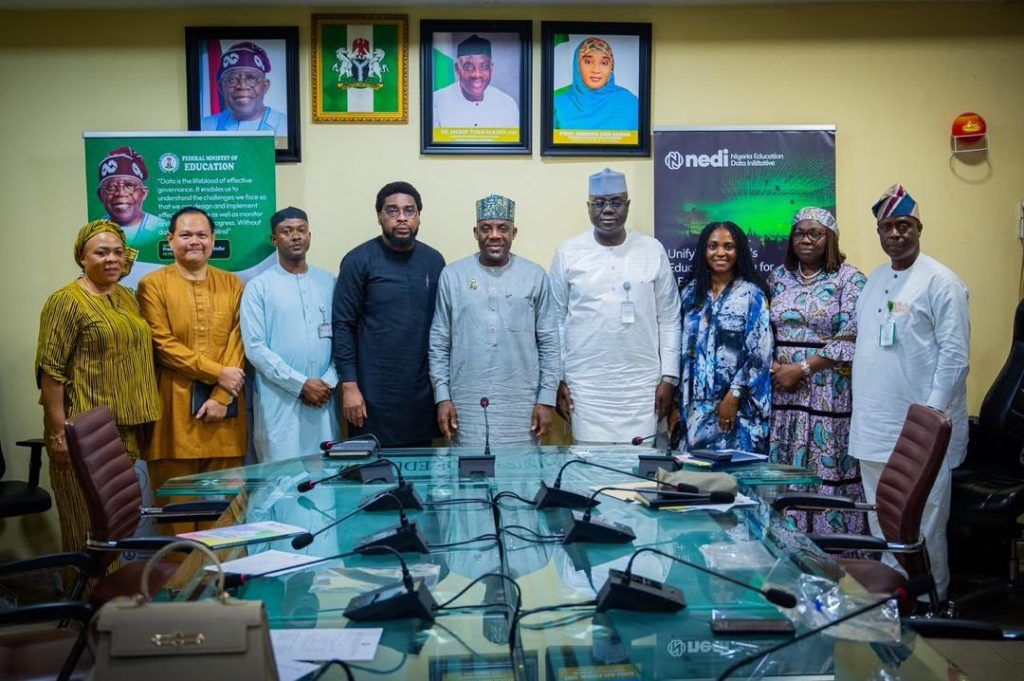
Alausa made the declaration at the weekend in Abuja while receiving the outcomes of the 2025 Nigeria 2050: Child Foresight Analysis for Futures Literacy and Intergenerational Equity, a flagship initiative of the Anticipatory Governance and Foresight Capacity Programme of the Office of the Vice President, implemented with technical support from UNICEF.
The Child Foresight team members were led to the education minister’s office by its Director General Chris Ngwodo and Special Assistant on special Duties to the Vice President , Mohammed Ahmed
The Minister said the findings of the Child Foresight Analysis were particularly significant for Nigeria because of the country’s youthful population, with about 70 per cent of its estimated 220 million people below the age of 30.
He said the size and composition of Nigeria’s population presented both a major opportunity and an urgent responsibility for government, stressing that the country must deliberately convert its youthful population into a demographic dividend through quality education, relevant skills, productive opportunities and long-term planning.
Alausa said the changes being witnessed under President Tinubu were not merely political rhetoric but were reflected in tangible reforms and outcomes across sectors, particularly in education.
“I can assure you of that one fact because today we have a President who is leading the country, managing this country from the front, with the highest level of integrity, commitment, patriotism and determination to change the face of this country,” he said.
“And these are not just rhetorics we are hearing now. These are things we are seeing, with a lot of tangible benefits and tangible change in the country.”
According to the Minister, three years into the Tinubu administration, Nigeria has moved beyond the uncertainty that previously characterised national development, with the government now focused on consolidating gains and addressing the areas where the country still has substantial ground to cover.
“The country is not at a crossroads again. We have a lot of catching up to do,” Alausa said.
He said the President’s commitment to education was particularly evident in the support provided to the Federal Ministry of Education to implement reforms under the Renewed Hope Agenda, noting that education would remain central to the administration’s ambition of moving Nigeria towards a $1 trillion economy.
Alausa said the Nigerian Education Sector Renewal Initiative (NESRI) was driving reforms across the entire education system, with priority attention to Technical and Vocational Education and Training (TVET), STEM education, teacher quality and quality assurance, reducing the number of children out of school, and strengthening education data and digitalisation.
He said the renewed emphasis on TVET was already changing the perception of technical education and creating new pathways for young Nigerians to acquire practical skills, pursue entrepreneurship, enter employment and continue to higher levels of education.
“Skills are the present and the future,” the Minister said, stressing that Nigeria could no longer afford an education system that did not adequately prepare young people for the realities of the modern economy.
He explained that technical education had once been an integral part of Nigeria’s education system, providing pathways for young people to become skilled workers, artisans, entrepreneurs and professionals, but had suffered decades of neglect and declining public confidence.
According to him, the Federal Government is now deliberately restoring technical and vocational education to the centre of the national education system because of its importance to employment, productivity and economic growth.
Alausa also linked the administration’s investment in medical education and professional training to efforts to address the skills shortages that have contributed to the migration pressures commonly referred to as “Japa”.
He recalled that Nigeria faced severe shortages of nurses and other health professionals despite having large numbers of young people seeking opportunities to study in those fields.
He said the government had responded by expanding access to nursing education and increasing training capacity within existing teaching hospitals, federal medical centres and specialist hospitals rather than relying solely on the construction of new institutions.
The Minister said the objective was to give more Nigerians the opportunity to acquire high-quality professional training at home while building a skilled workforce capable of competing internationally.
He said the same principle underpinned the broader education reforms, adding that young Nigerians must have access to the knowledge, skills and opportunities required to build productive lives in Nigeria and contribute to national development.
Alausa also highlighted the administration’s shift towards data-driven education planning, particularly in determining the actual number of out-of-school children in the country.
He questioned the long-standing estimates placing Nigeria’s out-of-school population at between 15 million and 17 million, saying the figures had been repeatedly cited without a sufficiently comprehensive household-level count.
According to him, emerging evidence from state-level household surveys suggests that the historical estimates may significantly overstate the actual number.
He cited Kaduna State, where a household survey covering more than 90 per cent of households reportedly produced a figure of less than 190,000 out-of-school children against an earlier estimate of about 585,000.
He also referred to another Kaduna estimate of about 1.2 million, which he said fell to less than 100,000 following a general household survey.
Jigawa State, he added, had also recorded significant differences between existing estimates and the results of its own household-level assessment.
Alausa said reliable data would enable government to determine where children are out of school, understand the reasons for exclusion, target infrastructure and interventions more accurately, and monitor whether children who return to school remain there.
He, however, stressed that any reduction in the estimated national figure would not lessen the urgency of the problem.
“Even if there’s significant reduction, any child out of school is still too many,” he said.
The Minister disclosed that more than one million children had been moved from the streets into school nationally over the past two and a half years, while Jigawa State alone had reportedly moved more than 180,000 children into school over the last two years.
He said the next challenge was to sustain enrolment, keep children in school and prevent new cases of school exclusion.
Alausa said the government was increasingly relying on digital education data to achieve this, noting significant progress in the 2026 Annual School Census through the digitised Nigerian Education Management Information System (NEMIS).
According to him, more than 56 per cent of public schools had entered their 2026 Annual School Census information, while 41 per cent of private schools had populated their records on the digital platform.
He described the growing participation of both public and private schools as a major step forward in strengthening education planning and accountability.
“Without data, you’re flying blind. Data will tell you everything,” the Minister said.
He explained that the data being generated would help the Ministry identify gaps in access and participation, monitor enrolment, plan infrastructure and assess the impact of education interventions more accurately.
The Minister said this was why education planning under NESRI was increasingly being anchored on reliable data rather than assumptions and historical estimates.
He also disclosed that the Ministry had conducted a national assessment to establish a baseline for literacy, numeracy and cognitive development among learners at the primary, junior secondary and senior secondary levels.
According to him, the assessment would provide a clearer picture of learning outcomes and enable government to measure the effectiveness of interventions over time.
Alausa said the data and reforms being generated across the education sector were directly relevant to the Child Foresight Analysis because the future of Nigerian children could not be secured through projections alone.
He said the foresight initiative provided an opportunity to embed long-term thinking, systems thinking, adaptive innovation and youth participation into national planning, while ensuring that decisions taken today protect the interests of future generations.
The Minister commended the Office of the Vice President, the Office for Strategic Preparedness and Resilience (OSPRE) and UNICEF for supporting the Child Foresight Analysis, describing the initiative as an important tool for moving Nigeria from reactive governance towards anticipatory action.
He said the Ministry would work to align the findings with NESRI, particularly in the areas of future literacy, long-term education planning, skills development, data systems and intergenerational equity.
Alausa said Nigeria now had an opportunity to shape the future it wants rather than simply wait for future challenges to emerge.
He urged stakeholders working on the foresight initiative to move beyond theoretical scenarios and connect their findings to the tangible reforms already underway in education and other sectors.
The Minister maintained that the most important measure of the country’s progress would ultimately be whether Nigerian children and young people receive better education, acquire relevant skills, find productive opportunities and are able to contribute meaningfully to national development.
He said the government’s responsibility was therefore to translate the country’s demographic strength into a national advantage through purposeful leadership, evidence-based planning and sustained investment in human capital.
“Nigeria has changed, and it has changed for good,” Alausa said.
The 2025 Nigeria 2050: Child Foresight Analysis for Futures Literacy and Intergenerational Equity is part of the Anticipatory Governance and Foresight Capacity Programme of the Office of the Vice President, supported technically by UNICEF. The initiative examines the risks, opportunities and drivers likely to shape the lives of Nigerian children aged 0 to 17 and young people aged 15 to 35 towards 2050, with the aim of strengthening futures literacy, anticipatory governance and intergenerational equity in national planning.