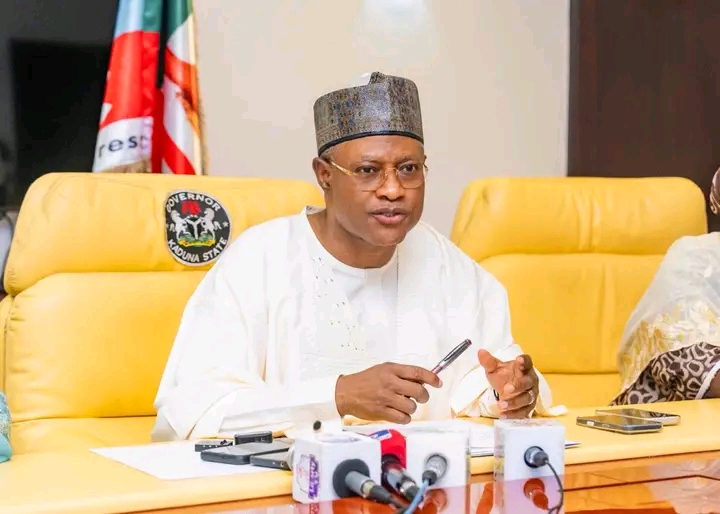
Kaduna State Governor Uba Sani.
Borno State Governor Uba Sani has advised states seeking to replicate the Kaduna Peace Model to first identify the root causes of their security challenges and allow communities to take ownership of peace-building initiatives.
The governor gave the advice while receiving the Implementation Monitoring Committee of the National Economic Council (NEC) at Sir Kashim Ibrahim House, Kaduna.
He said every state has unique security realities, stressing that understanding the drivers of conflict and ensuring community participation were critical to achieving lasting peace.
According to him, his administration inherited deep mistrust between the government and the people when it assumed office in May 2023, making the restoration of public confidence its first priority.
He added that the government also focused on justice, equity and fairness, arguing that politicians and conflict entrepreneurs had previously exploited ethnic and religious differences for personal interests.
“The first thing we addressed was the trust deficit between government and the people. We also ensured justice, equity and fairness because some politicians were exploiting these issues for selfish purposes,” he said.
Uba Sani noted that Kaduna previously battled both ethno-religious violence and banditry, adding that official data showed religious crises had claimed more lives than armed criminality.
He said his administration had addressed the challenge through inclusive governance and balanced development across the state’s 23 local government areas.
“I make bold to say that there has not been any ethno-religious crisis in Kaduna State since I became governor on May 29, 2023,” he said.
The governor described the Kaduna Peace Model as a home-grown and community-driven initiative that had significantly reduced incidents of kidnapping and banditry, adding that several states had approached him for guidance on replicating the model.
His advice, he said, was for leaders to “relegate politics and focus on governance,” insisting that government policies should not be influenced by political affiliation, religion or geographical considerations.
Highlighting the impact of improved security, Uba Sani said more than 500,000 hectares of abandoned farmlands had been reclaimed, over 100 schools previously shut because of insecurity had reopened, while more than 150 primary healthcare facilities that were once closed were now fully operational.
The governor said his administration’s priorities remained education, healthcare, agriculture and infrastructure.
On education, he said Kaduna had become Nigeria’s leading state in skills-based education, with about 4,300 graduates from its Institutes of Vocational and Skills Development receiving National Board for Technical Education certification.
He also said the state had reduced the number of out-of-school children by about 300,000 from the estimated 550,000 it inherited, citing UNICEF and National Bureau of Statistics records, while consistently allocating at least 26 per cent of the annual budget to education.
In the health sector, Uba Sani said Kaduna was the only state to upgrade all its 255 primary healthcare centres to Level Two status and had remodelled and equipped 16 of the 20 secondary healthcare facilities that were previously moribund.
He also highlighted the administration’s investments in agriculture, saying the sector’s budget had increased from about N1.4 billion in 2023 to N123 billion, representing about 13 per cent of the state budget.
The governor said Kaduna currently leads Nigeria in maize, tomato and ginger production and disclosed that the government distributed 900 truckloads of fertiliser free of charge to more than 240,000 smallholder farmers last year, with another round of distribution scheduled to begin within a week.
He added that Kaduna was also the first state in the country to establish a Special Agro-Processing Zone, describing it as a major step towards boosting agricultural value chains and economic growth.