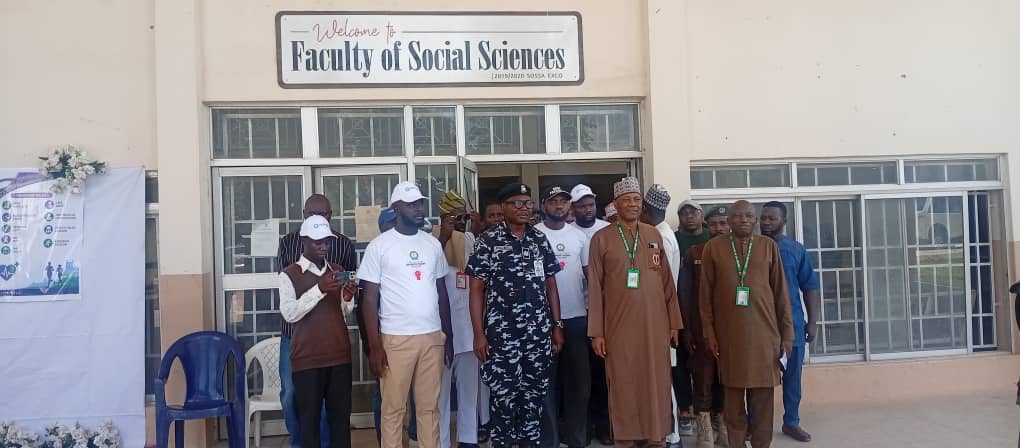
University of Jos (UNIJOS) has launched a campus-wide ” See Something, Say Something ” security campaign as part of renewed efforts to tackle cultism, mob justice, examination malpractice and other activities threatening peace and safety within the institution.
Vice-Chancellor of the university, Professor Tanko Ishaya, unveiled the initiative on Friday during a broad-based stakeholders’ meeting with students convened to address growing security concerns and recent incidents affecting the university community.
The meeting, attended by members of the university management, security agencies, religious leaders and student representatives, followed recent incidents, including the mob killing of a University of Jos graduate, reports of cult-related activities, and other security challenges within and around the institution.
Addressing the students, Ishaya said the university community must work collectively to protect lives, preserve the institution’s reputation and ensure a peaceful learning environment.
He said the university had witnessed actions by some students capable of damaging its image, stressing that every member of the institution had a responsibility to safeguard its integrity.
“We want to emphasize very strongly that this university is one community. We all have a shared responsibility, whether as students or staff, to ensure cooperation among ourselves. We can only protect our campus through active collaboration and partnership,” he said.
The Vice-Chancellor urged students to promptly report suspicious activities instead of remaining silent or recording incidents for social media.
“I want everybody to adopt this campaign: **If you see something, say something. Whenever you notice suspicious activities, report them immediately. A life may be saved,” he said.
Lamenting the increasing trend of bystanders filming violent incidents instead of seeking help, Ishaya said the culture must change.
“Very recently, people stood around recording while someone desperately needed help. Rather than assisting or calling for help, they focused on filming and posting videos. Are we losing our humanity?” he asked.
He disclosed that the university would make emergency contact numbers of its security personnel available to students to encourage prompt reporting of security threats.
The Vice-Chancellor also warned students against cultism, examination malpractice and other forms of misconduct, saying violators of university regulations would face disciplinary measures.
With the second semester examinations approaching, he urged students to prepare adequately instead of resorting to malpractice.
“Do not wait until examination day and attempt to smuggle materials or use your phone in the examination hall. You will be caught,” he warned.
Ishaya equally directed students who were yet to pay their school fees to do so immediately, insisting there would be no waivers.
He also expressed concern over excessive electricity consumption in student hostels, revealing that an internal committee found widespread use of prohibited electrical appliances, particularly hot plates.
According to him, management had decided to exercise restraint despite the scale of the violations but warned that future offenders would face disciplinary action.
He further advised students, particularly those living off campus, to avoid unnecessary movements at night and to always move in groups where possible.
Earlier, the Dean of Student Affairs, Professor Christopher Piwuna, said the meeting was convened following growing concerns over security, morality and student conduct within the university community.
Piwuna disclosed that the university had received credible intelligence indicating that some students were involved in cult-related activities in some hostels.
He also referenced several tragic incidents that had affected the university community in recent months, including the discovery of a corpse near the Village Hostel area, the killing of a student by a fellow student last year and the recent mob killing of a University of Jos graduate.
“The Vice-Chancellor was deeply worried about the incident that happened this week. We were all shocked and traumatised by the videos and pictures we saw,” he said.
The dean also criticised what he described as indecent conduct displayed during this year’s Faculty Week celebrations, saying the activities attracted widespread public criticism and raised concerns about the moral standards of students.
He urged those present at the meeting to serve as ambassadors of the institution by promoting discipline, responsible behaviour and respect for university regulations.
Also speaking, the Plateau State Police Public Relations Officer, SP Alfred Alabo, cautioned students against taking the law into their own hands.
He advised them to immediately report crimes to the police or relevant security agencies instead of participating in mob justice or attempting to investigate suspected offenders themselves.
Alabo also condemned the growing trend of recording violent incidents for social media rather than helping victims or notifying security agencies.
According to him, anyone who witnesses a crime has a civic responsibility to report it promptly.
The Students’ Union Government (SUG) President, Talyoung Younglan, pledged the union’s support for management’s efforts to strengthen security and discipline on campus.
While condemning cultism, examination malpractice and other forms of misconduct, Younglan called for institutional reforms, including faster disciplinary processes, wider circulation of the university’s student handbook, improved campus lighting, increased deployment of security personnel and the construction of additional hostels.
He also advocated alternative energy solutions for hostels to reduce electricity costs and proposed a regulated sign-out celebration for final-year students.
Younglan assured the university management that the student leadership would continue to work with the Directorate of Student Affairs and security agencies to preserve the image and reputation of the institution.
The meeting formed part of the university’s renewed efforts to strengthen campus security, promote responsible conduct and foster closer collaboration among students, management and security agencies.