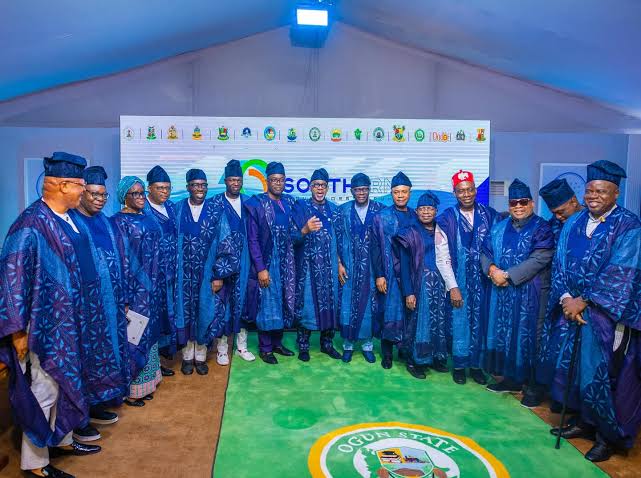
Southern Governors’ Forum on Wednesday praised President Bola Tinubu for what they described as his decisive and hands-on response to recent security threats across the country, especially the spate of abductions targeting schoolchildren.
Chairman of the Forum and Ogun State Governor, Dapo Abiodun, set the tone at the regional meeting held in Iperu, commending the president for stepping in personally during the latest wave of kidnappings rather than delegating the task.
According to him, the prompt rescue of abducted students “is evidence of a security strategy that has become more coordinated, intelligence-driven, and responsive.”
He added that the president’s approach demonstrated “a rare commitment to the protection of every Nigerian life.”
Abiodun noted that Tinubu’s intervention sends a clear message that safeguarding children remains a top national priority and that Nigeria will not be held hostage by criminals, insurgents, or opportunistic groups seeking to destabilise the country.
“The president’s swift action reminds us that leadership is measured not only in policy decisions but also in empathy, urgency, and decisive intervention,” he said.
He also highlighted Tinubu’s aggressive push on infrastructure, describing the Lagos–Calabar Coastal Highway and the Sokoto–Badagry Superhighway as transformative projects poised to “reshape Nigeria’s economic landscape, unlock new corridors of trade, and strengthen national integration.”
According to him, the meeting was more than a gathering of states from the same region; it was a reaffirmation of shared goals, common challenges and a united resolve to build a zone defined by peace and prosperity. He likened their cooperation to the spirit that bound the peoples of the old Southern Protectorate long before the 1914 amalgamation.
“Southern Nigeria now stands at a pivotal moment marked by rising security threats, economic pressures, and the urgent need for coordinated leadership,” Abiodun said.
He warned that the recent abductions across the country show that no region is immune from organised crime or violent extremism.
The governor stressed that the creation of state police “remains a non-negotiable component of our collective demand for true federalism and effective grassroots security.”
He also proposed a Regional Rapid Response Fund to support emergency deployments, rescue missions, forensic work and joint training across southern states.
At the state level, he said, governments must double down on measures such as mandatory documentation of foreign nationals, dismantling illegal settlements, regulating scavenger activities, intensified forest operations and suppressing illegal mining.
Abiodun underscored the central role of community policing, explaining that bringing security closer to the grassroots enhances intelligence gathering and ensures quicker responses along vulnerable corridors.
“By empowering local communities, traditional rulers, and neighbourhood structures to work collaboratively with formal security agencies,” he said, “we can protect schools, farms, border towns and other critical assets more effectively.”
He called on the region to strengthen joint task forces, improve intelligence sharing and adopt coordinated strategies to tackle shared threats. “I am confident that we can confront the challenges before us and chart a new path of peace, prosperity, and sustainable development for the entire southern region of Nigeria,” the governor stated.
Governors of Ekiti, Enugu, Ondo, Rivers, Abia, Akwa Ibom, Ebonyi, Anambra, Lagos, Bayelsa and Imo attended the meeting, while Cross River, Edo, Oyo and Osun states were represented.