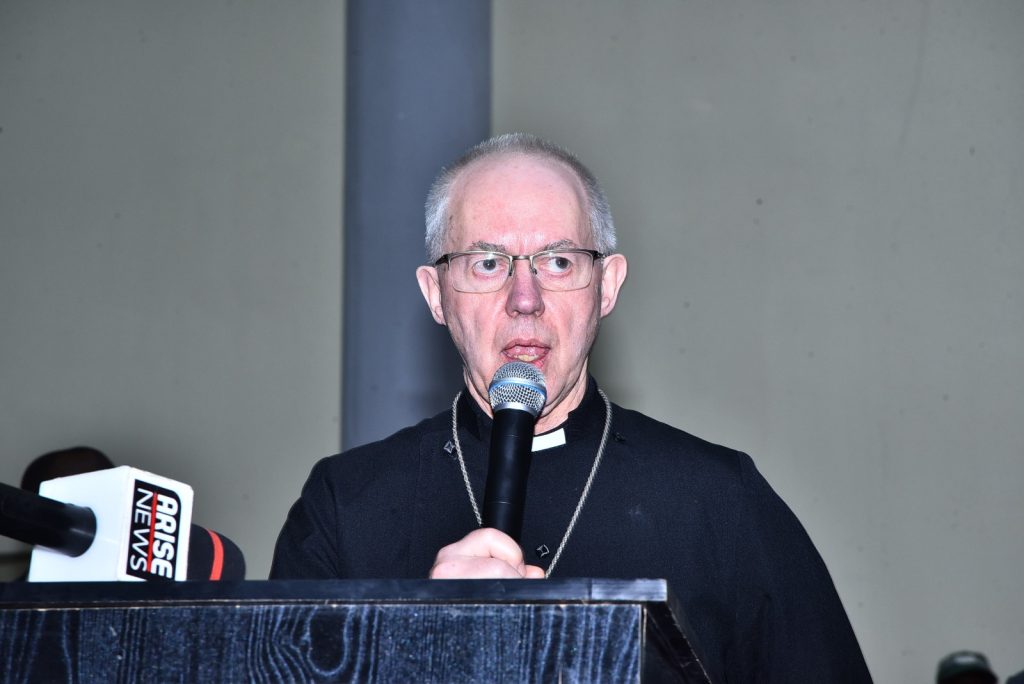
Former Archbishop of Canterbury, Rt. Rev. and Rt. Hon. Justin Welby
Former Archbishop of Canterbury, Rt. Rev. and Rt. Hon. Justin Welby, GCVO, has said that Nigeria’s future must be determined by Nigerians themselves, warning against surrendering the country’s sovereignty under any guise.
Welby stated this while delivering a public lecture at Ahmadu Bello University (ABU), Zaria, as part of activities marking the institution’s 45th Convocation Ceremony.
He said safeguarding Nigeria’s sovereignty was not the responsibility of government alone, but a collective duty that must be embraced by leaders across political, economic, religious, social, legal and traditional institutions.
“That means those in political, economic, spiritual, social, legal, traditional and other leadership must be willing, among many other demands, to take responsibility for guarding the sovereignty of Nigeria,” he said.
The lecture, titled “Building Inter-Ethnic and Religious Harmony in Nigeria: Pathways to National Unity,” took place at the Abdullahi Mahadi Conference Centre, ABU Main Campus, Samaru, Zaria.
Welby noted that inter-ethnic and religious harmony required Nigeria to honestly confront its weaknesses, seek support where necessary, and clearly define the limits of such engagement in order to protect its sovereignty.
He cautioned that efforts to build harmony would amount to “vain dreams” unless they were grounded in Nigeria’s history and realities, including its political, economic and international environments.
According to him, the lecture focused on four key areas: the foundations for inter-faith and ethnic harmony and national unity; the global environment; the values required; and practical steps to be taken, considering the interaction of social, economic and political conditions within and outside Nigeria.
Welby stressed the importance of honesty and transparency in addressing inter-ethnic and religious tensions, noting that corruption could not be completely eradicated in any society but must be fiercely confronted.
“Honesty values truth about a problem. It means saying what we mean, clearly and plainly. It also means being honest about the faults of our own faith communities and nation, recognising weaknesses and standing with the oppressed,” he said.
He warned that acting in deceit and hiding the true state of the nation only sows “the seeds of terror,” adding that transparency demands public accountability, except in matters of security.
The former Archbishop also underscored the need for decisive action, describing it as essential to resolving religious and ethnic crises. He said such action required firm leadership at all levels — “top down, middle out and bottom up.”
Welby further emphasised the pursuit of the common good, which he described as treating all citizens equally, without fear or favour.
He called for genuine theological dialogue among religious leaders, rather than symbolic meetings that avoid addressing core issues of faith, stressing that the role of religious leaders was not self-promotion but the glorification of God and the promotion of peace and lawful society.
“There can be no political peace without religious peace, and no justice in society without religious teaching and justice,” he said.
He added that religious leaders had a critical role in demonstrating national unity, noting that unity did not mean unanimity, but the ability to disagree respectfully while caring for the vulnerable.
“Unity is learning to disagree agreeably, and to care for the hungry, the uneducated child, and the ignored woman — not because they are Muslim or Christian, but because they are human,” he said.