Nigeria Democratic Congress (NDC) presidential candidate, Peter Obi, has called on Africans in the diaspora to become stronger advocates for good governance, insisting that competent leadership remains the missing ingredient preventing the continent from translating its vast resources into sustainable development.
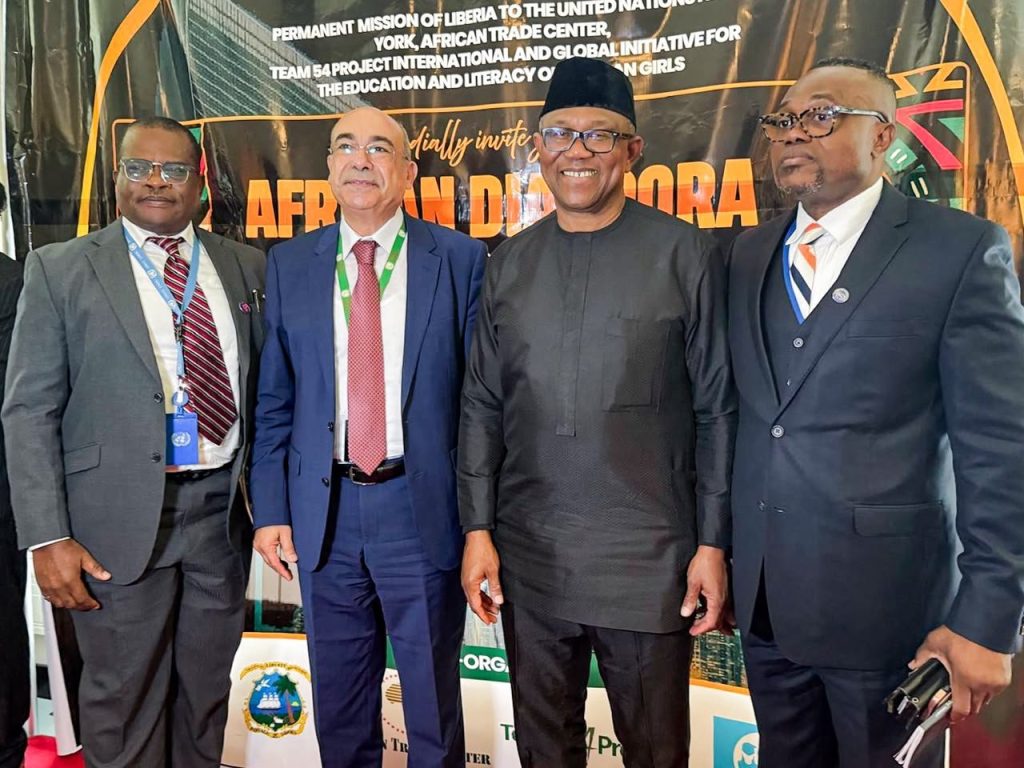
Obi made the call while delivering the keynote address on “The Role of the Diaspora African in Sustainable Development across Africa” at Mandela Hall, African Union Permanent Observer Mission to the United Nations in New York on Friday.
Sharing details of the event, Obi said Africa possesses enormous natural and human resources capable of transforming the continent into a global economic powerhouse, but lamented that millions of Africans still live in extreme poverty.
According to him, Africa is richly endowed with mineral resources, has the world’s largest youthful workforce and vast arable land, yet remains home to the largest concentration of people living in poverty.
He noted that the continent covers more than 30 million square kilometres and is home to over 1.5 billion people, with more than one billion of them being young people in their productive years.
Obi also pointed out that Africa has nearly one billion hectares of arable land, about 60 per cent of which remains uncultivated.
“When this demographic advantage is combined with nearly one billion hectares of arable land, about 60% of which remains uncultivated, it becomes clear that Africa possesses everything required not only to feed itself but also to become the food capital of the world,” he said.
Despite these advantages, Obi expressed concern that Africa continues to account for the largest share of the world’s poorest population.
“Regrettably, despite this enormous potential, Africa remains home to the largest concentration of the world’s poorest people. Of the approximately 800 million people living in extreme poverty globally, nearly 60% are in Africa. That is about 480 million people, with Nigeria and the Democratic Republic of the Congo among the countries most affected.”
He added, “In other words, nearly one in every three Africans lives in extreme poverty. Likewise, in multidimensional poverty, Africa continues to bear the greatest burden.”
Obi argued that Africa’s challenge is not the absence of resources but a failure of leadership.
“The question, therefore, is simple. With all these advantages, why has Africa not been able to lift its people out of poverty?
“It means there is a missing link. That missing link is Competent Leadership with Capacity, Compassion, Character, and Commitment to good governance.”
He stressed that the continent requires leaders who possess the competence and integrity to unlock Africa’s enormous potential.
“What Africa needs is leadership that will rise to the challenge and drive the continent in the right direction. This means competent leadership with character, capacity, compassion and commitment to begin turning the continent around. When we get leadership right, everything else begins to change. We start realising our true potential.”
Addressing Africans living abroad, Obi urged them to play a more active role in promoting accountability and democratic values across the continent.
“Because you live in societies where institutions largely work, where democracy is strengthened by accountability and where systems function more effectively, you have both an opportunity and a responsibility to help build Africa.”
He encouraged members of the diaspora to use their influence to demand better governance.
“It is time to become stronger advocates for good governance. Even where you cannot vote, your voices matter. They should be heard both at home and abroad whenever things are going wrong on our continent. Stand firmly for what is right. Speak truth to the leaders who visit you. Let them know where they are getting it wrong. That is what some of us have continued to do.”
Obi further noted that diaspora communities have historically played major roles in the economic transformation of several countries.
He cited Japan’s post-Meiji Restoration reforms and China’s economic transformation under Deng Xiaoping as examples of how citizens abroad contributed to national development through education, innovation and the transfer of knowledge.
According to him, China had more people living in poverty than Africa in 1980 but has since drastically reduced extreme poverty through reforms and effective leadership, while Africa continues to grapple with the challenge.
He maintained that Africa’s vast human and natural resources can only deliver meaningful development when matched with visionary leadership and active contributions from Africans at home and in the diaspora.