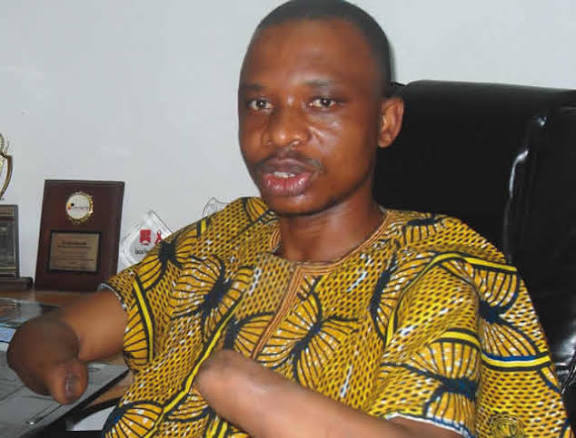
Executive Director of the Centre for Citizens with Disabilities (CCD), David Anyaele
Executive Director of the Centre for Citizens with Disabilities (CCD), David Anyaele, has shared how President Bola Ahmed Tinubu came to his aid after Sierra Leonean rebels brutally amputated his hands in 1999.
Anyaele, a well-known disability rights advocate, made the revelation on Friday evening during Nkata Umuibe, a monthly speaker series hosted by the Centre for Memories (CFM) in Enugu. Themed “Onye Aghana Nwanne Ya” (Let No One Be Left Behind), the event focused on inclusion, identity, and community responsibility.
Narrating his harrowing experience, Anyaele said he was in Sierra Leone on a business trip when he was attacked by fighters from the Revolutionary United Front (RUF), a rebel group notorious for mutilating civilians during the country’s brutal civil war between 1991 and 2002.
“I was targeted just for being Nigerian. Despite begging for mercy, they cut off both of my hands,” Anyaele recalled. “I was left in pain and nearly dead, but Nigerian-led ECOMOG forces rescued me and got me to a hospital. That moment changed my world. I suddenly found myself in the disability community with no idea what the future held.”
Following the attack, Anyaele said he reached out to several state and federal authorities, including governors in the South-East, but received no support. His pleas, despite widespread media coverage of his ordeal, were ignored.
However, he found an unexpected ally in then-Governor of Lagos State, Bola Ahmed Tinubu.
“I wrote to Governor Tinubu and, to my surprise, he responded. He instructed doctors to evaluate my condition. They recommended I be flown abroad, and that’s how I ended up in Germany for treatment, where I received artificial hands,” Anyaele said.
“I must thank the Tinubu administration and the good people of Lagos State for their hospitality and compassion,” he added.
Despite the support he eventually received, Anyaele highlighted the stigma and social exclusion he continued to face, particularly within Igbo communities.
“Living with a disability in Igboland often means facing rejection, discrimination, and being treated as invisible,” he said. “But disability can happen to anyone, at any time. We must change the way we treat persons with disabilities.”
He praised Abia State Governor Alex Otti for establishing the Abia State Disability Commission, calling it a progressive step toward inclusion. He urged Enugu State Governor Peter Mbah to follow suit and create a similar body to protect the rights of persons with disabilities.
NAN