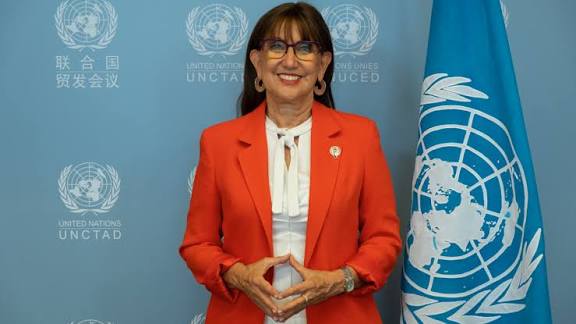
UN Trade and Development (UNCTAD) Secretary-General, Rebeca Grynspan. © UNCTAD
Developing countries are being crushed under a $31 trillion debt load that is severely hindering their economic progress, UN Trade and Development (UNCTAD) Secretary-General, Rebeca Grynspan, has warned.
Speaking on Monday in Geneva during an address to representatives of UNCTAD’s 195 member states, Grynspan painted a sobering picture of how deepening debt, rising tariffs, and global uncertainty are strangling development prospects in the Global South.
> “A debt and development crisis is still facing countries with impossible choices,” she said. “They have to decide: to default on their debt or on their development.”
Grynspan’s remarks come amid mounting economic pressures worldwide, with new tariff barriers rising and global investment flows pulling back for the second consecutive year — trends she says are undermining long-term growth and reinforcing global inequality.
While 72% of the world’s trade still operates under World Trade Organization (WTO) rules, she cautioned that the stability provided by the rules-based trading system is now under threat.
> “We have for now avoided the domino effect of tariff escalation that once brought the world economy to its knees in the 1930s,” she said. “This didn’t happen by accident. It happened because of you — because you kept negotiating when it seemed pointless… and building bridges even when they fell.”
Grynspan pointed to dramatic tariff hikes — including those imposed by major economies such as the United States — that have seen average rates spike from 2.8% to over 20% this year. These shifts, she said, are making global trade less predictable and far more costly for vulnerable economies.
> “Uncertainty is the highest tariff possible,” she noted. “It discourages investment, slows growth, and makes trade as a path to development much harder.”
The UNCTAD head also flagged the disproportionate impact of freight costs on small island states and landlocked countries, where transport bills are “up to three times the global average.”
On the digital front, Grynspan emphasized the urgency for developing nations to keep pace with rapid technological change. While artificial intelligence holds the potential to add trillions of dollars to the global economy, most low-income countries are not positioned to benefit.
> “Less than one in three developing countries have national strategies to harness the benefits of AI,” she said, adding that 2.6 billion people remain offline—the majority of them women in developing regions.
She concluded by urging the global community to uphold multilateral cooperation and push for reforms that give developing countries a fairer chance to thrive.
> “The rules-based trading system must not only be defended — it must be reformed in ways that reflect today’s realities and tomorrow’s opportunities,” she said.