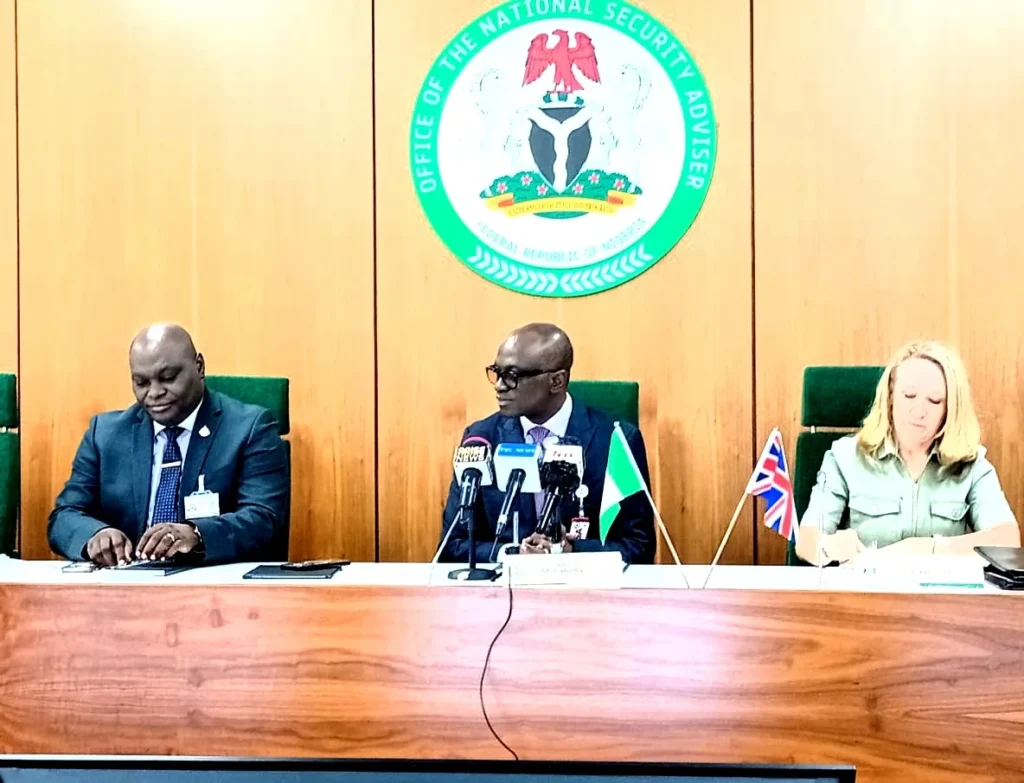
National Coordinator, National Counter Terrorism Centre, Office of the National Security Adviser (NCTC-ONSA), Maj.-Gen. Adamu Laka, speaking during a briefing on the Multi-Agency Anti-Kidnap Fusion Cell’s collaboration with the UK’s National Crime Agency in Abuja on Tuesday.
Federal Government has said it remains committed in its efforts to secure the release of the remaining Chibok girls and Leah Sharibu.
National Coordinator, National Counter Terrorism Centre, Office of the National Security Adviser (NCTC-ONSA), Maj.-Gen. Adamu Laka, shared this update during a briefing on the Multi-Agency Anti-Kidnap Fusion Cell’s collaboration with the UK’s National Crime Agency in Abuja on Tuesday.
Recalled that no fewer than 276 girls were abducted from Government Girls Secondary School in Chibok, Borno, in April 2014, with 87 still held captive after 11 years. Over time, 189 have been freed through military rescues or escapes from terrorist hideouts.
Similarly, Leah Sharibu and 109 others were kidnapped from Government Girls’ Science and Technical College in Dapchi, Yobe, on February 19, 2018.
Addressing questions, Laka emphasized that the government remains committed to their release.
“The rescue of the Chibok girls has been a gradual process involving negotiations and operations. I was in the theatre shortly after their abduction and witnessed the military and intelligence efforts that led to the initial rescues,” he said.
“We haven’t abandoned hope. Some of the girls were married to insurgents, and some have been freed. Our efforts also extend to other kidnap victims, including aid workers from UNICEF, UNHCR, and IOM.”
Laka stressed that while the government operates discreetly, it remains dedicated to rescuing the remaining captives, expressing hope that all 87 or more will be freed.
UK Deputy High Commissioner to Nigeria, Gill Levers, condemned the recent killing of 33 kidnap victims by bandits in Banga, Kaura Namoda Local Government Area of Zamfara.
She described kidnapping as a “heinous crime” that devastates communities, families, and economic progress, urging collective action to curb it. “My condolences go to the affected families and communities in Zamfara,” she added.
Levers highlighted the Multi-Agency Kidnap Fusion Cell, a three-year initiative fostering collaboration among Nigeria’s security forces to combat kidnapping nationwide. The cell supports the Nigerian Police and Department of State Services (DSS) by gathering, analyzing, and sharing data with the Office of the National Security Adviser, while also providing state-specific kidnapping trends.
“This initiative stems from the UK-Nigeria Security and Defence Partnership, part of our broader strategic partnership built on mutual trust and respect,” Levers explained.
“At our recent meeting in London, we agreed to expand the Fusion Cell’s capabilities to various states.” (NAN)