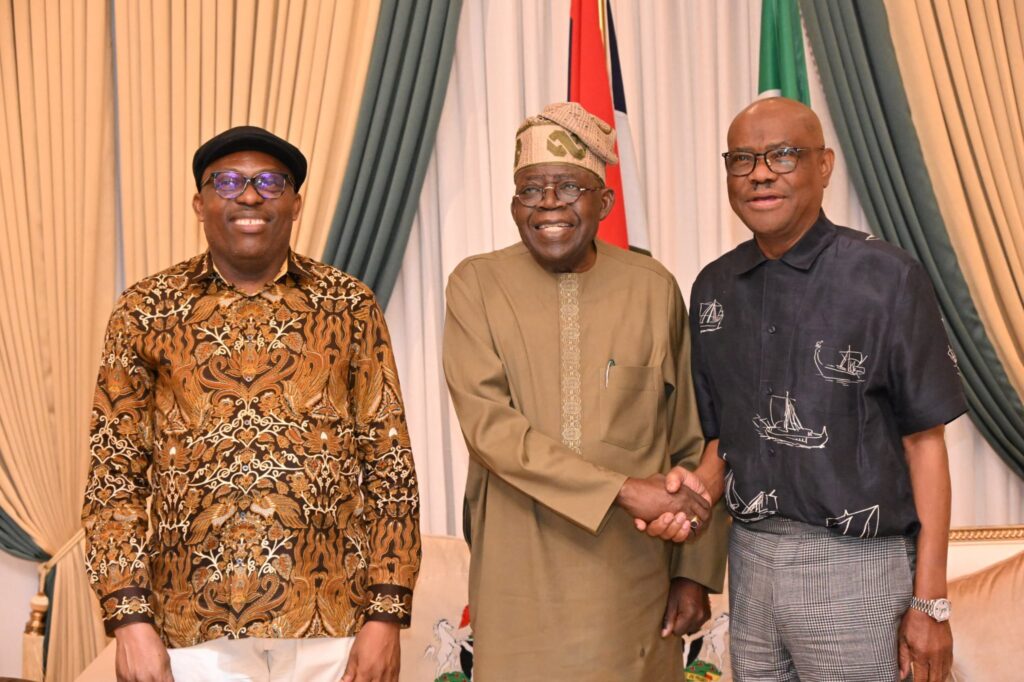
Suspended Rivers State Governor, Nyesom Wike, President Bola Tinubu and FCT Minister, Nyesom Wike, shortly after the peace talk at the Presidential Villa, Abuja
Diverse opinions have emerged among Rivers State political stakeholders regarding the six-month state of emergency, with some praising its stabilizing effects while others criticized its ineffectiveness.
According to the News Agency of Nigeria (NAN), President Bola Tinubu declared the emergency on March 18, 2025, in response to escalating political tensions in Rivers State. The conflict stemmed from a power struggle between Governor Siminalayi Fubara and his political mentor, Nyesom Wike, the Federal Capital Territory Minister, over control of the state’s political machinery.
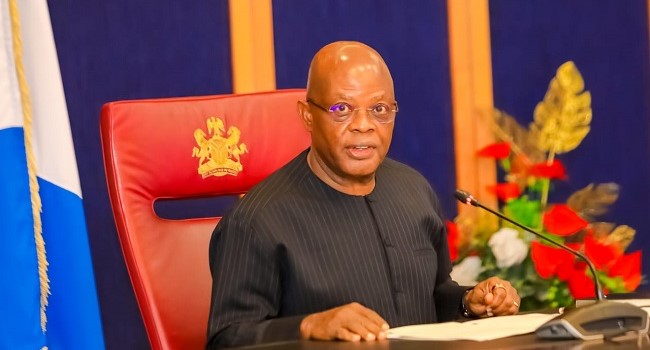
As part of the emergency measures, Tinubu suspended Fubara and the Rivers State House of Assembly, appointing retired Vice Admiral Ibok-Ete Ibas as the Sole Administrator to oversee the state.
Reflecting on the emergency period, Mr. Egele Bright, a Peoples Democratic Party leader in Andoni Local Government Area, commended Ibas for restoring calm. Bright noted that Ibas’s leadership reduced political tensions that had previously destabilized the state. “The smooth conduct of local government council elections and the swearing-in of chairmen and councillors across the 23 LGAs have also driven political stability to the grassroots,” he added.
Conversely, Mr. Henry Ekini, National Legal Adviser of the Committee for the Defence of Human Rights, labeled the emergency rule as unnecessary. He argued that Ibas, lacking a popular mandate, failed to advance public welfare or infrastructure, stating, “There were no public engagements or projects completed in the six months.”
Niger Delta activist Ms. Annkio Briggs echoed these concerns, pointing out that Ibas did not progress critical infrastructure projects like the Trans-Kalabari Road and coastal bridges. She criticized the emergency rule for sidelining elected leadership and stunting human capital growth, asserting it was not in the best interest of Rivers’ residents and shifted political control away from the state. Briggs also raised concerns about Fubara’s reinstatement, noting the National Assembly’s recess could complicate the process.
Comrade Savior Oscar, President of the South-South Youths Initiative, called for a probe into Ibas’s tenure, arguing that the local government elections he oversaw drew widespread criticism. Oscar claimed the emergency rule disrupted socio-economic activities in the state.
Similarly, lawyer Mr. Ambrose Igwe expressed frustration over Ibas’s failure to identify those responsible for crude oil pipeline explosions in Bodo and Bonny, which had contributed to the state’s unsafe image. “One of the major reasons for which the state was declared unsafe was a serial pipeline explosion in Bodo and Bonny,” he said, emphasizing that uncovering the culprits should have been Ibas’s priority.
Prof. Daniel Mbee, Director of the Centre for Disaster Risk Management and Development Studies, urged Rivers residents to prioritize the state’s progress. While acknowledging Ibas’s efforts, he noted that Rivers lagged behind states like Lagos, with Port Harcourt remaining the only developed city. “Development must be people-centred, not driven by personal or political ambitions,” Mbee said, advocating for unity to advance the state.
Meanwhile, Prof. Ibibia Worika, Secretary to the State Government, announced the start of the transition back to democratic governance, including an inter-denominational thanksgiving service as part of the process.
Commenting on the transition, lawyer Mr. Gogonte Obadiah noted that the emergency rule, set to end on September 18, 2025, had restored enough stability to facilitate Fubara’s reinstatement. “We believe strongly that there will be harmonious relationship between the executive, legislature and all other stakeholders,” he said, expressing optimism about Fubara’s ability to lead effectively.
Port Harcourt resident Mr. Neo Wilcox anticipated that competing interests would emerge post-reinstatement but urged stakeholders to find common ground for the state’s benefit. “We look forward to political and overall stability,” he said.
Businessman Mr. Felix Ogeh emphasized the need for collective action to maintain peace and prevent further crises. He called on politicians and media to avoid actions or reports that could jeopardize Rivers’ progress and urged support for Fubara’s return to avert unrest.
A security consultant, speaking anonymously, recommended increased security surveillance in vulnerable areas to counter potential disruptions by those opposed to the current peace. (NAN)