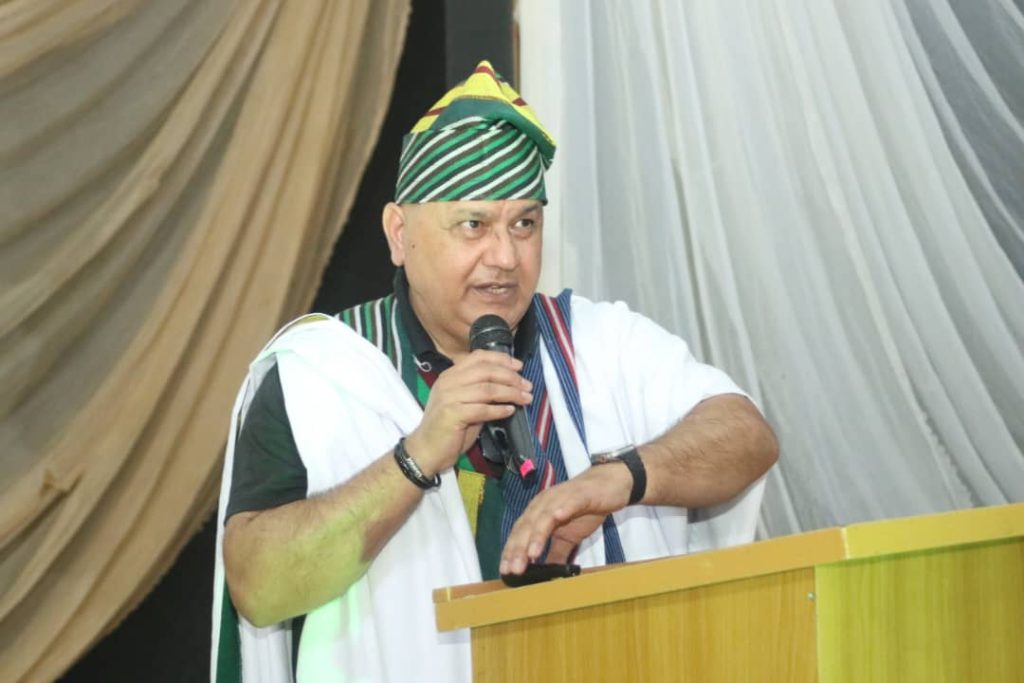
Global Director for the Water Global Practice at the World Bank Group, Mr. Saroj Kumar Jha, speaking during the the 1st Sustainable Urban and Rural Water Supply, Sanitation and Hygiene (SURWASH) Public Lecture at UNIJOS
Global Director for the Water Global Practice at the World Bank Group, Mr.Saroj Kumar Jha, has called on universities and young researchers to play a more active role in tackling the global water crisis through innovation, research and technology.
Jha made the call while delivering the 1st Sustainable Urban and Rural Water Supply, Sanitation and Hygiene (SURWASH) Public Lecture themed: ” _On Water Forward For A Water Secured World For All”,_ organised by the WASH Institute at the University of Jos.
Speaking to students and academics, he highlighted the growing global challenge of water insecurity and stressed the need for stronger collaboration between academic institutions, governments and development partners to develop sustainable solutions.
According to him, addressing complex development challenges such as water scarcity, food insecurity and climate-related disasters will require long-term commitment and the active participation of young people.
“You are the leaders of the future. You will shape the policies and programmes of your country and across international organisations. That is why institutions like the World Bank must engage with universities and young people,” Jha said.
He explained that the World Bank is strengthening collaboration with universities under a broader global initiative known as “Water Forward,”which aims to mobilise governments, development institutions, researchers and private sector actors to accelerate action on water security.
Jha said the initiative seeks to help 400 million people gain access to improved water services by 2030 by expanding water supply for households, improving irrigation systems for food production and strengthening infrastructure to manage floods and droughts.
Highlighting the scale of the challenge, he noted that the global water crisis continues to affect millions of people around the world.
According to him, about 1.3 billion people globally lack access to clean water, while nearly 700 million people in Africa do not have access to basic drinking water services.
Jha stressed that universities have a critical role to play in addressing these challenges through research, innovation and capacity building in fields such as water engineering, hydrology and water resource management.
He also encouraged students in technology-related disciplines to develop digital solutions that can improve water management, including data systems for monitoring water usage, digital tools for tracking infrastructure performance and innovations that support water recycling and conservation.
Jha, further, drew attention to the environmental impact of large technology facilities such as data centres, noting that while their energy consumption is widely discussed, their water usage also poses sustainability challenges.
“There is a need for research on how data centres can become more water-efficient and how water can be recycled and reused instead of relying on scarce freshwater resources,” he said.
In his remarks, the Vice-Chancellor of the University of Jos, Tanko Ishaya, said universities must take the lead in advancing research and policy dialogue on water security and sustainable development.
He noted that higher institutions have a responsibility to generate practical solutions to development challenges through interdisciplinary research and partnerships with governments and international organisations.
Earlier, the delegation from the World Bank Group led by Saroj Kumar Jha paid a courtesy visit to Caleb Mutfwang, where discussions focused on ongoing water sector reforms and efforts to strengthen water supply systems in Plateau State.
Jha commended the state government for progress made in improving water infrastructure and governance, while encouraging faster project implementation and the adoption of digital monitoring systems to enhance service delivery.