
Nobody sits at a desk and studies odds for half an hour anymore. Or rather, a small number of people still do, but they no longer represent the typical session. The person using a betting platform in 2026 opens an app between bus stops, places a live football selection while the match is still running, and closes the screen before the next passage of play. The whole thing takes four minutes. It happens two or three times per evening on match days.
The platform built for long desktop visits is serving an audience that behaves as if it is checking a messaging app.
Phones Won, and In-Play Won With Them
Mobile accounts for roughly three-quarters of all betting traffic globally. In African football markets, where services like https://afropari.ng/ sit alongside the bigger international brands, the mobile share runs closer to ninety percent because many users skipped the desktop era entirely. The phone was the first internet device in the household, and it stayed the only one.
That device shift rewired the product. A phone screen has room for one market at a time. Scrolling replaces browsing. Speed replaces depth. The interface that worked on a 15-inch monitor looks cluttered on a 6-inch screen, so operators stripped it back and reorganised everything around fewer taps per action.
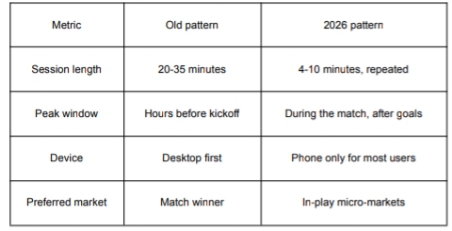
In-play volume grew as a direct result. A person watching a match on television with a phone in hand is already inside the event. The barrier between watching and placing a selection sits at roughly two thumb movements. Pre-match still exists, but the centre of gravity moved into the ninety minutes.
That compression changed what operators measure. Session length stopped being the number they chase. Frequency took its place – how many times a user opens the app per matchday matters more than how long any single visit lasts.
A user who checks in six times for forty seconds each is worth more than one who logs in once and browses for fifteen minutes without acting. The entire analytics layer shifted to match that pattern.
It also changed what goes wrong. A desktop user who misclicks has time to cancel. A phone user tapping fast during a live match does not. Complaints about accidental placements, wrong selections, and missed confirmation screens went up as sessions got shorter and the pace got faster. Some operators added confirmation steps.
Others decided the friction cost them more in drop-off than the complaints cost in support tickets. That trade-off says a lot about where priorities sit.
The Informed User Arrived Early
Football content consumption reshaped who shows up on these platforms and what they expect when they get there. Someone who spends twenty minutes reading tactical analysis, scrolling through expected-goals breakdowns, or working through a piece like a recent breakdown of how speed, stamina, and technical precision combine in modern football arrives with a formed opinion. That person is not scrolling the homepage. They already know which match, which market, and roughly which price they expect. The session is surgical.
The casual visitor still exists and still matters. Their pattern is different:
● They engage mostly during high-profile fixtures like derbies, cup finals, and international tournaments
● They stick to the simplest market, usually the match winner
● Their activity spikes hard during major events and goes quiet between them
● They rarely explore beyond the default homepage layout
A 2025 study published on PubMed Central found that users receiving personalised content on gambling platforms adjusted their stake sizes and betting frequency in measurable ways over time, which raises its own set of questions about where convenience ends and nudging begins.
Platforms have noticed the split and built for it. The informed user gets depth – detailed statistics panels, market filters, price histories, and early lines on matches that casual users would not think to look for. The casual user gets simplicity – a clean landing page with tonight’s biggest fixture front and centre and one or two obvious options underneath. Both paths lead to the same product, but the entry points are designed for different attention spans and different levels of confidence.
The tension sits in the middle ground. The user who starts casually but gradually picks up knowledge does not stay in the simple lane forever. They start noticing odd movements, comparing prices across platforms, and reading injury reports before placing anything.
That transition is where operators either earn long-term loyalty or lose the user to a competitor with better tools. It is also where the personalisation question gets uncomfortable– because the platform knows the user is shifting before the user fully realises it themselves.