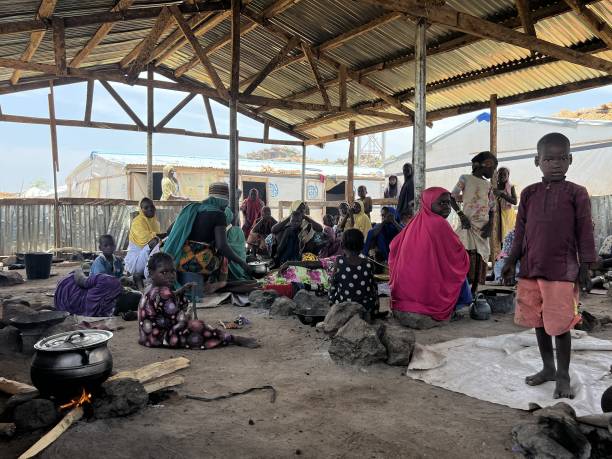
Internally Displaced Persons (IDPs) at their camp in Pulka, Borno State
In the heart of northeastern Nigeria, where the struggle against the Boko Haram insurgency has claimed countless lives, one story stands out—that of 16-year-old Jummai Hamman.
A young mother who, like many in her community, faces the daily challenges of survival, Jummai’s life changed irrevocably when she lost her husband in a tragic attack.
It was a seemingly ordinary day in Ngoshe when the peace was shattered. On that fateful day, the sounds of laughter and daily life were replaced by chaos and fear as Boko Haram militants descended on the village.
Jummai’s husband, a devoted family man and local farmer, rushed to protect his loved ones but was tragically caught in the crossfire. Jummai, then a newlywed, watched helplessly as her world crumbled.
The loss of her husband not only left a void in Jummai’s heart but also thrust upon her the burden of single motherhood at a very young age.
With a newborn baby to care for and no means of livelihood, she faced the grim reality of navigating life without the support of her partner. Yet Jummai embodies resilience. She is determined to provide for her child, drawing strength from memories of the love, hope and dreams they once shared.
Speaking to our correspondent in Pulka, where she currently lives as a displaced person alongside her in-laws and other relatives, Jummai recounted the challenges of rebuilding her life after the tragedy.
Her story is not only one of personal loss but also highlights the broader challenges faced by young mothers in conflict zones. The aftermath of the attack left many families displaced, while resources became increasingly scarce.
Education, healthcare and other basic necessities became difficult to access and, in many cases, unaffordable due to economic hardship resulting from the conflict. Despite these challenges, Jummai remains committed to ensuring that her child receives an education, believing it is the key to a brighter future. She hopes to enrol her child in a government-supported public school when the time comes.
In the wake of such tragedies, community solidarity has become crucial. Local and state governments, as well as non-governmental organisations and international aid agencies, have provided essential support to displaced families like Jummai’s.
From food assistance to counselling services, these programmes aim to empower young mothers and help them regain stability in lives forever altered by violence.
Despite her circumstances, Jummai has become a voice for other young mothers affected by the Boko Haram insurgency. She participates in community meetings, sharing her experiences and advocating greater support for women and young people affected by conflict.
Her story is a testament to the unbreakable spirit of those who, despite overwhelming odds, continue to fight for their families and communities.
Jummai Hamman’s journey is one of resilience, love and an indomitable will to survive. In a region often overshadowed by despair, her story shines a light on the strength of young mothers confronting unimaginable tragedy.
As she continues to navigate life after loss, Jummai not only honours her husband’s memory but also helps pave the way for a future filled with hope for her child and her community.
Her courage serves as a powerful reminder that even in the darkest moments, the human spirit can endure and triumph.