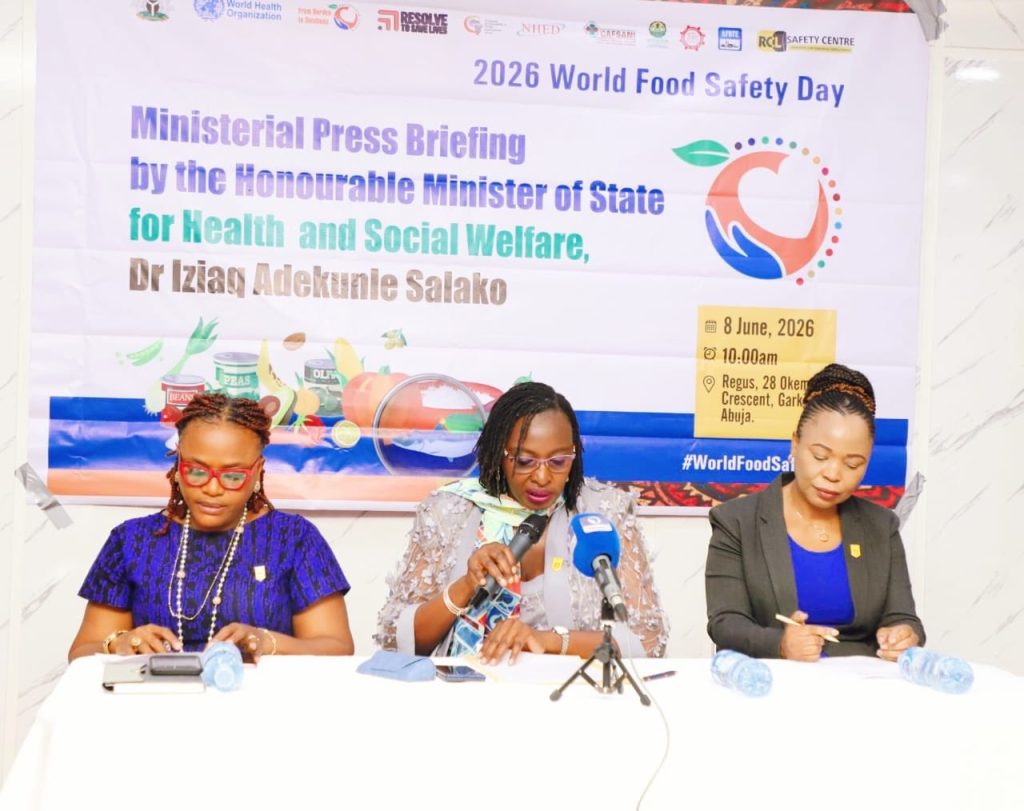
Federal Government has disclosed that unsafe food causes nearly 50 million illnesses and more than 53,000 deaths annually in Nigeria, underscoring the urgent need to strengthen food safety systems across the country.
The Honourable Minister of State for Health and Social Welfare, Dr. Iziaq Adekunle Salako, made this known at the commemoration of World Food Safety Day 2026 in Abuja, themed: “From Burden to Solutions – Safe Food Everywhere.”
Citing newly released estimates on the burden of food-borne diseases, Dr. Salako noted that children under five years account for more than 80 per cent of Nigeria’s food-borne disease burden, with over 40 million diarrhoea illnesses linked to food-borne pathogens such as Salmonella, E. coli, Campylobacter, Shigella and Rotavirus.
“Food safety is not merely a technical issue; it is a national development priority. The true cost of unsafe food is measured not only in sickness and death but in the lost cognitive, physical and developmental potential of our children,” he said.
Dr. Salako highlighted Nigeria’s progress in strengthening food safety governance, noting that the country’s 2025 State Party Annual Report (SPAR) score of Level 3 places it ahead of the WHO food safety target for low- and middle-income countries and Sub-Saharan Africa. He added that the National Food Safety Management Committee and the 2023 National Integrated Guidelines for Food-borne Disease Surveillance and Response have strengthened surveillance, outbreak response, laboratory confirmation, food recall and risk communication systems nationwide.
Dr. Salako also outlined ongoing measures to promote healthier diets and reduce the burden of non-communicable diseases, including implementation of the National Guidelines for Sodium Reduction, trans-fat elimination regulations, efforts to strengthen the sugar-sweetened beverage tax, and the development of Front-of-Pack Labelling to support healthier consumer choices.
The Honourable Minister of Environment, Balarabe Abbas Lawal, noted that food-borne diseases in Nigeria are strongly influenced by environmental conditions, including poor sanitation, unsafe water, pollution, climate change, inadequate waste management and unsafe agricultural practices.
In her welcome remarks, the Permanent Secretary, Federal Ministry of Health and Social Welfare, Daju Kachollom, mni, described this year’s theme as a timely call to action and stressed the need to integrate food safety and healthy diet policies as complementary pillars of a shared national agenda. She emphasised that safeguarding public health requires collaboration across sectors and commended stakeholders for their continued efforts towards building a stronger, safer and more resilient food system for all Nigerians.
Delivering a goodwill message on behalf of the World Health Organisation (WHO), Dr. Pindar Wakawa described safe food as a fundamental human right and a cornerstone of public health, nutrition and economic productivity. He noted that the latest global estimates show that most food-borne diseases are preventable and called for stronger action to protect children, address emerging risks such as chemical contamination and strengthen food systems. WHO also commended the Government of Nigeria for its continued efforts to strengthen food safety through policies, regulatory frameworks and multi-sectoral partnerships.
As Nigeria joins the global community to commemorate World Food Safety Day 2026, stakeholders renewed their commitment to ensuring that every Nigerian has access to food that is not only available and affordable, but safe and healthy.