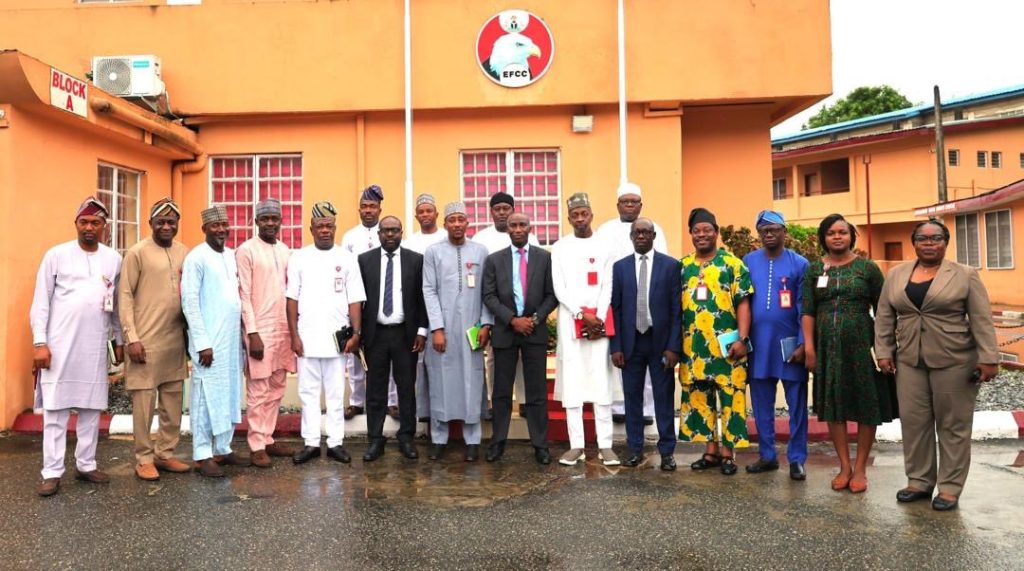
Economic and Financial Crimes Commission (EFCC), Lagos Zonal Directorate 1, on Friday, June 19, 2026, organised a specialised training programme on surveillance and intelligence gathering for its operatives as part of efforts to strengthen investigative capacity and enhance intelligence-led operations.
The training, conducted in collaboration with the Department of State Services, DSS, underscored the commitment of both agencies to deepening inter-agency cooperation, knowledge sharing, and professional development in the fight against economic and financial crimes.
In his welcome address, the acting Zonal Director of Lagos Zonal Directorate 1, ACE 1 Adeniyi Adebayo, highlighted the importance of continuous capacity building as a core component of professional practice.
Speaking through DCE Ayo Oyewole, Head, Public Affairs, he noted that regular training equips officers with the competence and adaptability needed to meet emerging operational challenges.
He said: “Learning should never be viewed as a one-time exercise, but as an ongoing process that equips officers with the knowledge, confidence and adaptability required to excel in a constantly changing operational environment.”
He also encouraged participants to maximize the opportunity presented by the training and apply the knowledge gained to enhance their effectiveness in their respective areas of operation.
In his paper, the Deputy Director of Internal Security, Base Command, Lagos, DSS, Rasheed Akanji, stressed the critical role of surveillance in modern law enforcement, describing it as a vital tool for crime detection, prevention, intelligence gathering, and successful prosecution of offenders.
He also stated that the evolving nature of criminal activities requires security and law enforcement personnel to continually upgrade their skills and adopt emerging intelligence-gathering techniques to stay ahead of criminal networks.
Speaking after the session, ACE II Ala Shehu, Head, Investigations, Lagos Zonal Directorate 1, described the initiative as a strategic investment in human capital development.
Ala emphasized that intelligence sharing, collaboration, and joint training programmes remain essential for building stronger institutions capable of tackling economic crimes and other security threats.
According to him “ When security and law enforcement agencies,
SLEAs, learn from one another, share experiences, and leverage their respective strengths, they create a more coordinated and resilient framework for combating crimes and protecting society.”
Participants commended the programme as insightful and practical, noting that it enhanced their understanding of surveillance techniques and reinforced the importance of intelligence-driven investigations.
The training forms part of ongoing efforts by the EFCC to strengthen institutional capacity, foster operational synergy, and improve the effectiveness of crime-fighting operations across the country.