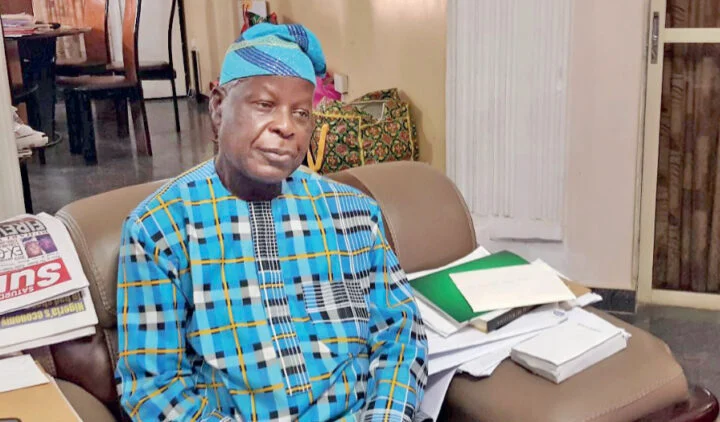
Mike Okiro, former IGP
Nigeria’s worsening security crisis has increasingly become more than a law enforcement challenge; it has evolved into a defining test of the country’s federal structure and its capacity to protect lives, property and public confidence. From relentless attacks by armed bandits and terrorists to the growing menace of kidnappers and organised criminal networks, the nation’s overstretched, centrally controlled policing system has come under intense scrutiny, fuelling renewed calls for a fundamental restructuring of internal security architecture.
Against this backdrop, the Nigerian Senate’s recent passage of the State Police Bill marks one of the most significant legislative interventions in the country’s security discourse in decades. The proposed legislation seeks to decentralise policing by empowering state governments, through their Houses of Assembly, to establish and oversee state police services while placing governors under greater constitutional responsibility for maintaining law and order within their jurisdictions. For many advocates, it represents a decisive attempt to bridge the widening gap between Nigeria’s complex security realities and the limitations of a one-size-fits-all policing model.
Among the earliest and most consistent proponents of this reform is retired Inspector-General of Police and former Chairman of the Police Service Commission (PSC), Sir Mike Okiro. Long before the current wave of legislative momentum, Okiro had repeatedly argued that Nigeria’s changing security landscape demanded a policing system that is more responsive, intelligence-driven and rooted in local communities. His advocacy has been shaped not only by years of experience at the highest levels of policing but also by a conviction that effective security can only be achieved when law enforcement institutions are sufficiently empowered to understand and respond swiftly to the unique challenges confronting the communities they serve.
Below are excerpts from an interview Sir Okiro granted a few days ago …
Let’s get your reactions to the passage of the State Police Bill by the Senate
I was not initially a proponent of State Police. Because of the benefit of hindsight. Before this time around Nigeria had regional police which led to skirmishes and misbehavior among police officers if you know the history of Operation Wetie in the West in those days. Because the police were used. So when Gowon came to power in the early 70s, we now had the unity police. When I heard clamour for State police I felt we can have geopolitical police. That’s we have six geopolitical zones in Nigeria-we can now have six police forces for policing within Nigeria. But now, the way things are going with the rate of insecurity in Nigeria demands creation of State Police so that the governor would be the chief security officers of their states to handle the security in their states. Because the police in that responsibility will be the first line of action with regards to security in the country. So if you have state police or whatever you call it with the governors in charge they will be able to take adequate precaution with regards to fighting insecurity in their states. Unlike the situation where the federal government is not funding the police properly. We need manpower in the police, adequate training. But the federal government has so much to think about and so the police just happen to be one of the percentages of the Nigerian budget. But if it is state police the governor will look after his state. Any governor that becomes lackadaisical and does not care about his state nobody will go there. People will not invest in the state. The governor will need to pay deeper attention to ensure that security is maintained by equipping the police and attending to them very well.
What is your idea of the structures? Going by your insight sir, if you are to offer a template of a functional structure what will this look like sir?
The organogram still remains the same in a way. In the federal police force we have the IGP, DIGs, AIGs, Commissioners of Police, down the line. In the states they can call it any name or title for somebody to be in charge of the police. It can be Commissioner in the state or even bigger names. If there is no more federal police you can even call it the IG. Nomenclature is not exactly what I’m talking about but there must be an organogram no matter what the nomenclature is, somebody must be in charge, on top of people on the field working. The governors know their local governments so they will sit down and plan how to handle their state security. If they need Area Commanders they know. All the states don’t have equal strength or equal geographical division. They have different demarcations in the states. So each state has its own problems, its own peculiarities. For example, a place like Rivers or Bayelsa may create a Marine section of police. A state like Enugu cannot create a Marine.
(CUT IN) But do we have marine police in place?
How will you respond to the fear being entertained by concerned persons that state police can become a tool in the hand of governors against their opponents or opposition groups?
Yes, that is an area I pointed out in an interview I had recently. I said in as much as the governor is the chief executive of his state, the law creating the state police should provide that the governor must not have everything in the police. If that is not guaranteed the governor will be so powerful that even the opposition cannot exist any longer in the state. The governor should allow the law to take its place, protection of the opposition should be provided in the law. He is the sitting governor today, so if he makes a law that the governor controls everything. He will not be the governor in the next 5 or 10 years. If the law is such that the governor controls everything, when he leaves office as governor, the new governor controls everything. So, it should be such that the state assembly in creating state police creates a proviso where the governor does not control everything. There should be a lee way for the commissioner of police to have his own way to do the proper things. And the removal of the commissioner of police should be enshrined in the constitution. So the governor cannot wake up one morning because he asked the commissioner to lock up the house of an opposition and he refused the next morning you hear the commissioner has been removed. These are areas the national assembly should look into.
Can you help clarify the argument whether this is mere reforms/decentralisation? Is the issue addressing State police or police reforms?
It is about the creation of state police. If you are talking about a reform it means you are still referring to federal police.
You have used your experience to ensure lasting peace exists between rival leaderships in your community and other associations facing serious parallel leadership crises. How did you achieve this sir?
I have been mediating matters affecting communities in my private life. You see, when God has gifted you that position of IG I have seen what many people have not seen. That was why I used my position as IG to mediate in the problem of Niger Delta. It was my intervention that brought about the amnesty programme, to care for the Niger Delta militants. You see you cannot sit in one place when things are going wrong and keep quiet. As our people say: an elderly person cannot sit at home and watch a tethered goat deliver. So when I observed some of these problems I invited them to listen to their matter. And because of my position you are bound to listen to me. Some believe that if they disobeyed there can be some repercussions. So I use that position as an elderstateman, hence, my commitment to society, my love for society, my patriotic disposition to the country and community to make sure there is peace, and prevailed.
- The former IGP spoke exclusively to JOHN NWOKOCHA, Editor of The First Mail, in Abuja.