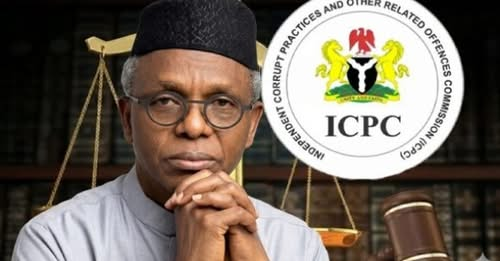
Photo combo showing former Kaduna State Governor, Nasiru El-Rufai, court gavel and ICPC logo
African Democratic Congress (ADC) has accused the Independent Corrupt Practices and Other Related Offences Commission (ICPC) of preventing former Kaduna State Governor, Mallam Nasiru El-Rufai, from receiving medical treatment, alleging that operatives also assaulted his wife and arrested his personal physician.
In a statement signed by its National Publicity Secretary, Mallam Bolaji Abdullahi, on Tuesday, the opposition party described the alleged actions as a violation of El-Rufai’s constitutional rights and called for his immediate release from what it termed “political persecution.”
According to the ADC, El-Rufai was scheduled to receive treatment at the National Hospital in Abuja, where doctors reportedly recommended that he be admitted because of his health condition.
The party, however, alleged that ICPC officials ignored the medical advice and insisted on taking him back into custody.
It further claimed that protests by El-Rufai’s wife and personal physician over the decision resulted in a confrontation during which his wife was allegedly assaulted while the doctor was arrested.
“The actions of the ICPC and the Tinubu government have for months now gone beyond the realm of law enforcement,” the statement said.
“Their actions have become an assault on the Constitution of 200 million Nigerians, on human dignity, and on the most basic principles of justice and human rights.”
The ADC also alleged that President Bola Tinubu was using anti-corruption agencies to target political opponents.
“The world should know today that President Bola Ahmed Tinubu is holding a political prisoner in Nigeria by the name of Mallam Nasiru El-Rufai,” the party stated.
It argued that no democratic government should deny a detainee access to medical care or prevent close family members from seeing him, especially where courts have granted access to lawyers, doctors and relatives.
“Such conduct belongs to authoritarian regimes that use state institutions to break political opponents rather than to uphold justice,” the statement added.
The party maintained that the matter extends beyond El-Rufai’s personal situation, warning that it raises broader concerns about the rule of law and constitutional democracy in Nigeria.
“As we have said since this treatment of Mallam El-Rufai began: ‘Today it is El-Rufai. Tomorrow it could be any Nigerian whose only offence is to disagree with those who wield power.'”
The ADC also demanded explanations from the ICPC over the circumstances surrounding the alleged denial of medical care and restrictions placed on El-Rufai.
It questioned the legal basis for denying him access to his family and physician and sought clarification on the alleged assault on his wife and the arrest of his doctor.
The party further called for an urgent review of what it described as punitive bail conditions imposed on El-Rufai, insisting that bail should guarantee attendance in court rather than serve as punishment before conviction.
Among its demands, the ADC called for unrestricted access to El-Rufai by his family, legal team and personal medical practitioners, full compliance with constitutional safeguards for persons in custody, greater transparency from the ICPC regarding the restrictions imposed on him, and an end to what it described as the use of state institutions for political intimidation and selective justice.
The ICPC had not publicly responded to the allegations at the time of filing this report.