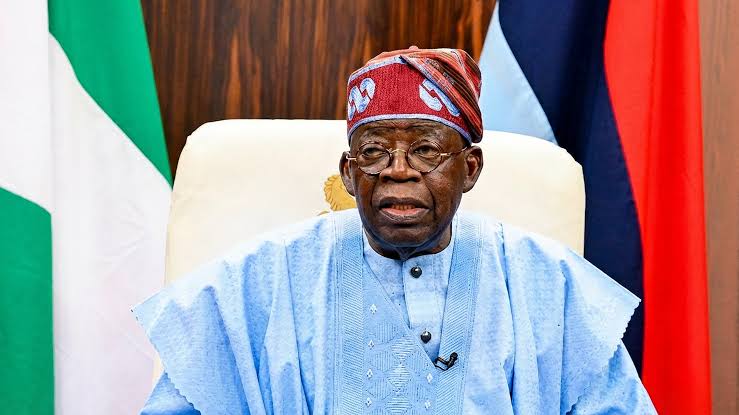
President Bola Tinubu
* Says anti-graft agency’s action days before governorship poll could undermine confidence in electoral process
By TOM CHIAHEMEN –
ABUJA – In a dramatic intervention just days before the Osun State governorship election, President Bola Ahmed Tinubu on Thursday ordered the Economic and Financial Crimes Commission (EFCC) to immediately withdraw the court order freezing the bank accounts of the Osun State Government, warning that the timing of the action risks creating the impression of federal interference in the electoral process.
The President, in an unusually candid statement from Abuja, said he was “deeply embarrassed” by the development—not because the EFCC was exercising its statutory powers, but because of the political implications of obtaining the order on the eve of a crucial election.
The directive effectively compels the anti-graft agency to return to court to vacate the order it secured on August 5 and discontinue the proceedings against the Osun State Government.
Tinubu stressed that although he had consistently resisted interfering in the operations of anti-corruption and law enforcement agencies since assuming office, the circumstances surrounding the latest EFCC action demanded presidential intervention in the overriding public interest.
“I have consistently maintained that anti-corruption and law enforcement agencies must be allowed to discharge their statutory responsibilities independently, professionally, without fear or favour, or political interference,” the President said.
He explained that his administration had deliberately allowed institutions of state to operate independently because strong democratic institutions remain essential to the rule of law and good governance.
Nevertheless, Tinubu noted that every action taken by a federal institution is ultimately attributed to the Presidency, whether or not he had prior knowledge of it.
“Every action taken by an institution of State, especially at the Federal level, is always credited to me as the President, even when I may not have had any prior knowledge of the action,” he stated.
Although he disclosed that he was yet to receive a full briefing on the facts that prompted the EFCC to obtain the court order, Tinubu insisted that the timing alone was sufficient to warrant immediate intervention.
“Osun State is only a few days away from its gubernatorial election. Therefore, nothing ought to be done to give an impression that the EFCC or indeed any other agency of the Federal Government is being used to interfere with the election,” he said.
Declaring that preserving public confidence in the democratic process must take precedence, the President directed the commission to immediately approach the court to vacate the freezing order and terminate the action against the state government.
“Accordingly, I have directed the EFCC to immediately proceed to the court to vacate the order and discontinue whatever action it has instituted against the Osun State Government in this regard,” Tinubu declared.
The President’s intervention is one of the most significant public directives issued to the EFCC since the beginning of his administration and is expected to trigger fresh debate over the delicate balance between the operational independence of anti-corruption agencies and the imperative of protecting the integrity of Nigeria’s electoral process.
The development also comes at a politically sensitive moment, with heightened attention focused on the conduct of federal institutions ahead of the Osun governorship election. While Tinubu reaffirmed his commitment to the independence of anti-corruption agencies, his decision underscores the premium his administration says it places on ensuring that no official action is perceived as capable of influencing the outcome of a democratic
The President’s directive is likely to ignite debate over the constitutional limits of presidential authority over an anti-corruption agency that is statutorily expected to operate independently. While Tinubu defended the intervention as necessary to protect the integrity of the Osun governorship election, critics may question whether directing the EFCC to terminate a court action sits comfortably with his long-standing pledge not to interfere in the commission’s operations.