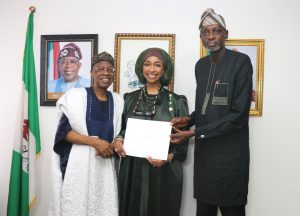
Minister of Women Affairs and Child Development, Hajiya Imaan Suleiman Ibrahim, addressing newsmen during the 26th National Council on Women Affairs, Child Advancement and Social Development meeting in Jalingo, Taraba State
National Council of Women (NCW) has called for a 50-50 affirmative action policy to guarantee greater representation of women in political positions across Nigeria.
The council made the demand on Wednesday, August 12, 2026, in Jalingo, Taraba State, where it inaugurated its 10 million women voices states working committees across the 36 states of the federation and the Federal Capital Territory.
The inauguration was performed by the Minister of Women Affairs and Child Development, Hajiya Imaan Suleiman Ibrahim, during the 26th National Council on Women Affairs, Child Advancement and Social Development meeting.
The meeting, themed “Advancing the Care Economy for Inclusive Development: Operationalising Nigeria’s Renewed Social Protection Architecture,” brought together women leaders and government officials to deliberate on policies aimed at improving the welfare, economic participation and political inclusion of women.
The council said women were no longer satisfied with the 35 per cent affirmative action target that had been advocated in previous years, urging them to become more actively involved in politics and demand their rightful place in decision-making.
The minister also challenged commissioners responsible for women affairs and child development across the states to move beyond policy discussions and begin implementing instruments developed by the ministry.
“Honourable Commissioners, this is where I make my first request of you. These instruments were built to be domesticated, not admired. I ask each state to receive them, adapt them to your context, secure Executive Council approval where required, and begin implementation within this financial year. The ministry will provide the technical support. What we cannot provide is your political will.
“The Renewed Hope Agenda of His Excellency, President Bola Ahmed Tinubu, GCFR, recognises this reality, and his declaration of 2026 as the Year of families and Social Development places the family at the centre of national transformation.
“Distinguished delegates, I want us to understand what the declaration means for the states in this room. It means that for the whole of this calendar year, the family and the systems that protect it carry Presidential priority. A window of that kind does not stay open indefinitely. Every State that moves decisively within it will find the Federal Government, the development partners in this hall and the private sector willing to move with them. Those who wait will be waiting alone.
“We have developed a Country Gender Profile for Nigeria. For the first time, we have a consolidated evidence base on the status of women and men across the economy, health, education, political participation, unpaid care, land, credit and social protection. It tells us where the gaps are, in which states, and by how much. That profile now anchors our planning, and it is available to support yours too.
“Directly relevant to every state in this room, we have commenced the end-term review of the National Gender Policy 2021 to 2026 and the development of its successor for 2027 to 2032. This is not a federal exercise to be conducted in Abuja and transmitted to you for compliance.
“The review is pillar-driven and evidence-led, and it will be shaped by what the states tell us works and what does not. We will be engaging each of you formally on your inputs in the coming weeks, and I ask that you designate the officers who will carry that responsibility before you leave Jalingo.”
The minister said the gender policy review would take into account the experiences and contributions of states, stressing that effective implementation would require political commitment at the sub-national level.
The NCW’s call for 50 per cent affirmative action is expected to further intensify discussions on women’s representation in political leadership and decision-making in Nigeria, particularly ahead of future electoral cycles.
The council also urged women across the country to organise, participate actively in political processes and use their collective strength to secure greater representation in government.