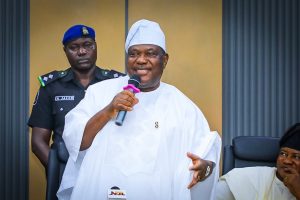
Benue State Governor, Hyacinth Alia
Benue State Government has presented her budget estimate totalling Six Hundred and Five Billion, Five Hundred and Six Million, Seven Hundred and Sixty-Four Thousand, and Sixty-Six Naira, Sixteen Kobo (₦605,506,764,066.16K), before the state house of assembly, in Makurdi, for consideration and subsequent approval.
Addressing the lawmakers during the budget presentation at the Benue State House of Assembly Complex, Governor Hyacinth Alia, who described the budget as a practical roadmap to inclusive growth stressed that economic progress must translate into better living conditions for ordinary households.
The 2026 budget titled “Budget of Rural Development, Livelihood Support and Sustained Growth,” according to the governor was a deliberate strategy aimed at repositioning the state’s economy, and to improve the living standards of the people of the State
The governor disclosed that the sum of Two Hundred and Eighty-One Billion, Eighty-Six Million, Four Hundred and Thirty Thousand, Four Hundred and Eighty-Five Naira, Five Kobo (₦281,086,430,485.05K) only was expected to fund total recurrent expenditure, amounting to 46.4% of the total budget size of 2026.
This amount according to him, “represents a 21.69% increment over the total recurrent cost of the revised 2025 budget, adding that “these votes will account for the sustenance of the payment of minimum wage and other incidental costs associated with our overheads”.
For capital expenditure, Governor Alia stated that Three Hundred and Forty-Two Billion, Four Hundred and Twenty Million, Three Hundred and Thirty-Three Thousand, Five Hundred and Eighty-One Naira, Ten Kobo (₦342,420,333,581.10K) only is expected to fund it.
While emphasizing that transformation of the state requires targeted investments that unlock rural productivity and improve everyday living conditions, the Governor insisted that “transforming our rural economy is not an option, it is a necessity. This budget prioritizes targeted investments in roads, infrastructure, and activities that will unlock rural productivity and improve quality of life.
“We will embark on a phased rehabilitation and construction of feeder roads linking farming communities to major markets, processing clusters to distribution hubs, and rural areas to health and educational facilities.
“This will reduce post-harvest losses, lower transport costs, and stimulate local commerce. We have allocated 30.23% of the capital budget to the development of rural roads, feeder roads, and bridges. Our goal is simple: connect farmers to markets, children to schools, and communities to essential services.”
Governor Alia insisted that the major key priority areas in the 2026 budget are “the sustained growth agenda, covering Education and Health Sector investment, Infrastructure for Long-Term Competitiveness, as well as innovation and Digital Transformation, with an allocation of 55.66%.
“This is followed by the Rural Development agenda which comprises of Rural Electrification, Water Supply, and Environmental Protection and Agriculture and Agro-Industrial Development with an allocation of 30.23% of the capital budget, while the Livelihood support with Social Protection Programs, MSME Growth and Cooperative Development is allocated 14.11% of the budget.”
Even as he lamented the security challenges and economic pressure in the 2025 fiscal year, the governor highlighted major gains across critical sectors.
Alia noted that “security coordination was strengthened through the deployment of 5,000 personnel of the Benue State Civil Protection Guards, working alongside federal agencies and community structures to restore relative peace in previously affected areas.”
On infrastructure, Governor Alia announced the near completion of two underpasses in Makurdi, and Gboko, completion of about 50 kilometres of roads in the state capital, and ongoing work on over 387 kilometres of roads across the state.
According to the governor, these efforts have placed Benue among the top five states nationally in capital expenditure per capita.
He expressed gratitude on the progress in workers’ welfare, revealing that “salary arrears inherited by his administration had been reduced from ten months to three, while pension and gratuity backlogs were similarly reduced. “
In spite of the pressure on state finances, Governor Alia said his administration chose to prioritise workers and retirees as a moral and economic necessity.
The Governor announced the government’s outlined landmark interventions which includes “the reactivation of the fertilizer blending plant, subsidised farm inputs, distribution of 150,000 oil palm seedlings under the Benue Alia Palm Project, and the test run of a fruit juice factory to curb post-harvest losses.”
He noted that “education, health, digital skills, and youth empowerment also featured prominently, with investments in school infrastructure, teacher recruitment, digital training training for civil servants and youths, and the upgrade of the Benue State University Teaching Hospital.”
Alia expressed the readiness of his administration to maintain “strict fiscal discipline, block leakages, and expand internally generated revenue through automation, without imposing undue burdens on citizens.”
He noted with confidence that with legislative support, “the 2026 budget would deepen development, expand opportunities, and secure a more prosperous future for Benue State.”