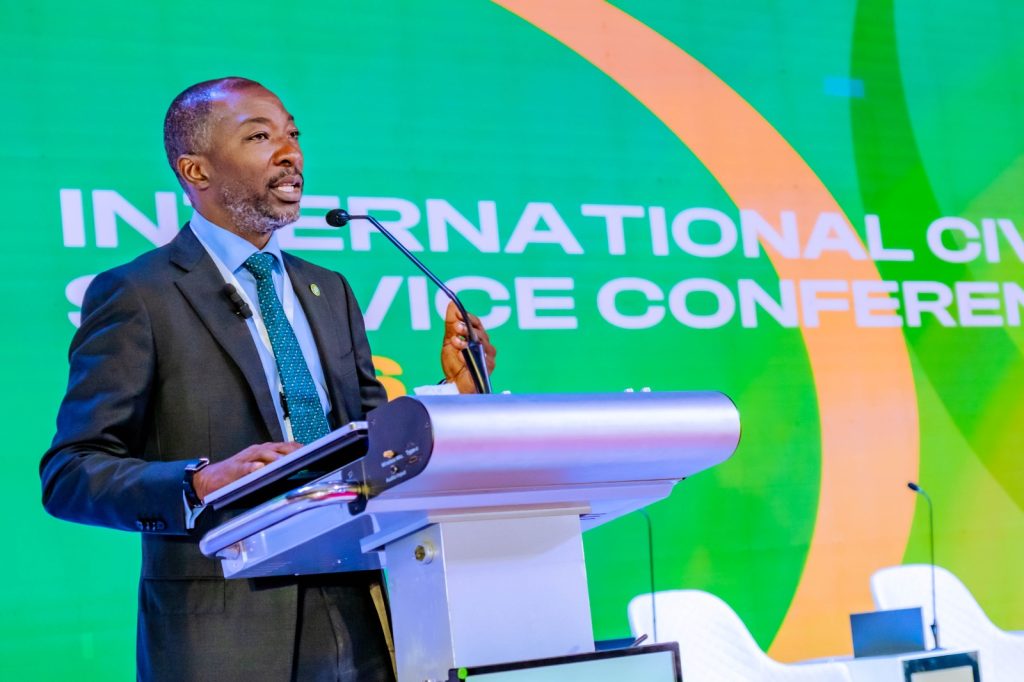
Managing Director of the Fund, Oluwaseun Faleye, speaking on Wednesday during the 2026 International Civil Service Conference in Abuja.
Nigeria Social Insurance Trust Fund (NSITF) has said more than 7.6 million Nigerian workers have now been enrolled into the Employees’ Compensation Scheme (ECS) as the agency continues efforts to widen social protection coverage across the country.
The Fund also announced the enrollment of the Nigeria Police Force into the scheme, describing it as the first time the police would formally come under the compensation programme.
Managing Director of the Fund, Oluwaseun Faleye, disclosed this on Wednesday at the 2026 International Civil Service Conference in Abuja.
Faleye said the enrollment followed engagements with the Inspector-General of Police, adding that the move would give officers more confidence, especially those working in dangerous conditions.
“We have enrolled over 7.6 million employees into the Scheme. We secured the enrolment of the Nigeria Police Force into the ECS, a historic first, after engagements with the Inspector-General of Police,” he said.
“When our officers know that their families will be protected should they sustain injury or lose their lives in the line of duty, their confidence and gallantry will increase, and our national security will be safer for us all.”
Speaking on the conference theme, “Reforms, Resilience and Results,” the NSITF boss said public institutions must improve and adapt to meet the needs of citizens.
According to him, when he assumed office on July 15, 2024, the Employees’ Compensation Scheme was facing uneven compliance, low awareness and delays in processing claims.
He said the agency decided to tackle the problems through reforms instead of complaining about them.
Part of the reforms, he explained, included collaboration with the Independent Corrupt Practices and Other Related Offences Commission (ICPC) to strengthen transparency within the Fund.
Faleye said 120 staff members were appointed as Anti-Corruption and Transparency Unit liaison officers across NSITF offices nationwide as part of efforts to improve accountability.
On digital reforms, he said the Fund was gradually moving away from paper-based processes to automated systems aimed at reducing delays and improving service delivery.
“We are investing in automated workflows, real-time tracking of claims, and standardised processing timelines. Our goal is simple. No Nigerian worker or their family should face unnecessary delays when they are entitled to compensation under the law,” he stated.
The NSITF MD also said the agency had intensified engagements with state governments to expand compliance under the scheme.
He revealed that the Fund signed an agreement with the Lagos State Government in April 2026 for the full implementation of the ECS for state workers.
According to him, similar engagements were held with governors of Rivers, Delta, Sokoto and Taraba states.
Faleye further disclosed that the Fund processed 22,350 compensation claims in 2024 and recorded a 21 per cent increase in claims payout.
He said a worker of Seplat Energy received N90 million compensation, while dependants of a Nigerian Breweries employee were paid N76 million.
He added that NSITF also covered N31 million medical bills for a Nestlé Nigeria worker and paid N42.5 million compensation to the family of a deceased Depthwize employee.
“These are not just numbers. These are families who received support in difficult moments,” he said.
On workplace safety, Faleye said the Fund partnered with the Nigeria Employers’ Consultative Association (NECA) and the Nigeria Labour Congress under the 2025 Safe Workplace Intervention Project (SWIP), through which more than 200 workplaces have been audited nationwide.
He also noted that the Federal Government had made the Employees’ Compensation Scheme mandatory for federal public workers.
According to him, changing work patterns driven by technology, remote work systems and artificial intelligence mean public institutions must become more proactive in protecting workers and strengthening social safety systems.