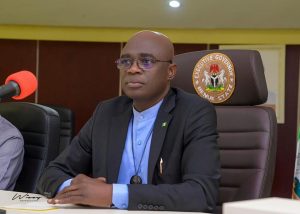
Participants at the workshop held in Maiduguri
By SADIQ ABUBAKAR, Maiduguri –
The Borno Coalition for Democracy and Progress (BOCODEP) has organized a two-day capacity-building training workshop to promote women’s participation in anti-corruption government agencies and related bodies.
The workshop, held in collaboration with the MacArthur Foundation, aimed to advance women’s participation in anti-corruption and accountability in Borno and Yobe states.
According to the Executive Director of BOCODEP, Professor Abubakar Mu’azu, the workshop’s main objective was to gather community-level insights on corruption, service delivery, and opportunities for women-led accountability.

The training also sought to enhance the capacity of women in anti-corruption and accountability, strengthen their engagement and participation in decision-making, raise awareness about the effects of corruption, and increase women’s voices and contributions to anti-corruption efforts.
The workshop brought together representatives from various government agencies, including the Economic and Financial Crime Commission (EFCC), Independent Corrupt Practices and Other Related Offences Commission (ICPC), Nigerian Financial Intelligence Unit (NFIU), Code of Conduct Bureau (CCB), Code of Conduct Tribunals (CCT), Technical Unit on Governance and Anti-corruption Reforms (TUGAR), and National Drug Law Enforcement Agency (NDLEA).
Professor Mu’azu emphasized the need for impactful projects with measurable outcomes that contribute to community and state anti-corruption plans.
He noted that the workshop’s specific objectives were to enhance the capacity of women in anti-corruption and accountability, strengthen their engagement and participation in decision-making, generate wider awareness and enlightenment on the effects of corruption, and increase women’s voices and contributions to anti-corruption efforts.

Professor Joseph Wilson who is also a consultant with BOCODEP and a former HOD Mas Communication University of Maiduguri in his paper presentation said there is the urgent need for corrupt leaders to be held responsible for their corruptive actions and mismanagement of public funds.
He also enjoined organizations, agencies and commissions in anti graft to wake up and be very active and effective in the discharge of their responsibilities in order to bring sanity into the society by ridding the society of corruption while describing corruption as enemy of progress and development.
Professor Wilson, however, noted that there different forms of corruption which are being perpetrated in governance, leadership , politics and business community across all strata of the society without proper actions to arrest the culprit or situation.
He tasked women in leadership position and governance as well as legislature to wake up and be more active in tackling issues of women corruption , promote and empower womenfolk improve their status quo, stressing that, through capacity building training workshops and orientations, the society will be corrupt free or less with women in power and leadership positions.
He noted that it is important for women in leadership position and governance to be provided with more opportunities to make them transparent and accountable to the people and their organizations cutting across all women groups, women in communities, schools, institutions, civil service, business community, professional organizations , etc, particularly, the mainstream gender who are the womenfolk.
He encouraged women to actively participate in governance, decision making process, politics, legislature, urging them to say no to corruption, yes to accountability in order to promote transparency and accountability in leadership and governance at all the levels of government of the country.
Dr. Umar Farouq Mohammed , a Technical Advisor with BOCODEP spoke extensively on the overall and strategic goals of Women Participation in Anti-Corruption and Accountability in Selected Communities in Borne and Yobe States as an Inclusive State Anti-Corruption Action Plan to be developed which will increase Women Participation in Anti-Corruption Decision Making Processes at al Levels of governance and leadership,.
He also coordinated the group work of the participants in impact level and outcome result level developed while urging the women participants to learn more from the orientation.
Professor Joseph Wilson, a consultant with BOCODEP and former Head of the Mass Communication Department at the University of Maiduguri, emphasized the need for corrupt leaders to be held accountable for their actions.
He urged anti-graft agencies to be more proactive in tackling corruption, describing it as a major obstacle to progress and development.
Wilson noted that corruption manifests in various forms across governance, leadership, politics, and the business community. He called on women in leadership positions to take a more active role in addressing corruption, promoting transparency, and empowering women.
To achieve a corruption-free society, Wilson stressed the importance of capacity-building training workshops and orientations for women. He encouraged women to participate in governance, decision-making processes, and politics, promoting accountability and transparency.

Dr. Rahila Jibrin, a consultant with BOCODEV from the Mass Communication department, University of Maiduguri emphasized the need for continuous capacity-building training to promote women’s empowerment and dignity.
While a panel discussion led by Professor Nuhu Gapsiso identified cultural, social, and environmental constraints faced by women in leadership positions.
The discussion also covered impact-driven issues, including advocacy, mobilization, gender extension, women empowerment, and financial support. Participants proposed a way forward, emphasizing the importance of unity, love, solidarity, understanding, honesty, empathy, and commitment.
Additionally, the training included Action Plan drafting, formulation, and implementation, as well as the stages involved in each step, to enhance participants’ knowledge of project implementation and sustainability.