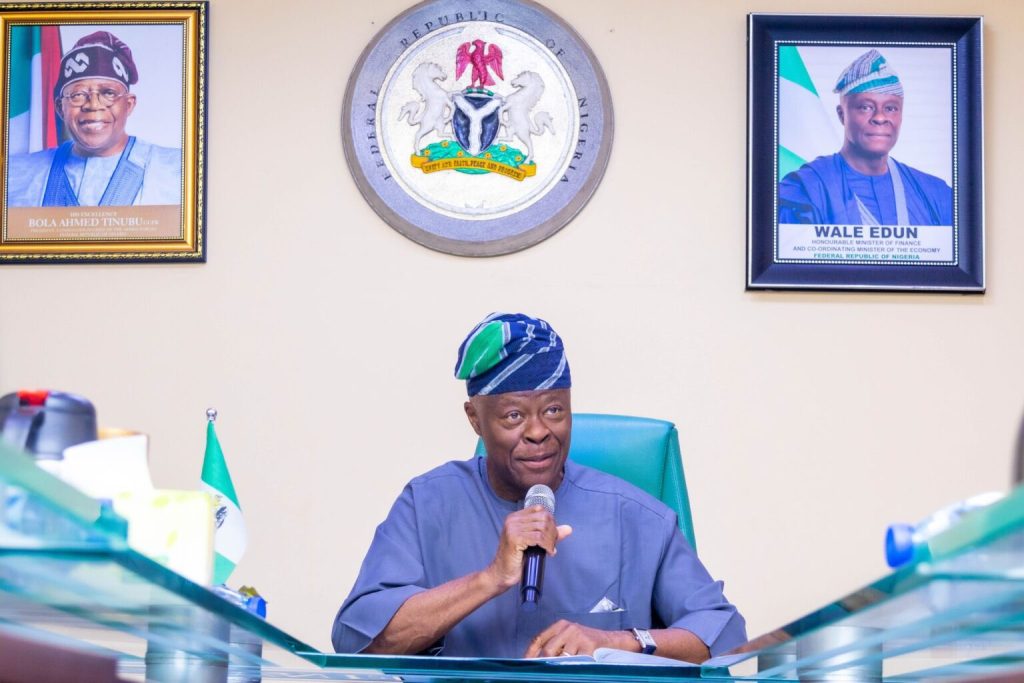
Finance Minister, Wale Edun
Nigerian Government has announced plans to deepen investment in the economy, rely more on domestic revenue, and significantly reduce its dependence on borrowing as part of ongoing fiscal reforms.
Nigeria’s Minister of Finance and Coordinating Minister of the Economy, Wale Edun, disclosed this on Tuesday while speaking on Bloomberg Television at the ongoing 56th World Economic Forum (WEF) in Davos, Switzerland.
According to Edun, the country is shifting its fiscal focus towards generating more internal revenue rather than accumulating new debt.
> “The issue now is to focus on revenue, focus on domestic resource mobilization,” he said.
“We’re hoping to rely less on borrowing.”
Focus on Domestic Resources
The minister explained that although Nigeria still has access to international capital markets, the government’s primary strategy is to harness local resources to fund development.
He said efforts are ongoing to strengthen tax collection, improve fiscal sustainability and expand government revenues amid mounting global economic pressures.
Edun further stressed that while international bond markets remain an option if required, domestic reforms remain central to Nigeria’s economic agenda.
Tinubu’s Economic Reforms Take Shape
Since assuming office in 2023, President Bola Tinubu’s administration has rolled out wide-ranging reforms aimed at stabilising public finances and accelerating growth.
These include the removal of foreign exchange restrictions, the scrapping of costly fuel subsidies, and a major overhaul of Nigeria’s tax system.
One of the key targets of the reforms is to increase tax revenue to 18 per cent of GDP by next year, from about 14 per cent currently, a move government officials believe will enhance long-term fiscal sustainability.
Edun noted that these policies are designed to reduce reliance on external debt while strengthening investor confidence.
IMF Sees Early Gains
Economic indicators suggest Nigeria’s reforms may already be yielding results. The International Monetary Fund (IMF) recently upgraded Nigeria’s growth forecast to 4.4 per cent for 2026, up from an estimated 4.2 per cent in 2025, despite weaker global oil prices.
The IMF said Nigeria’s reform agenda is expected to stabilise revenue flows and improve fiscal sustainability.
> “The combination of domestic resource mobilisation and ongoing reforms underscores Nigeria’s effort to reduce debt dependence and strengthen its economic foundations,” the IMF stated.
Nigeria’s Message at Davos
Edun is expected to use the Davos platform to engage global investors on key concerns such as policy consistency, inflation control, foreign exchange stability and fiscal discipline.
Nigeria’s presence at the World Economic Forum this year is also marked by a major milestone, as the Federal Government unveils its first-ever official national pavilion — Nigeria House Davos — aimed at promoting the country’s investment opportunities.
Nigeria’s economic messaging at WEF 2026 is being shaped by broader global realities affecting emerging markets, with authorities projecting confidence in the country’s reform trajectory.