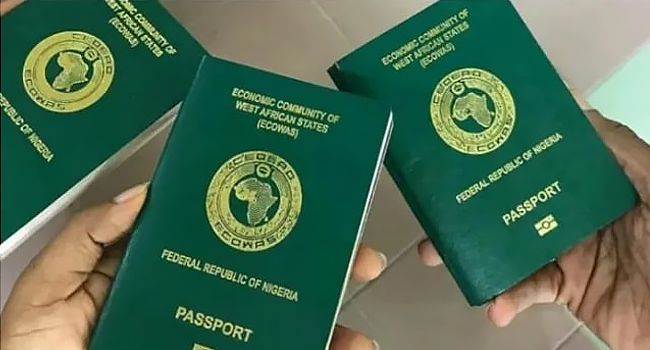
Nigerian passports
A diverse group of Nigerians has voiced a blend of frustration and cautious optimism regarding the Federal Government’s decision to double international passport fees, effective from September 1, 2025. While some applaud potential improvements in service efficiency, others decry the steep costs as a burden on everyday citizens, demanding greater accountability and faster fixes for ongoing operational headaches at immigration offices.
The Nigeria Immigration Service (NIS) revealed the fee adjustment on August 28, 2025, framing it as essential for maintaining the high standards and security of the nation’s enhanced e-passport system.
Under the updated pricing, a standard 32-page passport valid for five years now costs ₦100,000 ($150) for applications within Nigeria, up from the previous ₦50,000. The premium 64-page version, valid for 10 years, has jumped to ₦200,000 ($230).
For Nigerians abroad, fees remain unchanged at $150 for the five-year booklet and $230 for the 10-year one.
In interviews conducted by the News Agency of Nigeria (NAN) in Abuja, residents shared a spectrum of views on the policy’s impact.
Aisha Musa, a small-scale trader seeking her first passport, called the ₦100,000 price tag for the 32-page booklet “simply crushing,” adding, “How many market women can produce N100,000 just to get a passport? The government says it wants quality, but it must also think of struggling families.”
Echoing her sentiment, Toluwani Johnson, a student at the University of Abuja, labeled the increase “another barrier for young people.”
She explained that many peers had scrimped to afford the old ₦50,000 fee, and now, “I need a passport for postgraduate admission abroad. Saving N100,000, plus transport and other travel documents, is very hard.” Johnson lamented, “Many students like me, may postpone their dreams. This is sad and disheartening.”
On a more positive note, travel consultant Success Daniel acknowledged recent gains in processing times but issued a stern warning.
“I got an appointment online within 48 hours. If I collect in under two weeks, I might accept the new cost. But Nigerians will not tolerate the old delays at double price,” he stated, cautioning against any backsliding.
Abdullahi Adamu, another travel agent assisting with visas and documents, viewed the hike as inevitable amid ongoing upgrades.
“The technology and security upgrades cost money but must deliver results,” he noted, insisting the government ensure “no failed networks, no touts, no endless waiting.”
Engineer and car dealer Benson Eze prioritized reliability over expense, saying, “If I can apply online, capture once and collect in seven days, I will accept it. The issue has always been delay and extra charges.”
He urged the NIS and Ministry of Interior to enhance delivery, warning, “If not, this increment will amount to nothing but mere discomfort on the people.”
Civil servant Ngozi Kalu, renewing her passport, raised alarms about potential “hidden” fees, calling for stricter oversight.
“Even now, some officers whisper about facilitation money. If we are paying so much, we must see total automation and zero extortion,” she demanded.
Retired civil servant Adeniyi Adekunle criticized the broader process as cumbersome, asserting that “a responsible government should not only chase revenue but also deliver on its promises.”
Addressing these grievances, the government has committed to transformative changes in passport issuance. Interior Minister Olubunmi Tunji-Ojo highlighted recent overhauls, promising delivery within one week of enrollment.
“Every Nigerian should have their passport in hand without unnecessary delay. Our goal is not just faster delivery but quality passports that reflect the integrity and dignity of our nation,” he vowed.
Tunji-Ojo detailed how the reforms target past inefficiencies, including waits of up to seven months and rampant extortion for expedited service. A new centralized personalization center, he explained, boosts production capacity fivefold, enabling vetting in under 24 hours.
“With this facility, we can print five times more passports than we currently need; once you enrol, it doesn’t take us more than 24 hours to vet as printing capacity is no longer our problem,” the minister said.
He also stripped Passport Control Officers of approval powers to minimize corruption, emphasizing, “This reform is aimed at curbing racketeering, eliminating delays and restoring integrity to Nigeria’s travel documents. We realised that the best way to cut corruption is to remove human contact to the barest minimum.”
As the new fees take hold, the onus remains on authorities to match higher prices with seamless, extortion-free service—or risk deepening public discontent.
NAN