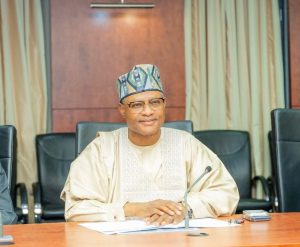
NNPCL GCEO, Bashir Bayo Ojulari
Nigerian National Petroleum Company Limited (NNPCL) has announced plans to secure $60 billion in investments over the next five to seven years to enhance Nigeria’s gas infrastructure and strengthen its position in the global energy market.
Speaking at the Gastech Exhibition and Conference in Milan, Italy, NNPCL Group Chief Executive Officer Bayo Ojulari told an audience from 150 countries, “This $60 billion investment is merely the starting point for transforming our oil and gas sector.”
Ojulari explained that the investment will drive Nigeria’s natural gas production to 12 billion cubic feet per day and expand refinery capacity to meet surging global energy needs. “We’re actively seeking investors to boost our production capabilities,” he said.
He credited the 2021 Petroleum Industry Act (PIA) for converting NNPCL into a limited liability company, enabling access to direct funding and international partnerships.
Currently, NNPCL produces 1.6 million barrels of crude oil per day (bpd), with goals to reach 2 million bpd by 2027 and 3 million bpd by 2030. Ojulari highlighted key initiatives, including the Ajaokuta–Kaduna–Kano (AKK) pipeline, the West African Gas Pipeline extension to Morocco and Europe, and the Nigeria LNG project’s expansion.
“Nigeria supplies 60% of LNG to Portugal and Spain, and with Train 7 set for completion in 2026, we’re planning Trains 8 and 9,” he noted, adding, “Our LNG operations are among the world’s best.”
On clean energy, Ojulari outlined Nigeria’s push for LPG adoption through a program distributing 2 million cylinders nationwide and a Compressed Natural Gas (CNG) initiative for vehicles and machinery.
He also emphasized Nigeria’s role in global energy security, noting that geopolitical events, like the Russia-Ukraine conflict, have spurred regional pipeline projects.
With over 200 undeveloped oil and gas fields, Ojulari described these as “prime greenfield opportunities for global investors” and highlighted existing partnerships with ExxonMobil, Chevron, Shell, Agip, and Total. “Despite foreign policy shifts, Nigeria remains focused on fostering a stable market,” he said.
Minister of State for Petroleum Resources (Gas), Ekperikpe Ekpo, reinforced Nigeria’s commitment to leveraging its 210 trillion cubic feet of gas reserves.
“Natural gas is the backbone of our economy, fueling industries, clean cooking, and job creation,” Ekpo stated. He noted that the Nigeria LNG project will increase capacity from 22 million to 30 million metric tonnes per annum with Train 7.
Additionally, Nigeria is advancing regional energy connectivity through the 5,000-kilometer Nigeria-Morocco Gas Pipeline and collaborations with Algeria and Equatorial Guinea on the Trans-Saharan Gas Pipeline.
Ekpo emphasized investor-friendly reforms under President Bola Tinubu.
“Our natural gas serves as a bridge to renewables, ensuring Nigeria remains a key player in the global energy transition,” he said.
According to the News Agency of Nigeria (NAN), Nigeria’s presence at the summit signals its ambition to lead in the global energy landscape.