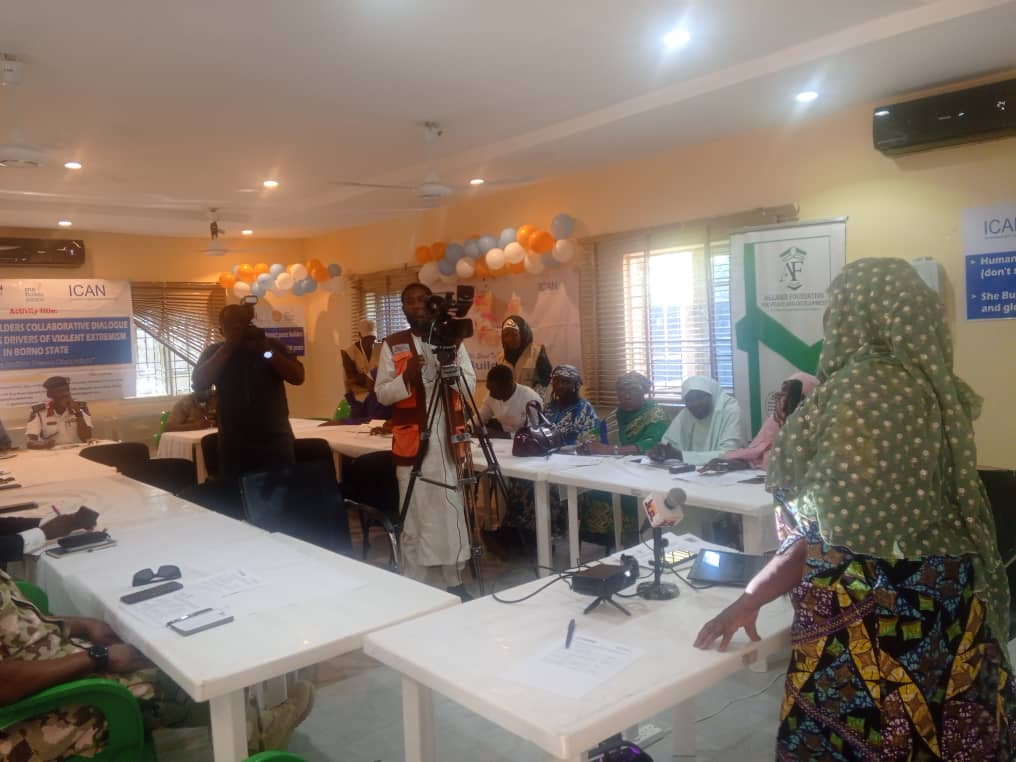
In a bold push to confront the roots of violent extremism in Borno State, the Allamin Foundation for Peace and Development on Tuesday convened a high-level dialogue bringing together members of the She Builds Peace (SBP) Network, security agencies and key government institutions.
The meeting, held at the Hajja Mangal Memorial Conference Hall in Maiduguri, focused on strengthening community-driven strategies to counter the lingering threats of radicalization across the state.
Opening the session, Executive Director of the foundation and Nigeria’s SBP Coordinator, Hajiya Hamsatu Allamin, delivered a passionate call to action, urging women to embrace their roles as frontline peacebuilders.
She stressed that women—often the first to sense early signs of radical behaviour within homes and communities—must speak out and alert security actors whenever suspicious activities arise.
“Women must stand shoulder-to-shoulder and defend peace,” she said, emphasizing the need for unity among women and girls.
“Our voices can prevent violence if we raise the alarm early enough. We must engage security agencies, community leaders and religious institutions to ensure that threats are not ignored.”
Hajiya Hamsatu also highlighted the urgent need for what she called “humanized security”—an approach where security personnel work closely with communities in trust and partnership rather than fear and suspicion.
She noted that the foundation’s long-standing advocacy for women’s inclusion in security leadership has steadily transformed local peace efforts in Borno.
According to her, addressing violent extremism requires understanding the complex factors that fuel it.
These include trauma from years of Boko Haram insurgency, broken community structures, and the manipulation of youths by extremist groups.
She noted that sustainable peace would only come through reconciliation, forgiveness, unity and reintegration of victims and repentant fighters into society.
During the technical session, Dr. Mohammed Abdullahi, a facilitator from the Foundation, unveiled findings from the She Builds Peace Campaign which mapped key drivers of violent extremism.
These factors, he explained, fall under governance failures, economic hardship, cultural pressures, ideological manipulation, and psychological vulnerabilities.
He outlined how these elements combine to create frustration, anger, misinformation, distrust and fertile ground for extremist propaganda.
Dr. Abdullahi emphasized the need for deradicalization, rehabilitation and community reintegration—especially for women, children and youths who are often the most affected.
Another facilitator, Hamza Dadum Maigari, Program Manager at ALFRED, stressed the necessity of building stronger systems of transparency and accountability.
According to him, good governance, justice, human rights protection and civic education are crucial pillars in the fight against extremism.
He called for more advocacy, media awareness and capacity-building initiatives to sustain peace and security gains in Borno.
The one-day dialogue ended with renewed commitment from participants to deepen collaboration among security agencies, MDAs and women-led networks—ensuring that communities remain at the heart of efforts to curb violent extremism and rebuild trust across the state.