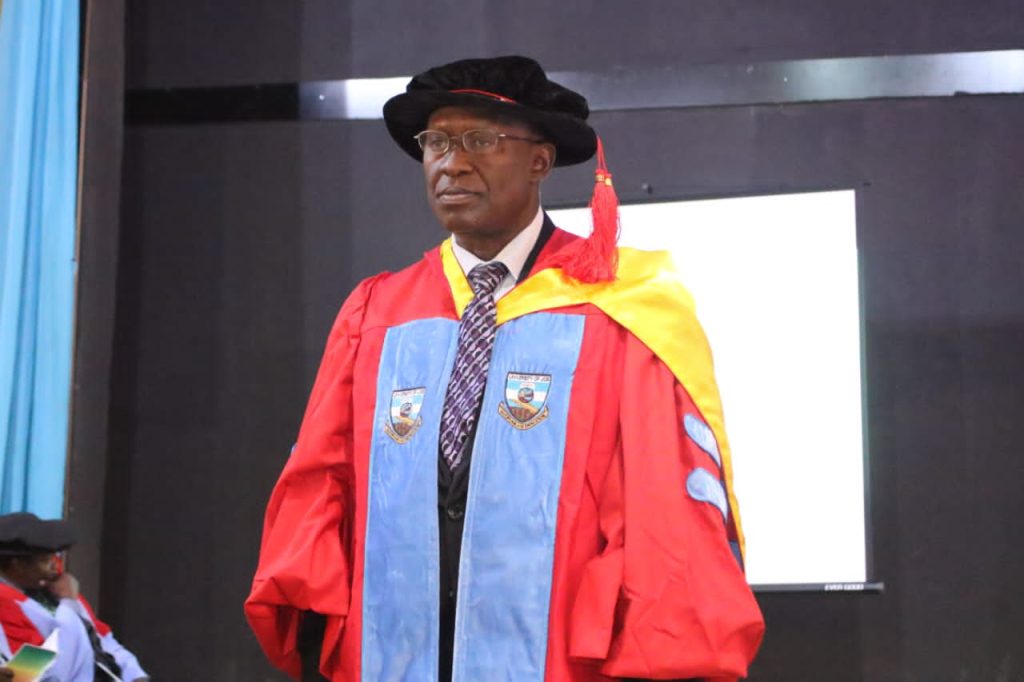
Professor Philip Asura Nggada of the Department of Religion and Philosophy, UNIJOS
University of Jos (UNIJOS) has become the first African university to secure direct access to ancient manuscripts, positioning it at the forefront of biblical textual criticism and manuscript studies on the continent.
The disclosure was made by Professor Philip Asura Nggada of the Department of Religion and Philosophy during the University’s 116th Inaugural Lecture titled: “Textual Examination of Sofer Marks in the 16th Century Torah Scroll: A Quest for National Development”.
Professor Nggada explained that the breakthrough followed nearly a decade of academic engagement and collaboration with a manuscript research group based in Grand Haven, Michigan, United States.
He noted that the 16th-century Torah scroll examined in his research provided rare material for the study of scribal correction marks known as sofer marks, inserted by Jewish scribes to preserve textual integrity.
He said: “This may interest you to know that the study of ancient manuscripts began in this university about ten years ago as an extracurricular initiative. From modest beginnings, we have grown significantly. The University of Jos is the first African university to have direct access to ancient manuscripts.
“Textual criticism concerns the recovery of the author’s original wording as found in the autograph. The task of the textual critic is to examine corrections and variants in order to restore, as much as possible, the original text. The goal is accurate interpretation of God’s word in its proper context.”
According to him, the precision of ancient scribal practices demonstrates a culture of accountability and accuracy in textual transmission, values he said remain relevant for modern scholarship and national development.
He further emphasised the role of scientific advancement in manuscript research, particularly the use of multispectral imaging technology to recover faded or erased texts.
“The way forward includes the use of multispectral imaging, a scientific technique used to recover erased or faded text in ancient manuscripts. Education is central. Literacy is foundational for national development. Without literacy, people can be misled easily,” he added.
Professor Nggada recommended the establishment of a postgraduate programme in Biblical Textual Criticism within the Department of Religion and Philosophy, as well as the creation of a Centre for the Study of Biblical Languages covering Hebrew, Greek, Aramaic and Coptic. Strengthening the discipline would consolidate the University of Jos’ leadership role in ancient manuscript studies across Africa.
In his remarks, the Vice-Chancellor of the University of Jos, Professor Tanko Ishaya, commended Professor Nggada for his scholarship and for choosing a topic of global relevance.
Represented by Professor Chentu Dauda Nguvugher, Dean of the Faculty of Arts, the Vice-Chancellor noted that while the lecture appeared highly specialised, its lessons extend beyond religious studies to national development, governance and ethical leadership.
“Even if one came here not fully understanding the subject, you are now better informed and enlightened,” he said, urging reflection on the principles of justice, accountability and moral responsibility highlighted in the lecture. He congratulated all who contributed to the successful organisation of the inaugural lecture and encouraged younger academics to emulate Professor Nggada’s dedication to scholarship and intellectual excellence.