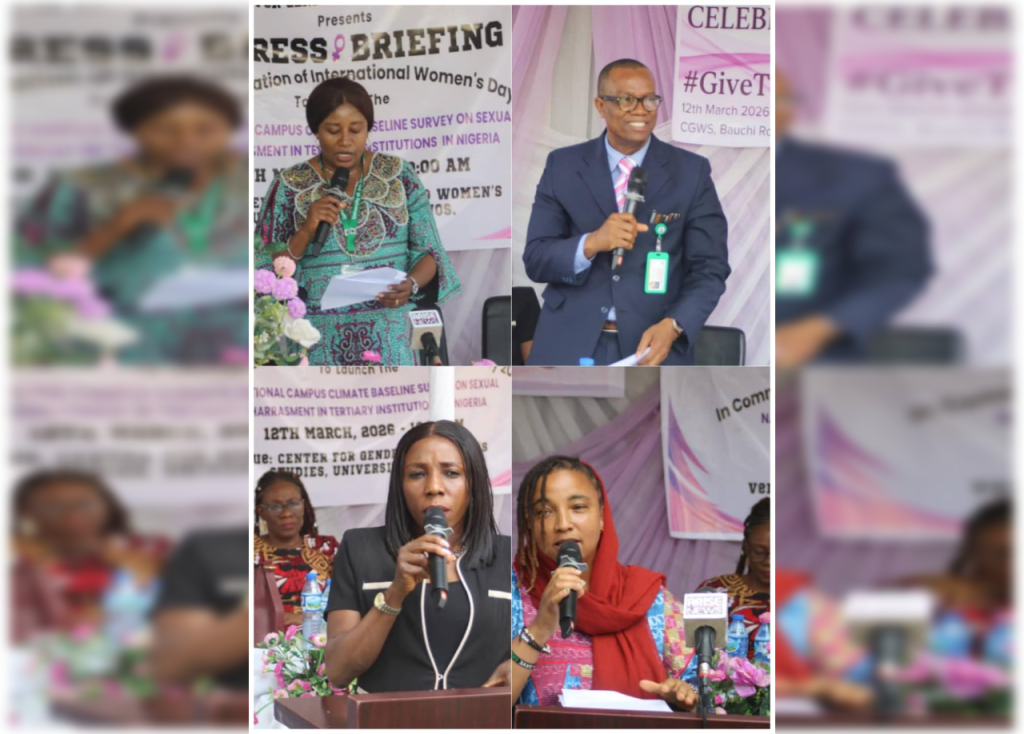
Guest speakers at the launch of the National Campus Climate Baseline Survey on Sexual Harassment in Tertiary Institutions in Nigeria at the 2026 International Women’s Day celebration organised by the Centre for Gender and Women’s Studies.
University of Jos (UNIJOS) has reaffirmed its zero-tolerance stance on sexual harassment following findings from a national survey that revealed widespread gender-based violence across Nigerian universities.
The survey, conducted by Alliances for Africa, found that 70 per cent of female students and 30 per cent of male students have experienced at least one form of gender-based violence on campus. The study also showed that 63 per cent of female staff and 37 per cent of male staff reported similar experiences within university environments.
The findings were highlighted during the launch of the National Campus Climate Baseline Survey on Sexual Harassment in Tertiary Institutions in Nigeria at the 2026 International Women’s Day celebration organised by the Centre for Gender and Women’s Studies.
The event was held under the theme “ _Give to Gain: Reciprocity and Intentional Action for Gender Equity.”_
The gathering brought together academics, government officials, civil society organisations and students to discuss gender equality, campus safety and institutional accountability.
Speaking at the event, the Director of the Centre, Prof. Chikas Danfulani, said the institution remains committed to ensuring that the university community operates in an environment of dignity, equality and safety.
She stressed that addressing sexual harassment must remain a core responsibility of academic institutions.
“Promoting gender equity and protection from harassment are not symbolic gestures but core institutional responsibilities,” she said.
Danfulani added that the centre was working to strengthen awareness, reporting mechanisms and prevention strategies within the university system.
“The Centre for Gender and Women’s Studies is committed to driving actions aimed at providing a safe learning and working environment for students and staff of the institution,” she added.
Also speaking, the Vice-Chancellor of the university, Prof. Tanko Ishaya, represented by the Deputy Vice-Chancellor (Administration), Prof. Charles Onwochei, disclosed that the university had recently taken disciplinary action in a sexual harassment case.
He noted that the institution has put measures in place to protect students who report harassment cases and emphasised that harassment can affect people across genders.
“I am aware that recently — just about two or three weeks ago — the management took punitive and disciplinary action against someone for sexual harassment.
“Students who report sexual harassment are protected. We recently took certain actions to protect students who appeared as witnesses in sexual harassment cases. I have personally handled cases of sexual harassment of male staff by female students,” he said, stressing that the university’s response to such cases remains firm and impartial.
Delivering the keynote address, educator Dr. Nanre Nafziger highlighted the historical role of women’s movements in Nigeria and called for renewed collective action to confront persistent inequality and violence against women.
She referenced historic struggles such as the Aba Women’s War and the activism of Funmilayo Ransome-Kuti, noting that Nigerian women have long been central to social and political change.
“The history of Nigeria cannot be told without acknowledging the contributions of women. Nigerian women have fought colonial oppression, expanded education, strengthened economic life and defended democracy and human rights,” she said.
She urged institutions and civil society groups to move beyond symbolic celebrations of International Women’s Day and pursue deeper structural reforms.
In a goodwill message, the Plateau State Coordinator of the National Human Rights Commission, Dr. Mrs. Kiyenpiya Mafuyai, said empowering women was critical to national development.
She commended the UNIJOS for establishing a centre dedicated to gender and women’s studies, describing the initiative as a step toward transforming academic research into actionable human rights advocacy.
Also speaking, the Chairperson of the Plateau State Gender and Equal Opportunities Commission, Barr. Olivia Dazyam, emphasised the need for stronger institutional policies to address sexual and gender-based violence.
Meanwhile, disability rights advocate Prof. Michael Abednego of the Department of Special Education and Rehabilitation, University of Jos, called for greater inclusion of persons with disabilities in higher education, noting that many students face barriers in accessing information and physical infrastructure.
He emphasised that inclusive education requires improved accessibility and communication support for students with disabilities.
“When we talk about disability in the university environment, the issue is largely a problem of attitude.
“Access to education also means access to facilities and access to information. Institutions must take deliberate steps to ensure that students with disabilities are not left behind,” he said.
The event also featured panel discussions on mentorship, leadership and the power of reciprocity in advancing women’s opportunities. Other highlights included a special presentation by students of Theatre Arts and Music, as well as technical sessions addressing gender advocacy, inclusion and institutional responses to sexual harassment.