

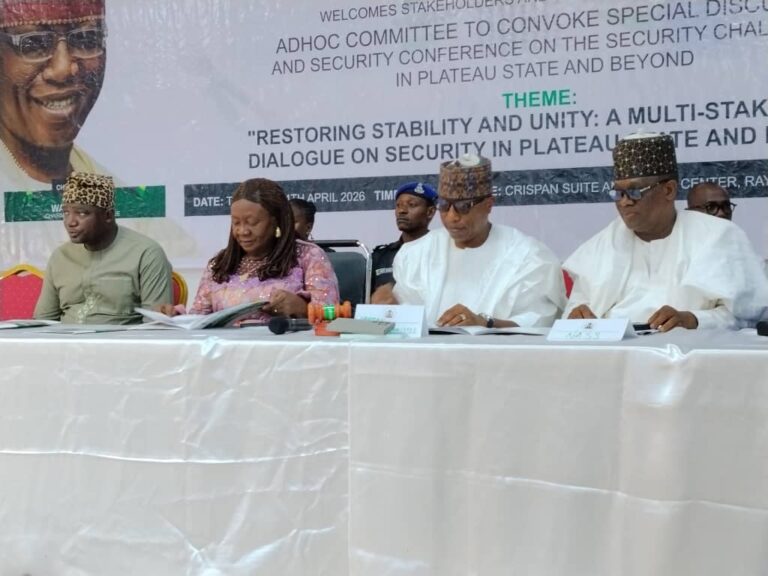
House of Representatives has intensified efforts to end recurring violence in Jos, as key stakeholders push for inclusive dialogue and coordinated security measures to restore lasting peace in Plateau State.
Speaking at a multi-stakeholder security conference, the Speaker of the House, Tajudeen Abbas, said the National Assembly would not allow Plateau to be defined by conflict, describing the gathering as a national imperative to address the root causes of violence in the state.
“We must not allow Plateau to be defined by cycles of violence. Instead, we must work collectively to build a future rooted in peace, justice, and shared prosperity,” Abbas said.
“The crisis has persisted for over two decades, leading to tragic loss of lives, destruction of homes, and displacement of thousands of citizens. The time has come for decisive and coordinated action.”
Abbas noted that the state has experienced sustained violence since 2001, resulting in thousands of deaths, the destruction of over 18,000 homes, and the displacement of about 80,000 people across more than 400 communities.
He attributed the crisis to multiple factors, including land disputes, historical grievances, marginalisation, resource competition, and criminal infiltration, urging stakeholders to work collectively to rebuild trust and promote peaceful coexistence.
The Speaker also pledged legislative action, including a review of laws on security, land management, and conflict resolution, as well as prioritising funding for reconstruction, resettlement of displaced persons, and deployment of modern security infrastructure.
Chairman of the House ad hoc committee on security challenges, Wale Hammed, said the panel was established in response to persistent insecurity in Plateau, stressing that peace cannot be achieved through force alone.
“Peace cannot be achieved through military deployment alone. We must create space for dialogue where grievances can be addressed and communities can rebuild trust,” Hammed said.
“This engagement is designed to bring all stakeholders together to develop sustainable solutions that will prevent future conflicts.”
Meanwhile, Plateau State Governor, Caleb Mutfwang, who was represented by Deputy Governor Josephine Piyo, described the dialogue as timely and necessary, noting that successive administrations have struggled with recurring cycles of violence.
The governor highlighted measures taken by his administration, including revamping Operation Rainbow, deploying modern surveillance technology, refurbishing security vehicles, and reconstituting the Plateau Inter-Faith Advisory Council.
He reaffirmed the state government’s commitment to protecting lives and property, adding that justice and the rule of law would remain central to efforts to stabilise affected communities.
The conference, themed “ Restoring Stability and Unity: A Multi-Stakeholder Dialogue on Security in Plateau State and Beyond,” brought together political leaders, traditional rulers, security agencies, religious bodies, civil society organisations, and members of the public to develop practical solutions to the crisis.
Participants emphasised that sustained dialogue, community engagement, and improved coordination among security agencies are critical to ending the cycle of violence and restoring Plateau’s reputation as the Home of Peace and Tourism.


