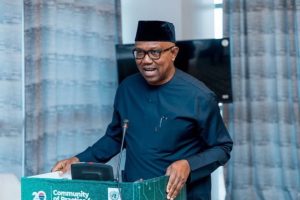
CBN Governor, Yemi Cardoso
Governor of the Central Bank of Nigeria (CBN), Olayemi Cardoso has called on banks to stay vigilant against emerging risks after the banking sector recapitalisation exercise, even as the Monetary Policy Committee kept the benchmark interest rate unchanged.
Speaking after the MPC 305th meeting in Abuja, Cardoso said the committee retained the Monetary Policy Rate at 26.5%, citing persistent inflationary pressures and global economic uncertainty. The committee also held the standing facilities corridor at +500 and -100 basis points, and maintained the Cash Reserve Ratio at 45% for Deposit Money Banks, 16% for merchant banks, and 75% for non-TSA public sector pl deposits.
The MPC welcomed the conclusion of the recapitalisation exercise, which produced 33 stronger banks with improved financial soundness indicators and greater capacity to support economic growth.
“The MPC urged the banks to remain proactive and adopt necessary measures to address potential post-recapitalisation risks towards preserving financial system stability,” Cardoso said.
On inflation, the committee noted a marginal rise for the second consecutive month but described the trend as largely temporary. Headline inflation rose to 15.69% in April 2026 from 15.38% in March, driven by higher food prices. Food inflation climbed to 16.06%, while core inflation eased to 15.86%. The 12-month average inflation rate slowed to 19.16%.
Cardoso said spillovers from the Middle East crisis have raised global energy and logistics costs, but Nigeria’s exposure has been limited. He credited exchange rate stability, stronger external reserves, improved monetary policy transmission, a well-capitalised banking system, and ongoing fiscal consolidation for bolstering the economy’s resilience.
The MPC also pointed to Nigeria’s recent sovereign rating upgrade as a sign of improving macroeconomic fundamentals and reform credibility.
“The committee was convinced that the essential conditions for price stability remain firmly in place,” Cardoso said, adding that policymakers will continue to monitor both domestic and global developments.