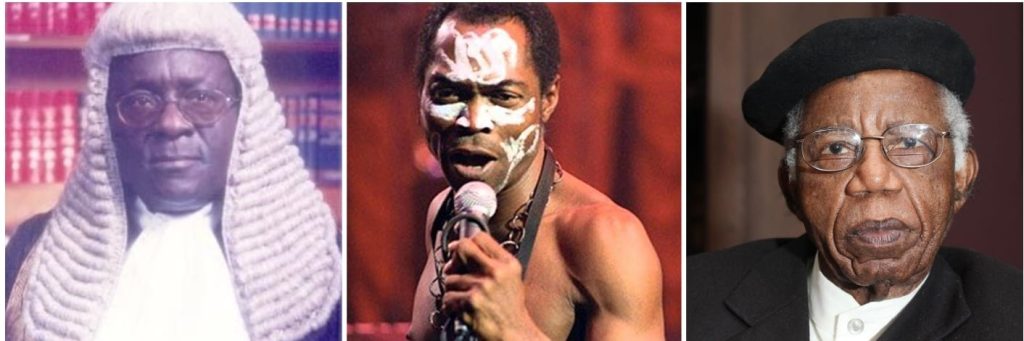
(L-R) Gani Fawehinmi, Fela Kuti & Chinua Achebe.jpg
By PAUL EJIME
Odoo is a business management software suite developed in Belgium. But its advert billboard often reminds me of Fela Anikulapo Kuti’s popular song with the same acronym.
O. D. O. O, or Overtake Don Overtake Overtake, is the title of Fela’s 1989 album, which, like most of his revolutionary songs, did not spare political leaders in Africa for the hardships inflicted on the masses, while the ruling class basked in opulence.
The song’s chorus goes thus:
I get my money
Plan my plan finish
Start to go for market
Start to go for shopping
Before I reach market nko o?
Government show don enter
My plan don spoil o…
Overtake don overtake overtake!
The second stanza says:
When they want to call, eh
When they want to call, eh
When they want to call Nigerian government
Them give am name, “Federal Military Government”
For Libya dem give am name, “Liberation Council”
For Liberia dem give am name, “Redemption Council”
For Zaire (DR Congo) dem give am name, “Revolutionary Council”
Them get different different names
For different different governments
But the correct name for them
Na “soldier go, soldier come”
The next stanza adds:
Na so our lives for Africa dey roll
Since them say we get independence
The civilian government wey them dey
Na soldier dey protect them
When our lives roll small
He go go knock head for wall
When our lives roll small
He go go knock head for tree
When our lives roll small
He go go knock head for stone
When I see say our lives dey roll
Like one yeye ball
Wey one yeye wind
Dey blow from one yeye corner
I put my mouth for song:
“Kalakuta Show….
My first close encounter with Fela was at his Kalakuta Afrika Shrine in Ikeja, Lagos during the launch of O. D. O. O in 1989. At that time, government-owned broadcasting entities were forbidden from playing Fela’s songs, and the ban probably still subsists.
However, as a correspondent with the News Agency of Nigeria (NAN), I was assigned by my Editor, Damian Obika (DD of blessed memory), to cover the launch. NAN is a government-owned wire service, but on this occasion, as journalists, we decided to push the boundaries of press freedom by publishing the story of Fela’s album launch and copiously quoting him calling for the release of 11 NEPA Senior Staff jailed over an anti-government strike.
The NAN story made headlines the following day, with other media outlets quoting the agency as the source, apparently expecting us to get into trouble. It was unusual for a government news agency to run such a “sensitive or controversial” story. But at NAN, we got away with it, and credit must go to the editorial management, which did not impose self-censorship.
In 1997, as the West Africa Bureau Chief of the Dakar-based Pan-African News Agency (PANPRESS), the editorial duty again fell on me to report on Fela’s passing in Lagos. I was in Monrovia, Liberia, to cover that country’s elections, which brought former warlord turned President Charles Taylor to power at the end of the first phase of Liberia’s civil wars, which killed an estimated 250,000 people.
Like his other iconic works, such as Zombie, Water No Get Enemy, Sorrow, Tears and Blood, Shakara, Coffin for Head of State and Expensive Shit, Fela used his music to champion struggles against corruption, injustices, military rule, police brutality, colonialism/imperialism and the exploitation of African societies.
Born Olufela Olusegun Oludotun Ransome-Kuti to a clergyman and an activist mother, Fela was, until his death in August 1997, aged 58, a rebel with a cause. His open confrontations with successive Nigerian governments and their agencies made him, arguably, the most arrested citizen during his lifetime. Charges against him ranged from murder to armed robbery and assault.
In 1984, Fela was arrested, put on trial, and sentenced to five years in prison for foreign currency smuggling under the military regime’s draconian decree that banned Nigerians from operating domiciliary bank accounts. He was released after 20 months.
Watching Nigeria’s socioeconomic and political ecosystem today, with the apparent decimation of political opposition, subdued civil society, and almost compliant media, Fela is sorely missed.
Variously described as an artist, philosopher, and political activist, Fela was brave and used his music as a platform for resistance, challenging and speaking uncomfortable truths to power.
It was no surprise that on the 31st of January this year, before the 68th Annual Grammy Awards, Fela made history as the first African to receive the Academy’s Lifetime Achievement Award, which is reserved for artists who made outstanding contributions to the recording arts.
Felabration is an annual festival conceived by Fela’s family in 1998 to celebrate the life and legacy of the Nigerian music icon. But where is the spirit of Fela or that of fellow late activist-lawyer Gani Fawehinmi in other Nigerians today? Gani subjected most government policies, laws/decrees, and measures, especially the controversial ones, to legal tests, whether he won or lost.
Where are the Nigerians that fought General Sani Abacha through NADECO, Radio Kudirat, Guerrilla journalism, or those who organised the #Occupy Nigeria protests during President Goodluck Jonathan’s administration after it raised the pump price of fuel?
Are Nigerians enjoying the conduct and performance of their elected representatives and the political class, who change political parties at will and live in opulence at the expense of the masses?
Are Nigerians satisfied with their country’s international image? Or, is Nigeria’s legendary novelist and poet Chinua Achebe vindicated in the title of his memoir There Was A Country, released in October 2012, six months before his death in March 2013?
Achebe wrote more than 20 works, including the iconic Things Fall Apart, published in 1958, translated into more than 50 languages. Some of the books are fiercely critical of politicians and the failure of leadership in Nigeria.
Nigeria’s once-vibrant organised labour and student union movement have capitulated. Except for the Chief Emeka Anyaoku-led Patriots, Prof. Chidi Odinkalu, Dr Oby Ezekwesili, Omoyele Sowore and a few other groups and individuals with alternative voices, Nigeria can be likened to a large Orchestra under a supreme conductor, who are oblivious of the feelings of their audience.
Fela, Achebe, and Gani have since gone to meet their Creator. What did other Nigerians learn from their activism for a better Nigeria?
Africa, the Black race, and the world at large are anxiously waiting for Africa’s most populous nation to wake up from slumber and provide much-anticipated leadership.
The January/February 2027 general election is an opportunity for transformational changes. But will the usual primordial politics of religion and ethnicity permit it? Political battles are fought more on social media, without concrete steps by stakeholders, including opposition parties, to improve citizen participation in the electoral process, given the dismal 2023 level, when less than 30 million voters cast their ballots in the presidential poll out of the 93.4 million registered voters in the country.
Despite constitutional provisions on checks and balances and the separation of powers, the executive and legislative arms of government at the federal and state levels are indistinguishable, while the courts are trying to outdo each other with outlandish decisions, thereby raising doubts about judicial independence and even enabling electoral outcomes to be settled in the courtroom rather than through the ballot box.
The weaponisation of poverty means that the people may have their say, but powerful and rich politicians will always have their way in Nigerian politics.
In addition to electoral malpractices such as vote-buying, voter intimidation and disenfranchisement, over-voting, ballot-snatching/stuffing and orchestrated violence to gain undue political advantage, it must be emphasised that any electoral process that produces less than 30% voter turnout will always raise questions about the legitimacy of its outcome.
- Ejime is a Global Affairs Analyst and Consultant on Peace & Security and Governance Communication*