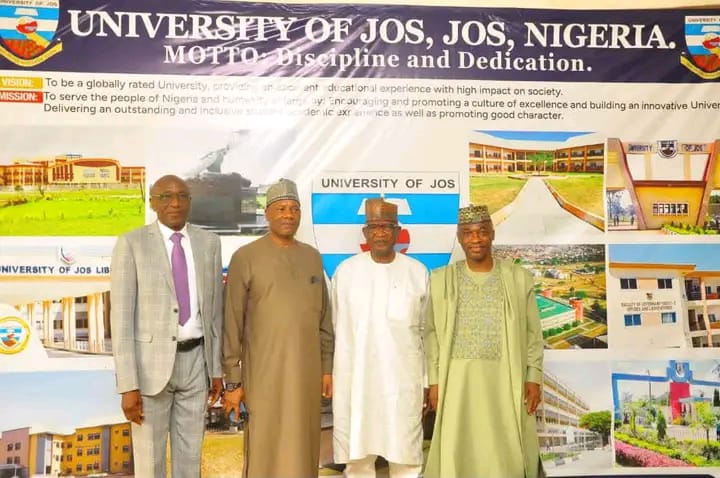
Vice-Chancellor of the University of Jos (UNIJOS), Professor Tanko Ishaya, has urged institutions to celebrate distinguished individuals while they are still alive rather than waiting until after their death, as the university honoured its pioneer Dean of the Faculty of Pharmaceutical Sciences, Professor Elijah Sokomba.
Professor Ishaya made the call on Wednesday at the fourth edition of the annual Professor Elijah N. Sokomba Lecture Series held at the Aliyu Akwe Doma Indoor Theatre, Permanent Site, Jos.
The lecture, themed: “Honouring the Past, Inspiring the Future: Lessons from a Founding Scholar, ” brought together academics, government officials, students, pharmacists and other stakeholders to celebrate Sokomba’s contributions to pharmaceutical education and the development of the University of Jos.
Speaking at the event, Ishaya said the annual lecture series, which was initiated during his tenure as vice-chancellor, had now reached its fourth edition.
He described the occasion as an opportunity to honour Sokomba while he was still alive, stressing that society should recognise the contributions of accomplished individuals rather than wait until after their death.
“It is better to honour them and to recognize them when they are alive,” he said.
The vice-chancellor commended Sokomba for his contributions to the University of Jos, Nigeria and the wider world, particularly through mentorship and the training of professionals in pharmaceutical sciences.
He also called on other faculties in the university to emulate the initiative by honouring individuals who had contributed significantly to their development.
The Faculty of Pharmaceutical Sciences instituted the annual lecture series in recognition of Sokomba, who played a pioneering role in establishing the faculty and laying the foundation upon which successive generations of academics and professionals have built.
Welcoming guests, Chairman of the Organising Committee and Provost of the Federal College of Education, Pankshin, Professor Noel Wunang, described Sokomba as a mentor whose influence had shaped the careers of many academics.
“Professor Sokomba has shaped lives, built futures, and transformed an entire generation, of which I am fortunate to be one,” Wunang said.
He urged current lecturers and university leaders to protect the legacy established by the pioneer dean and ensure that future generations benefited from it.
Delivering the keynote lecture, Professor Jonathan Ayuba said the growth of the Faculty of Pharmaceutical Sciences from its humble beginning to a faculty with seven departments demonstrated the strength of the foundation laid by Sokomba and other pioneers.
He noted that the faculty had produced doctors, professors, vice-chancellors, ministers and other professionals, describing the achievements as products of the sacrifices made by the founding generation.
Ayuba recalled the challenges surrounding the establishment of the faculty, including accreditation difficulties and uncertainty over its future, saying Sokomba accepted the challenge of building the faculty despite discouragement from colleagues and family members.
He said Sokomba went beyond his academic expertise by investing his personal resources and experience in ensuring the faculty attained stability and accreditation.
Ayuba appealed to the university management to name a structure, road or faculty building after Sokomba as a permanent memorial to his contributions.
“Thanking him is not enough. We have to go beyond just saying thank you to demonstrate that we really benefited from his sacrifice and for everything that he has done for this institution,” Ayuba said.
He also proposed the establishment of a founders’ platform to document the history and contributions of individuals who played key roles in building the Faculty of Pharmaceutical Sciences.
Ayuba identified patience, alongside academic excellence and commitment, as one of the major qualities younger academics could learn from Sokomba’s mentorship.
Chairman of the occasion and Niger State Commissioner for Health, Dr. Murtala Bargana, described Sokomba as an accomplished professional whose contributions had extended beyond the University of Jos.
He disclosed that Sokomba currently chairs the Niger State Health Advisory Committee established by Governor Mohammed Bago to provide expert guidance on the state’s health sector reforms.
According to him, the committee brings together experienced professionals from government, academia and industry to advise the state on strengthening primary, secondary and tertiary healthcare services.
Describing the lecture series as commendable, Bargana urged other faculties to adopt similar initiatives.
“Honestly, I would encourage a lot of faculties, not only pharmaceutical sciences but a lot of faculties, to honour one of theirs,” he said.
He described Sokomba as “an example of humility” who had provided selfless service to the University of Jos, Nigeria and the West African sub-region.
Responding to the tributes, Sokomba expressed gratitude to the university management, organising committee, lecturers, students, guests and other participants for honouring him.
He described the recognition as both a privilege and a responsibility, saying the event had provided an opportunity to reflect on his years of service and contribution to pharmaceutical education.
“I stand here before you this afternoon with a heart full of gratitude and humility. I am deeply honoured by the lecture and all the presentations that have been made,” Sokomba said.
He particularly thanked the vice-chancellor for approving the annual lecture series and commended the organising committee for sustaining the initiative.
“My heartfelt appreciation goes to our distinguished lecturer, guest lecturer, for the thoughtful, insightful and inspiring presentation. Your kind words and careful reflections have touched me deeply,” added.
The annual Professor Elijah N. Sokomba Lecture Series is organised by the Faculty of Pharmaceutical Sciences, University of Jos, to celebrate the pioneer dean’s contributions while inspiring future generations to uphold the values of scholarship, mentorship, leadership and service.