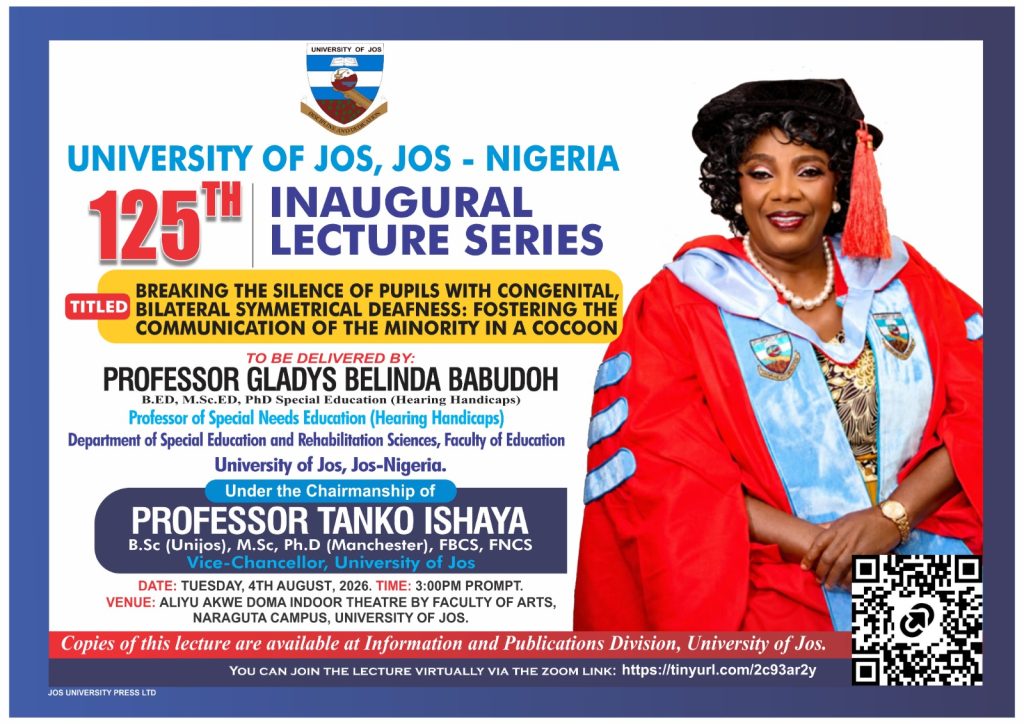
A Professor of Special Needs Education (Hearing Handicaps) at the University of Jos (UNIJOS), Prof. Gladys Belinda Babudoh, has urged governments and relevant institutions to establish early hearing detection programmes, subsidise cochlear implants and expand sign language education to improve communication and learning outcomes for children born with profound congenital deafness.
Babudoh made the call on Tuesday while delivering the University’s 125th Inaugural Lecture titled, ” Breaking the Silence of Pupils with Congenital Bilateral Symmetrical Deafness: Fostering the Communication of the Minority in a Cocoon.”
She said children born with profound congenital deafness remain a neglected minority because existing rehabilitation approaches often fail to address their communication needs, leaving them isolated from society.
“The group being discussed in this lecture consists of individuals with hearing losses of 90 dB and above in both ears. This group is unique because rehabilitation efforts by professionals, teachers, governments and non-governmental organisations often do not adequately reach them. In fact, they are frequently omitted unintentionally.
“That is why the presenter refers to them as the minority. Because of their characteristic silence, they are also described as a group in a cocoon. Without exposure to a full visual language, such as sign language, the child remains isolated. Cognitive development, including thinking, memory, planning and social understanding, depends heavily on communication,” she said.
Babudoh explained that while interventions such as hearing aids, classroom positioning and auditory-verbal therapy benefit children with residual hearing, they offer limited support for those born with profound congenital deafness. She therefore proposed a six-phase instructional model focusing on sign language development, word recognition, sentence formation, interactive communication, reading comprehension and dramatization to improve manual communication, reading and writing skills.
She stressed that breaking the silence surrounding children with profound congenital deafness requires deliberate investment in communication-based interventions rather than assumptions that they cannot learn.
“Governments and relevant institutions should collaborate to establish effective programmes for the early detection of hearing problems in children
“Children with profound congenital deafness should be given access to cochlear implants whenever appropriate. We are appealing to government because cochlear implantation is extremely expensive. The procedure can cost tens of millions of naira, making it unaffordable for many families.
“Sign language should be taught not only to the child but also to parents, siblings and other people around the child. If family members cannot communicate with the child, the child remains isolated in silence. The Department of Special Education and Rehabilitation Science should also consider expanding its programmes to include certificate courses in sign language,” Babudoh added.
Earlier, the Vice-Chancellor of the University of Jos, Prof. Tanko Ishaya, said inaugural lectures provide a platform for showcasing research that addresses societal challenges and contributes to national development.
He described the lecture as timely, noting that issues affecting persons with special needs are often overlooked despite their importance to building an inclusive society.
“One of the reasons why we organise inaugural lectures is because we believe one of the best things to do is research. We want to demonstrate the research we do in the university because the outcomes are important to this country. It is the best way to provide the knowledge that society needs.
“Today we are here to listen to a very important topic, one that I believe has been neglected. People with special needs are part of society just like every other human being. Most of the time we struggle to understand what to do, but I believe this lecture will help us know how to relate with and support them better.
“Everyone has one disability or another in one way or the other. That is why we must continue to promote understanding and inclusion,” Ishaya said.