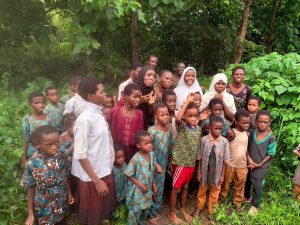
Africa’s future is too often discussed in the abstract, as if it were a distant promise. In truth, the continent’s youth are already powerful force— dynamic, restless, and actively shaping realities on the ground. The central question is no longer whether Africa’s youth will influence the continent’s trajectory, but whether there are institutions capable of channeling this demographic power into sustainable progress. In this light, the work of the Africa Youth Growth Foundation (AYGF) warrants greater attention.
For over two decades, AYGF has adhered to a simple yet increasingly rare principle: development should be practical, sustained, and grounded in local realities. Its programmes regard young people not as passive recipients of aid, but as economic actors, community leaders, and future custodians of the state. This distinction is critical. Africa’s youth challenge is not just about numbers—it is fundamentally about capability, health, skills, and civic responsibility.
AYGF’s emphasis on education and skills acquisition reflects a traditional truth often forgotten in modern policy debates: no society advances faster than the quality of its human capital. Through scholarships, vocational training, and digital literacy initiatives that reach both rural and urban communities, the foundation prepares young Africans for work that exists, not jobs imagined in policy papers. Entrepreneurship is encouraged not as a slogan, but as a necessity in economies where the state cannot absorb every graduate.
Equally important is AYGF’s investment in leadership and civic education. Africa’s democratic deficit is not caused by youth apathy alone, but by the absence of structured pathways into public life. By organising debates, policy dialogues, and leadership seminars, AYGF reinforces the idea that citizenship entails both obligations and rights. This steady cultivation of civic culture is slow work, but it is the kind that endures.
Where AYGF’s approach becomes particularly instructive is in public health and humanitarian response. Its role in the World Bank–supported Accelerating Nutrition Results in Nigeria programme illustrates how youth-focused organisations can also deliver large-scale, technically sound interventions. Millions of nutrition services across Kogi, Niger, and Katsina States are not abstract achievements; they translate directly into healthier children, stronger mothers, and more productive communities. The same can be said of its malaria elimination work in Edo State and its food-security interventions with the World Food Programme, which combine immediate relief with market resilience.
Perhaps most telling is AYGF’s work with survivors of human trafficking. Reintegration, vocational training, psychosocial care, and legal support are not glamorous development headlines, but they address one of West Africa’s most corrosive social failures. In restoring dignity and economic agency to survivors, the foundation reinforces social stability at its most fragile point.
The cumulative impact is difficult to ignore: millions reached, thousands trained, local health systems strengthened, and children returned to school. These are not isolated projects, but components of a coherent development philosophy—one that recognises that youth empowerment encompasses nutrition, health, education, migration, governance, and climate resilience.
Africa’s demographic dividend is time-bound. If it is not harnessed deliberately, it will harden into unemployment, insecurity, and social strain. Institutions like AYGF show that another path is possible—one grounded in discipline, evidence, and respect for the fundamentals of development. Youth are not merely the future; they are the present. The task before Africa is to ensure they are prepared to carry it.