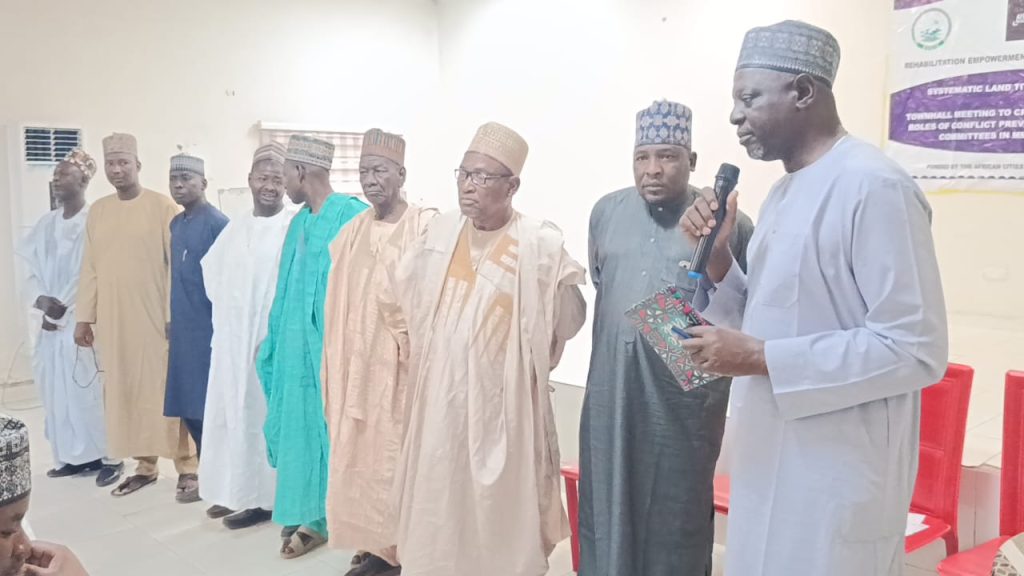
In a major step toward strengthening land ownership and community stability, the Rehabilitation Empowerment and Better Health Initiative (REBHI) has convened a high-level town hall meeting in Maiduguri, Borno State.
The meeting, held at the Armani Event Center, brought together key stakeholders to discuss the rollout of the Systematic Land Titling (SLT) programme across Maiduguri Metropolitan Council (MMC) and Jere Local Government Area.
The initiative is designed to replace informal and verbal land agreements with legally recognised titles, giving residents stronger security over their property.
According to a statement issued by the Nigeria Union of Journalists (NUJ), Borno State Council Chairman, Comrade Abdulkareem Haruna, the project is part of a broader intervention by the African Cities Research Consortium (ACRC).
The programme is led by the University of Manchester and funded by UK Aid, in collaboration with the Borno State Geographic Information Service (BOGIS) and REBHI.
It is specifically targeted at converting informal land ownership into formal legal assets, with a strong focus on protecting women, internally displaced persons, and other vulnerable groups.
From Customary Claims to Legal Assets
Speaking at the event, the ACRC lead researcher, Dr. Babakura Bukar, said the initiative goes beyond research and aims at real change on the ground.
“In Maiduguri, we are turning traditional land claims into legal titles,” Dr. Bukar stated.
“These documents are more than just paper; they are financial assets that empower residents to secure their future and provide lasting tenure security.”
The town hall attracted a wide range of participants, including traditional leaders such as Bulamas (ward heads) and Lawans (village heads), as well as women leaders and representatives of community-based organisations.
REBHI Executive Director, Mrs. Ajikatu Imam, highlighted the importance of legal ownership in empowering communities.
“This project is about giving our people real power,” she said.
“When you have a legal title, you aren’t just living in a house—you own a protected asset.”
Conflict Resolution Measures Introduced
As part of the rollout, Conflict Prevention and Resolution Committees were inaugurated to address disputes early and prevent escalation.
The committees are led by Ambassador Ahmed Shehu of the Peace Ambassadors Center and Comrade Bulama Abiso, Executive Director of Civil Society in Borno State.
Their role will include mediating land-related disagreements before they develop into court cases or communal clashes.
To ensure inclusivity, the District Head of Bolori announced measures to ease access to the programme for disadvantaged groups.
These include:
Zero-cost services: Bulamas are to provide free support to women and persons with disabilities seeking land titles.
BOGIS backing: The directive aligns with existing provisions by BOGIS to minimise financial barriers for vulnerable residents.
Positioning Maiduguri for Future Growth
With Maiduguri experiencing rapid urban expansion, stakeholders say the need for proper land documentation has become urgent.
Professor Abubakar Kawu Monguno, Lead Consultant on SLT, noted that Maiduguri and Yerwa are currently the only Nigerian cities participating in the wider African programme.
“The SLT project is a direct response to the rapid growth of our city,” Professor Monguno remarked.
“It provides an essential opportunity for residents to secure their landed property as a legally recognized legacy.”
The Systematic Land Titling initiative is expected to bridge the gap between traditional land practices and modern legal systems.
Stakeholders believe the programme will not only improve tenure security but also enhance social cohesion and urban governance in Borno State.