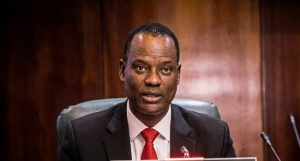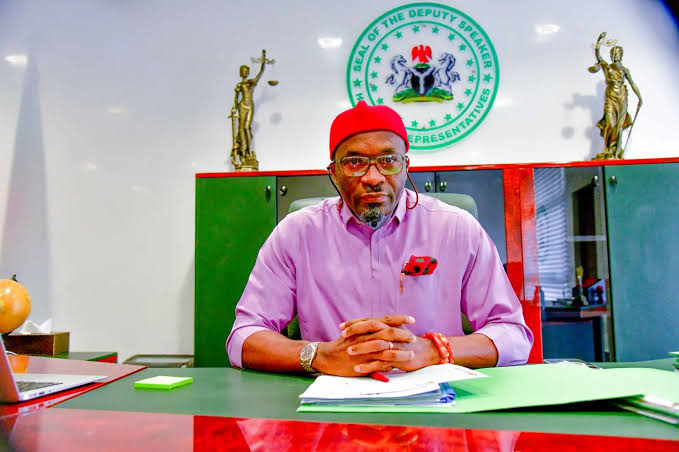
Deputy Speaker, Benjamin Kalu.jpeg
Office of the Deputy Speaker of the House of Representatives, Rt. Hon. Benjamin Okezie Kalu, has dismissed reports alleging that the 2026 federal budget contains a ₦1 billion provision solely for the purchase of musical instruments for churches in Bende Federal Constituency, Abia State.
In a statement issued on Tuesday by the Deputy Speaker’s Chief Press Secretary, Levinus Nwabughiogu, the office described the reports as misleading, insisting that they failed to capture the actual purpose and scope of the budget provision.
According to the statement, the allocation is not ₦1 billion as widely reported but ₦780 million after VAT and other statutory tax deductions.
The statement explained that the funds are designated for a Youth Re-orientation and Social Support Programme to be implemented through faith-based organisations across Bende Federal Constituency.
“Bende has 13 federal political/electoral wards and over 200 churches. The first phase of this support targets 130 of these churches averaging about 10 churches per ward, which amounts to approximately 5 to 6 million Naira per church. It is designed to equip churches to expand existing youth engagement platforms focused on character reform, and to deliver more impactful community outreaches,” the statement said.
The Deputy Speaker’s office further explained that the intervention is intended to strengthen community-based campaigns aimed at addressing social challenges among young people.
“The funds are intended to support the purchase of evangelical instruments and public address systems to promote campaigns against vices like the spread of narcotics, sexual offences, violent crimes while instilling discipline, values, peace, and character development among young people in the communities,” the statement added.
Defending the initiative, the office argued that government investment should not be limited to physical infrastructure alone but should also extend to programmes that promote moral values and social cohesion.
“Nation-building must go beyond roads and physical infrastructure. Government must also invest in building the character and value system of the people who use the infrastructure using various value delivery platforms. Government is also employing non-kinetic approaches to promote peace, unity and progress of Nigeria,” the statement read.
It also noted that traditional institutions have long received government support through the construction of town halls and community centres to preserve cultural values, adding that faith-based organisations equally have an important role in promoting good morals.
“This emphasizes that faith-based organizations have a critical role to play in sustaining good norms and values in the society,” the statement said.
The Deputy Speaker’s office maintained that similar faith-based youth development initiatives exist in other parts of the country, although the model has yet to become widespread in the South-East.
“This development is not entirely new or strange. Faith based organizations in other parts of the country invest in youth development but it is a strategy that has not gained currency in the South East region. The provision therefore, seeks to adopt, strengthen and support the effort in Bende federal constituency, using the church platforms,” it stated.
The statement also clarified that the 2026 budget has not yet entered the implementation stage, stressing that no funds have been released for the programme.
“For the avoidance of doubt, the 2026 budget where this is domiciled is yet to be implemented. The selected churches will receive notification once the procurement processes have been concluded.
“At the moment, the country is still operating on the 2024 and 2025 budgets. The 2026 budget is yet to be funded. It is yet to receive releases, which must take place before the commencement of procurement.”
The office further disclosed that it had identified what it described as a technical error in the procurement description and had initiated a corrigendum to the Budget Office through the Appropriation Committee to effect the necessary correction before implementation.
“Similarly, we have also identified a technical error in the procurement description. A letter of corrigendum to this effect has been initiated for the needed correction by the budget office through the appropriation committee before implementation,” the statement noted.
Reiterating the objective of the intervention, the Deputy Speaker’s office said the programme is broader than the procurement of equipment for churches.
“This intervention is not about instruments alone. It is about leveraging trusted community values sustaining structures to reorient our youths, promote unity, and sustain moral instruction across the constituency.”
The office urged journalists and members of the public to disregard what it described as sensational reports and instead support initiatives aimed at strengthening both infrastructure and the moral fabric of society.