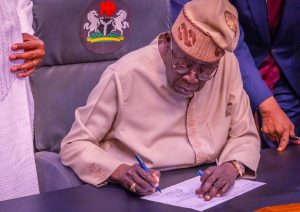
President Bola Tinubu
As Nigeria marks its 65th Independence Anniversary, President Bola Tinubu has spotlighted notable gains in transportation and economic recovery—particularly a 40% surge in rail transport and a 27% boost in waterway operations—as proof that his administration’s infrastructure drive is beginning to bear fruit.
In a nationwide message to commemorate the milestone, the president said the federal government had made “significant progress” in the last 28 months, expanding infrastructure that supports trade, mobility, and national development.
> “This administration is expanding transport infrastructure across the country—rail, roads, airports, and seaports,” Tinubu said in his Independence Day address. “Rail and water transport grew by over 40 per cent and 27 per cent, respectively.”
He noted that major projects like the Kano-Katsina-Maradi Standard Gauge railway (284 km) and the Kaduna-Kano rail line are nearing completion, while construction is progressing on legacy routes such as the Lagos-Calabar Coastal Highway and the Sokoto-Badagry Highway.
A further boost came with the Federal Executive Council’s approval of $3 billion to complete the long-delayed Eastern Rail Project, a move Tinubu described as “essential to unlocking economic potential in underserved regions.”
—
Economic Recovery: “The Worst Is Behind Us”
Beyond transport, President Tinubu reeled off a list of economic milestones that, according to him, show that Nigeria is turning a corner after years of fiscal mismanagement.
> “I say the worst is over—yesterday’s pains are giving way to relief,” he stated confidently. “In just two years, our reforms are delivering measurable results.”
Among the achievements highlighted:
Q2 2025 GDP growth hit 4.23%—the fastest in four years, beating IMF’s projection of 3.4%.
Inflation dropped to 20.12% in August, the lowest in three years.
Non-oil revenue exceeded N20 trillion by August, reaching the 2025 target months ahead of schedule.
In September 2025 alone, the government raised N3.65 trillion in revenue—a 411% increase compared to May 2023.
Debt service-to-revenue ratio dropped from 97% to below 50%.
Foreign reserves climbed to $42.03 billion, the highest since 2019.
> “We have restored fiscal health and begun to pay down the reckless ‘Ways and Means’ advances that nearly collapsed our economy,” Tinubu said.
—
Fuel Subsidy Removal: Pain Now, Progress Ahead
Tinubu also defended the controversial removal of fuel subsidies, calling it a necessary decision to free up funds for “critical investments” in the economy and social safety nets.
> “The corrupt subsidy system has ended. Trillions of Naira are now being redirected to support vulnerable Nigerians and strengthen all tiers of government,” he explained.
—
Global Recognition and Call to Action
The president noted that international financial bodies are beginning to take note of Nigeria’s improving economic fundamentals. Several sovereign credit rating agencies have upgraded their outlook on Nigeria, he said, signalling renewed investor confidence.
While acknowledging that many citizens are still grappling with the immediate fallout of economic reforms, Tinubu reassured the nation that tangible change is underway.
> “Success must go beyond numbers. It must be seen in full plates at the dinner table, better schools, reliable electricity, and safer communities.”
He ended his address with a rallying call for unity, resilience, and innovation:
> “Let us open the taps of productivity and enterprise. Together, we can make Nigeria great again.”
NAN