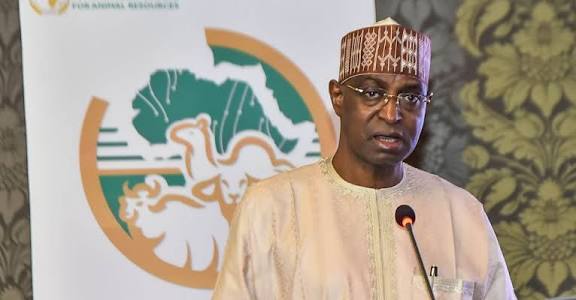
Minister of Livestock Development, Dr Idi Maiha
Federal Government has announced that Nigeria’s livestock industry could contribute as much as $74 billion to the nation’s GDP by 2035, under the new National Livestock Growth Acceleration Strategy (NL-GAS).
Minister of Livestock Development, Dr. Idi Maiha, disclosed this on Wednesday in Abuja during a Donor and Partnership Workshop on Livestock Development in Nigeria, themed: “Strengthening Strategic Partnership for Livestock Transformation.”
Maiha explained that the NL-GAS (2025–2035) is a comprehensive, market-driven roadmap aimed at repositioning the livestock sector as a major driver of economic growth, job creation, and food security.
> “It is achievable and exciting. We are not scared; we can do it for this country,” he said.
“The presence of donors and other partners here reflects your enduring commitment to Nigeria’s development and your belief in the transformative power of collaboration.”
According to him, the strategy—approved by the National Economic Council (NEC)—is built on a private sector-led and public sector-enabled framework, and aligns with President Bola Tinubu’s goal of building a $1 trillion economy by 2030.
Maiha recalled that the creation of the Federal Ministry of Livestock Development in 2024 was part of President Tinubu’s plan to unlock the sector’s full potential, enhance food and nutrition security, and promote climate resilience.
He said the NL-GAS is anchored on 10 strategic pillars designed to address long-standing constraints across the livestock value chain.
> “The pillars cover livestock value chain and market access, animal health and zoonoses control, feed and fodder development, water resources management, livestock extension services, peacebuilding and social cohesion,” he listed.
“Others include finance and insurance, statistics and information systems, infrastructure and waste management, as well as youth and women empowerment.”
The minister emphasized that women and youth empowerment would form the backbone of the strategy, aimed at doubling the national herd, boosting productivity, and positioning Nigeria as a global supplier of high-quality animal protein.
Representatives from international partners pledged their support for the government’s livestock transformation vision.
Programme Manager at the Delegation of the European Union (EU) to Nigeria and ECOWAS, Temitayo Omole, said the EU sees livestock as a key investment area, especially in feed production, animal genetics, breeding, and disease control.
> “We are intervening in agriculture, livelihoods, and other sectors. One of our key focus areas is animal health, which is critical to livestock development,” Omole noted.
“We are addressing two major diseases—Newcastle disease in poultry and PPR in ruminants—through vaccine production.”
Also speaking, the FAO Country Representative in Nigeria and ECOWAS, Dr. Hussein Gadain, said the UN agency continues to work with the government to strengthen policies, technical expertise, and local capacities in livestock production.
> “The livestock sector is a vital part of Nigeria’s productive economy, employing millions and contributing significantly to food and nutrition security,” he said.
“Since the COVID-19 pandemic, a zoonotic disease, FAO and partners have championed the One Health approach to prevent and control animal-borne infections.”
Gadain added that FAO’s support extends to breeding programs, feed development, and farmer field schools, helping rural communities adopt best practices in sustainable livestock production.