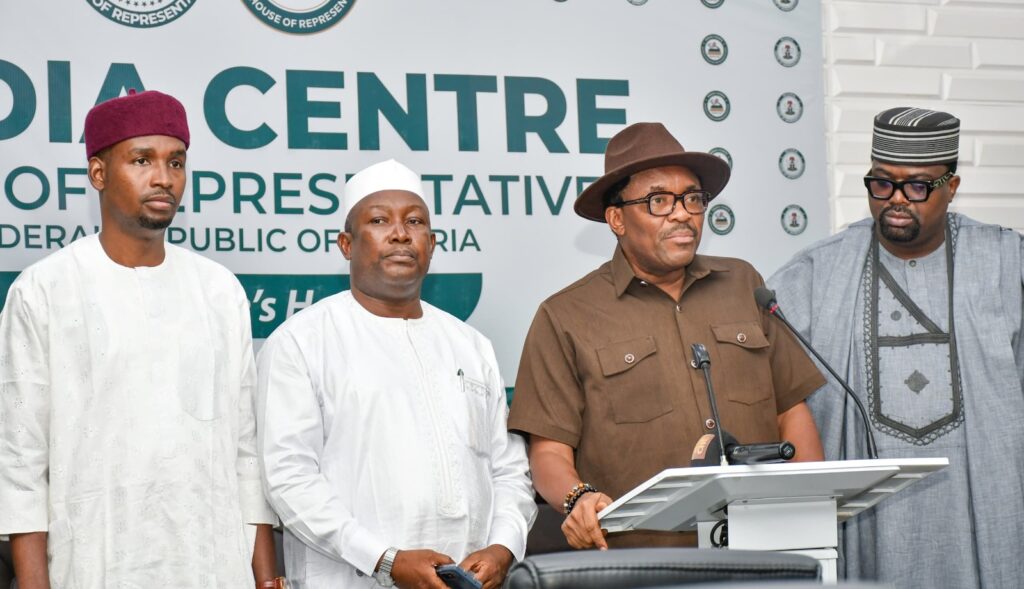
Chairman of the House of Representatives committee on Nutrition and Food Security, Hon Chike Okafor (2nd right), accompanied by other members of the House committee on Nutrition and Food Security, during the pre-summit press conference held at the National Assembly, Abuja,...Thursday
The national Summit on Nutrition and Food Security organized by Nigeria’s House of Representatives entered its third day in Abuja on Thursday with various critical stakeholders and professionals offering suggestions on how to increase food production and combat hunger in Africa’s most populous nation.
With its theme as “Curbing Malnutrition and Food Insecurity Through Effective Synergies,” the 3-Day summit was declared open on Tuesday by Vice President Kashim Shettima, who called for continued collaboration between the Executive and Legislative arms of government at the federal and state levels in the push to significantly reduce malnutrition and stop the deaths caused by the condition, especially among children.
In this regard, Shettima, identified programmes such as the N774 Initiative and the National Legislative Network on Nutrition and Food Security as sustainable routes through which the government can introduce and implement policies and laws to promote food security and combat malnutrition.
Shettima, who was represented by Deputy Chief of Staff to the President (Office of the Vice President), Senator Ibrahim Hadejia, Shettima averred that the government at all levels must take the challenge of malnutrition and its negative impact on the country seriously, describing as highly unacceptable the fact that malnutrition is depriving about 40 percent of Nigerian children under the age of five of their full physical and cognitive potential.
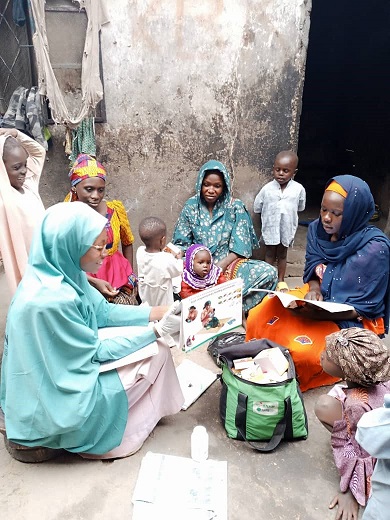
He expressed gratitude to the World Bank for the Accelerating Nutrition Results in Nigeria (ANRiN) project, which has helped in strengthening community-based nutrition systems in several states across the country.
A state-led, performance-based project, ANRiN aims to increase the utilization of cost-effective nutrition services for pregnant and lactating women, adolescent girls, and children under five years of age in select states in Nigeria, namely Akwa Ibom, Gombe, Kaduna, Kano, Kogi, Kwara, Nasarawa, Niger, Oyo and Plateau states.
“We are grateful to the World Bank for the Accelerating Nutrition Results in Nigeria program, strengthening community-based nutrition systems in several states. We appreciate UNICEF and Médecins Sans Frontières for the community-based management of acute malnutrition CMAM program, reaching the most vulnerable with lifesaving interventions. We recognise the ICAM project by GAIN, which marries nutrition with climate-smart agriculture, and the Multiple Micronutrient Supplementation Program, MMS, by Nutrition International, combating maternal anaemia and improving pregnancy outcomes,” the Vice President said.
Chairman of the House Committee on Nutrition and Food Security, Hon Chike Okafor, had in his welcome address, listed the negative effects of malnutrition, from the impact on health, such as stunting, low birth weight, anaemia in children, adolescent girls and women, to the economic cost on the country.
Okafor said, “The cost of inaction on these parameters on Nigeria’s economy is aggregated to about 12.2% of the Country’s Gross National Income, about $56b, based on data from Nutrition International, I and the World Bank.”
He added, “Food insecurity has been aggravated by post-harvest loss, estimated at $2b by the Food and Agriculture Organisation (FAO) yearly. This colossal loss alone is more than the Nutrition budget of the Ministries of Agriculture, Health, Education and Women Affairs put together.
“This continued loss is not only unacceptable, but unsustainable given the austere times in which we currently live. On the above premise, my committee is working with those in the 36 states of the federation to do things differently.”
He said the House of Representatives was undertaking strategic capacity-building sessions to have a better understanding of the root and dynamics of current nutrition and food security challenges in Nigeria and expressed hope that the capacity-building sessions are institutionalised in partnership with the National Institute of Democratic and Legislative Studies, with support from our ever-helpful development partners.
In an interview with journalists on the sidelines of Wednesday’s event, Okafor also called on the federal and state governments to deal decisively with gangs and bandits terrorizing farmers across the country, as many farmers have been killed, while even higher numbers have abandoned their farmlands in fear.
According to the lawmaker, that attacks on farms and farming communities over the years had seen formerly productive farmers fleeing their lands and abandoning food production, pointing out that there was a linkage between abandoned farms, rising food costs, malnutrition and hunger.
He therefore called on the Federal Government and States to prioritise the protection of famers and their cultivated land in order for displaced and dejected farmers as well as newcomers in the agricultural sector to return to farming.
Also speaking to newsmen at the summit, the Country Director for the Global Alliance for Improved Nutrition, (GAIN), Dr. Michael Ojo, identified climate change, the high-level insecurity as well as the fact that Nigeria’s population growth outstrips its food production, as some of the issues causing malnutrition.
He said: “Malnutrition is a big problem for the country. But it is not a new problem. I think there is a lot more focus on this, partly because it is an increasing problem and the reasons for this are multiple. We produce a lot of food but we are growing faster than we produce food. So, there is a lot of pressure on the amount of food available to us. Unfortunately, in recent years, production capacity has reduced because of insecurity and other factors such as climate change.
“Also, it is one thing to produce food and it is another thing to produce food that is nutritious, so when we talk about malnutrition, we talk about it also in the context of food and nutrition insecurity. So, we are trying to deal with a double-headed problem. This is why this initiative by the House Committee on Nutrition and Food Security is really good. What we have is not a problem for the Federal Government, it is a problem for the three tiers of government. The Federal Government can make policy, but where the real action is at the states and Local Governments, this is where the real action is”.
Chief Host of the summit and Speaker of the House of Representatives, Hon Tajudeen Abbas, highlighted the need for a multi-sectoral and collaborative approach in dealing with the malnutrition challenge.
Abbas said, “Credible estimates place the annual economic cost at 12.2 per cent of Nigeria’s Gross National Income, approximately fifty-six billion dollars, while post-harvest losses alone account for two billion dollars each year. Such figures compel us to move beyond rhetoric to concrete, sustained interventions.
“To that end, the Committee is collaborating with stakeholders in all 36 States to transition from policy pronouncements to on-the-ground impact. Through capacity-building workshops and cross-sectoral consultations, we are addressing the root causes of malnutrition and strengthening the systems needed for rapid and effective response.
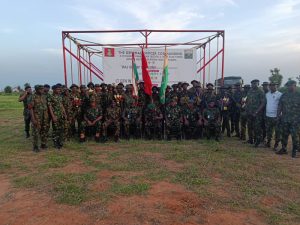
On his part, Nigeria’s Chief of Army Staff, Lt-Gen Olufemi Oluyede, called immediate adoption of ranching as a national policy as a way of addressing the growing food insecurity across the country.
The Army Chief, who was represented by the Executive Director, Nigerian Army Farms and Ranches Limited, Major-General Olufemi Dare, said on Thursday that open grazing was no longer sustainable.
General Oluyede, while calling on the National Assembly to enact legislation banning open grazing and provide ranching alternatives for herders, .said, “the issue of food insecurity is give and take. Even if all security agencies are deployed to the farms, they cannot cover every farmland.”
The summit comes a year after ANRiN, Nigeria’s largest-ever investment in nutrition till date, delivered a package of cost-effective, life-saving nutrition services to over 13.7 million women, children, and adolescents across the 12 select states between 2019 and 2024.
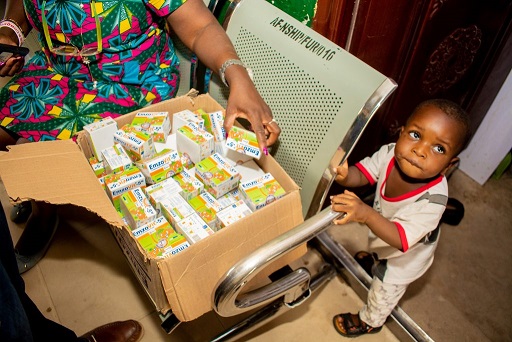
With financing and technical assistance from the World Bank, ANRiN mobilized over US$138 million in 11 high-burden states, reaching 13.7 million women and children with essential services. It was the first program to deliver at this scale using both state systems and performance-based contracts with non-state actors.