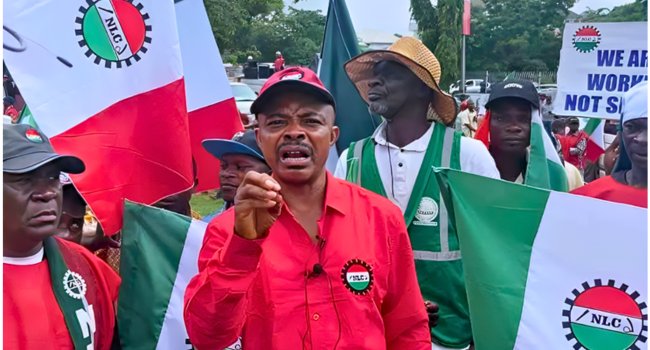
NLC protesters
Nigeria Labour Congress (NLC) has sharply criticized the Federal Government’s enforcement of its “No work, no pay” directive, insisting that the union’s firm stance remains: “No pay, no work.”
Speaking to journalists after a courtesy visit to Governor Alex Otti in Nvosi, Isiala Ngwa South LGA of Abia State, NLC President Joe Ajaero decried the federal policy as “unjust and insensitive,” arguing that it is “illogical for government to expect productivity from workers who have not been paid their entitlements.”
His remarks come in response to an October 13, 2025 circular signed by Education Minister Dr. Tunji Alausa, instructing federal university Vice-Chancellors to enforce the policy on members of the Academic Staff Union of Universities (ASUU), who are currently on strike.
Ajaero blamed the recurring strikes on government’s persistent failure to honour agreements, some dating as far back as 2009. “The cause is non-payment, and the consequence is no work,” he declared.
He urged the Federal Government to focus on resolving the root causes of industrial actions rather than penalising workers. According to him, the ongoing neglect of the education sector is steadily eroding the country’s intellectual capital.
“All unions in the education sector will convene on Monday to deliberate on a united course of action,” Ajaero disclosed, warning that no nation can prosper without investing heavily in education.
He noted that poor working conditions and inconsistent pay have driven many Nigerian academics abroad, where better opportunities await. “Fixing the education system will automatically uplift the economy and enhance national stability,” he added.
On the internal crisis within the Labour Party, Ajaero reaffirmed NLC’s legal ownership of the party, stating that the Congress holds the original certificate of registration. He dismissed opposing factions as “birds of passage” and announced plans to restructure the party from the ward to national level.
Commenting on workers’ welfare in Abia State, Ajaero praised Governor Otti’s strides but called for urgent correction of salary disparities, where some junior staff reportedly earn as much—or more—than their seniors due to inconsistent salary adjustments.
He appealed to the state government to rectify the imbalances swiftly to ensure equity, merit-based promotions, and lasting industrial peace.