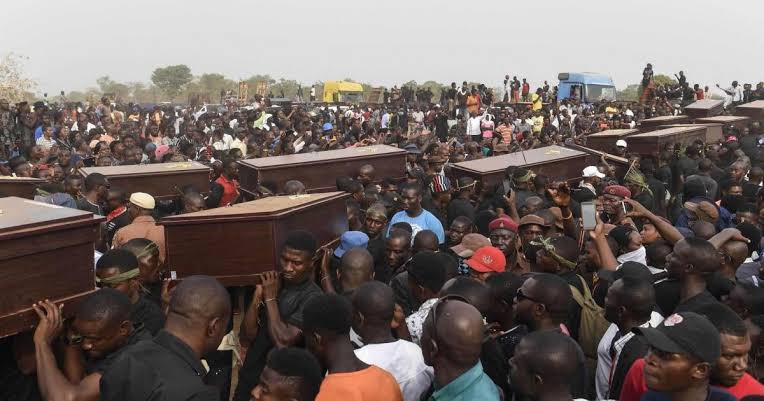
Pallbearers carry coffins during the funeral service for people killed during clashes between cattle herders and farmers in Ibrahim Babangida Square in the Benue state capital, Makurdi. Violence between the mainly Muslim Fulani herdsmen and Christian farmers has claimed thousands of lives across Nigeria's central states over the past few decades. © PIUS UTOMI EKPEI/AFP/Getty Images
A 6-year investigation by the Observatory for Religious Freedom in Africa (ORFA) has revealed that 79,323 people were killed in terrorism-related violence across Nigeria between 2020 and 2025, while 34,773 civilians were abducted during the period.
The findings are contained in ORFA’s 2026 report titled, _Four Times Boko Haram? How the World Misreads Nigeria’s Violence,_ unveiled on Tuesday.
According to the report, Nigeria recorded an average of seven terror attacks and 36 deaths daily during the six-year period, with 42,033 of those killed identified as civilians, while 37,290 were security personnel and members of armed groups.
ORFA said its findings were based on years of cross-referencing attack patterns using five data streams, including field researchers, local partners, independent academic projects, media and NGO reports, as well as verified social media accounts.
Senior Research Analyst at ORFA, Frans Vierhout, said the study challenges long-held assumptions about the principal drivers of violence in Nigeria.
“The data makes this very difficult to ignore. We look at how killing occurs, who they target, where they operate, the seasonal fluctuations of killings, and the evidence points strongly in one direction,” he said.
The report stated that Boko Haram and the Islamic State West Africa Province (ISWAP), widely regarded as the country’s most notorious terrorist organisations, accounted for 12 per cent of civilian killings during the review period, with Boko Haram responsible for eight per cent and ISWAP four per cent.
It said armed groups categorised as “Fulani Terror Groups” accounted for 44 per cent of civilian deaths, representing 18,577 killings, compared to the combined 4,941 civilian deaths attributed to Boko Haram and ISWAP.
ORFA, however, stressed that the classification refers only to armed groups and should not be interpreted as referring to the Fulani ethnic group as a whole, noting that the overwhelming majority of Fulani people are not involved in violence.
“Violence linked to Fulani militias is the dominant force behind Nigeria’s death toll. The Western preoccupation with Boko Haram is, at best, misleading,” Vierhout said.
He added, “Nigeria is incubating a terror network which the outside world has yet to acknowledge.”
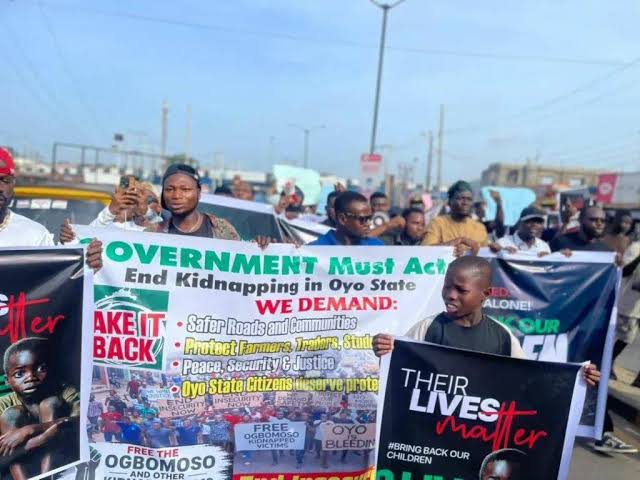
The report also documented 34,773 civilian abductions during the six-year period, stating that armed groups it classified as “Fulani Terror Groups” accounted for 43 per cent of the kidnappings, while unidentified armed groups were responsible for 49 per cent.
On the religious dimension of the violence, the report said 28,551 Christians and 13,224 Muslims were killed during the period. It added that, relative to the population of affected states, Christians were killed at 4.4 times the rate of Muslims.
According to the report, 15,932 Christians and 15,272 Muslims were abducted during the period. However, drawing from survivor testimonies, ORFA alleged that Christian hostages generally faced higher ransom demands, longer negotiations, harsher treatment and a greater risk of execution than Muslim captives.
“The field research reveals a lesser value is assigned to a Christian life,” Senior Research Analyst and author of Captivity by Creed: The Religious Sorting System Nobody Talks About, Steven Kefas, said.
“From the moment of capture, Muslim and Christian hostages enter different realities. It is not about individual captors. It is a system—consistent across multiple states, armed groups and multiple years of survivor testimony,” he added.
The report further stated that 75 per cent of civilian deaths occurred during attacks on farming communities involving abductions, rape and destruction of property.
ORFA urged governments and international organisations to study the findings, arguing that efforts to tackle insecurity in Nigeria would remain incomplete without a fuller understanding of what it described as the religious dimensions of the violence.
The organisation said the study was compiled using five data streams, including field researchers, local partners, independent academic projects, media and NGO reports, as well as verified social media accounts, with up to 60 data elements recorded for each verified incident.
The full ORFA 2026 six-year study, _Four Times Boko Haram? How the World Misreads Nigeria’s Violence_ , together with its appendices and methodology, is available on the organisation’s website, orfa.africa.