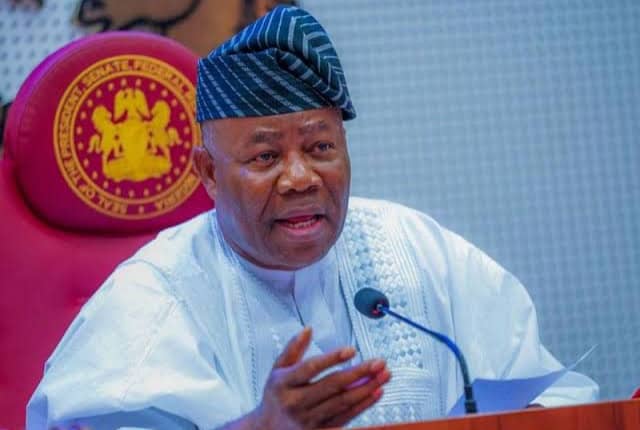
Senate President, Godswill Akpabio
In response to growing international scrutiny, particularly from the United States, the Nigerian Senate has formed a 12-member ad-hoc committee to address allegations of state-sponsored persecution of Christians in the country.
The committee was established following a closed-door session held on Tuesday, during which senators deliberated on recent remarks from the U.S. government that hinted at potential acts of genocide against Christian communities in parts of Nigeria.
This move comes amid rising diplomatic pressure and concerns over how such allegations might affect Nigeria’s global image, foreign relations, and interfaith harmony.
The committee comprises senators Victor Umeh, Yemi Adaramodu, Aniekan Bassey, Niyi Adegbonmire, Abdul Ningi, Titus Zam, Tony Nwoye, Tahir Munguno, and Asuquo Ekpenyong, among others. Their mandate is to produce a detailed position paper that will inform the Senate’s stance and be presented to both the Nigerian Executive and international stakeholders.
Senate President Godswill Akpabio, who announced the formation of the panel, emphasized that the report must be grounded in credible data and facts. “There are misconceptions that need to be corrected. We are dealing with a complex terrorist threat, and it’s important that our counterparts in the US understand that the violence affects both Christians and Muslims,” he said.
The Senate also agreed to open direct communication with the U.S. Congress to counter what lawmakers described as “misleading narratives” that simplify Nigeria’s security challenges as a religiously driven conflict.
The resolution was prompted by a motion from Senator Ali Ndume, which triggered an intense debate on how Nigeria is being portrayed abroad. Lawmakers expressed concern that although many foreign reports stem from genuine humanitarian concerns, they often misrepresent the full context and inadvertently harm Nigeria’s reputation and economy.
Akpabio floated the idea of sending a small, well-informed delegation to the U.S. for private meetings with American lawmakers, stressing the need for dialogue grounded in factual context rather than sensationalism.
Senator Jimoh Ibrahim also weighed in, urging that Nigeria’s response to terrorism should be driven by strategic, data-informed approaches rather than reactive measures.
The ad-hoc committee is expected to shape Nigeria’s legislative engagement on the matter as international conversations continue.