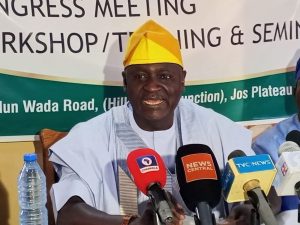
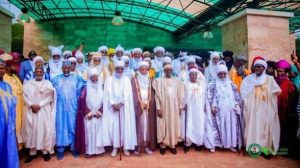
A cross section of stakeholders at the end of the sensitization programme in Jos
By Christiana Lot, Jos –
Stakeholders have emphasized the urgent need for increased religious tolerance in Nigeria amidst persistent religious tensions and conflicts.
This appeal was made during a recent grassroots sensitization program held in Jos, Plateau State.
The program featured the presentation of a survey report focused on Freedom of Religion and Belief (FORB) in Nigeria, forming part of a broader initiative titled: “Mechanisms for Monitoring Freedom of Religion and Belief in Nigeria.”
This initiative is being implemented by the National Human Rights Commission (NHRC), the Kukah Center, and the Nasrul-lahi-l-Fathiu Society(NASFAT), with funding provided by the King Abdullah Ibn Abdulaziz International Center for Interreligious and Intercultural Dialogue (KAICIID).
In his address, Joseph Atang, Nigeria’s representative for KAICIID, highlighted the significance of interreligious dialogue, stating, “KAICIID prioritizes Interreligious Dialogue (IID). We are convinced that religious leaders can play an essential role in driving societal change. The organization was inspired by King Abdullah of Saudi Arabia, who collaborated with the Vatican to establish this interfaith initiative. Our board of directors and staff encompass various religions, underscoring our commitment to interreligious collaboration. We hope that the insights gained from this workshop will be effectively communicated to your communities.”
Additionally, Veronica Abe, representing the NHRC, highlighted the necessity of educating citizens about their rights, particularly regarding religious freedom.
She remarked, “Our commission has found that many individuals remain unaware of their rights or the existence of a federal commission dedicated to protecting them. Freedom of religion is a fundamental human right, and it deserves universal respect.”
She also pointed out the NHRC’s initiatives in Plateau State aimed at fostering tolerance among children through regular school engagements.
State coordinators such as Barrister Sadiq Lawal from Plateau, Mr. Jamir from Kano, and Mr. Williams Dealoegoet from Sokoto commended the project’s effectiveness in advocating for freedom of religion and belief.
Outlining the project’s strategies for promoting freedom of religion and belief, Hajia Halimat T. Oyedele, the FORB Project Coordinator, stated that the initiative intends to achieve this through policy reform, awareness-raising activities, and the establishment of networks to monitor and report violations of religious freedoms.
She stated “The project is focused on selected Northern and Southern States of the country comprising two Muslim majority States and one Christian majority State in the North, and two Christian majority States and one Muslim majority State in the South.
“The specific States were selected based on the current level of interreligious intolerance and the reach and influence of the partnering organizations in the selected States. For this, the following States were selected: Northern region: – Sokoto, Kano, and Plateau States Southern region: – Edo, Ebonyi, and Osun States.
“The project foresees the creation of a sustainable and operational network aiming at monitoring and reporting violations to Freedom of Religion or Belief in the North and South of Nigeria by compiling violations from which policy recommendations can be extracted to be shared with relevant Government stakeholders and policymakers…”
“the respect of freedom of religion and beliefs will increase the level of tolerance of the population and, hence, the possibility for peaceful coexistence between communities.” She explained.