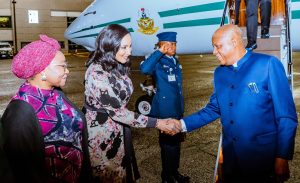
President Bola Tinubu
African Democratic Congress (ADC) has called on President Bola Tinubu to consider resigning from office following recent World Bank figures showing that about 139 million Nigerians, representing roughly 60 per cent of the country’s population, now live below the national poverty line.
In a statement issued by the party’s National Publicity Secretary, Bolaji Abdullahi, the ADC described the poverty statistics as evidence of what it called the failure of the Federal Government’s economic policies over the past three years.
According to the opposition party, the worsening economic hardship was the predictable outcome of policies that prioritised economic indicators over the welfare of ordinary Nigerians.
The party argued that despite repeated government claims of improved economic growth, rising revenue and stronger foreign reserves, many Nigerians continue to struggle with hunger, unemployment and declining living standards.
The statement read: “The African Democratic Congress (ADC) is seriously disturbed by the recent reports by the World Bank indicating that 139 million Nigerians or about 60% of the entire population now live below the national poverty line.”
It added: “This is hardly surprising as this catastrophic situation is the inevitable consequence of economic policies that have favoured money over people and statistics over survival.”
The ADC said it had consistently warned that economic reforms should be judged by their impact on citizens rather than by macroeconomic figures.
The party accused the Tinubu administration of refusing to review policies that it believes have deepened hardship.
“The ADC has repeatedly warned that the economic growth, increased revenue, and rising foreign reserves that the Tinubu-led APC government continues to celebrate are meaningless if they do not translate into better lives for the people or protect their livelihoods,” the statement said.
It further stated: “Instead of changing course, the government has stubbornly stuck with its ruinous economic policies and even continues to market recklessness as courage and wickedness as ‘necessary pains.'”
The opposition party also cited reports that millions of Nigerians face the risk of starvation, insisting that the current administration should accept responsibility for the country’s economic situation.
“However, three years down the line, it is now clear that the chicken has come home to roost. The evidence of 139 million people living in poverty and 17 million at the risk of starvation is President Tinubu’s scorecard. On account of this catastrophic failure alone, President Tinubu should be contemplating resigning from office rather than seeking re-election,” the statement added.
The ADC said Nigeria requires leadership that understands the realities confronting citizens and formulates policies aimed at improving living conditions rather than increasing hardship.
The party criticised the government’s reliance on palliative programmes, arguing that temporary relief measures cannot solve the country’s poverty challenges.
According to the statement, “This is why the ADC rejects the cycle of temporary interventions and emergency responses that has come to define the APC’s economic policies in the name of social intervention programmes. Poverty cannot be defeated through palliatives. It can only be defeated by building an economy that enables Nigerians to produce more food, earn decent incomes, and live with dignity.”
The ADC outlined a four-point economic plan it said would address the root causes of poverty and hunger if elected into office.
The party pledged to improve security in farming communities, lower energy costs and make agricultural production safer to encourage farmers to return to their fields.
It also promised to rehabilitate Nigeria’s 264 abandoned dams to support year-round irrigation, improve access to quality farm inputs and expand investments in storage, preservation and agro-processing facilities to reduce post-harvest losses.
In addition, the ADC said it would establish regional agricultural production belts to coordinate food production, processing, transportation and market access across neighbouring states based on their comparative advantages.
The party further pledged to increase investments in nutrition, primary healthcare, quality basic education and skills development, insisting that sustainable economic growth depends on improving the wellbeing of Nigerians rather than relying on short-term interventions.