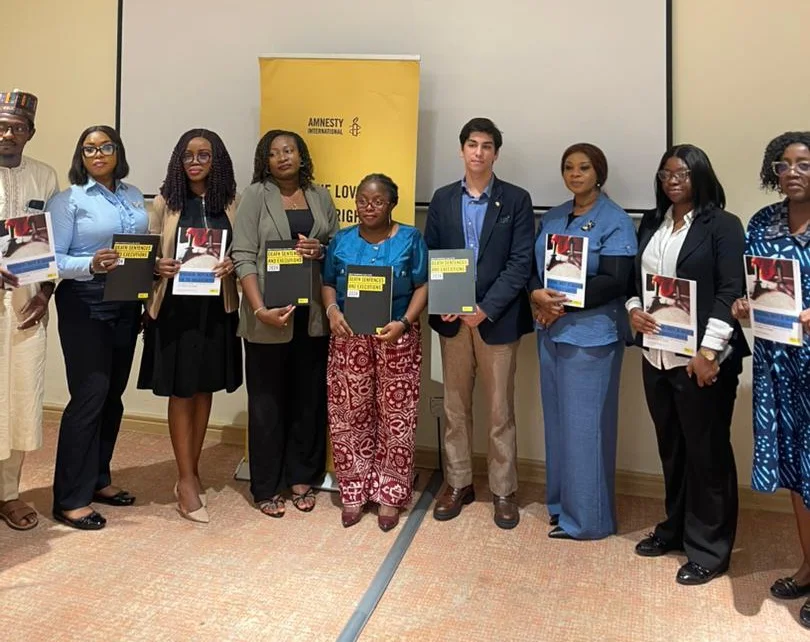
Amnesty International is calling on Nigeria’s federal and state governments to completely scrap the death penalty, warning that it is ineffective and incompatible with modern justice systems.
Speaking during a stakeholders’ dialogue in Abuja to mark the World Day Against the Death Penalty, Mrs. Barbara Magaji, Programmes Manager at Amnesty International Nigeria, emphasized the urgent need to reform the country’s criminal laws.
The event, jointly organized by Amnesty International and the French Embassy, brought together legal experts, human rights advocates, and policymakers to discuss the future of capital punishment in Nigeria.
Magaji highlighted that Nigeria’s legal provisions allowing for the death penalty are out of step with international human rights standards. She called for the removal of such laws at both national and state levels, stressing that justice must not come at the cost of human rights.
> “The Federal Government should, through the National Assembly, consider abolishing the death penalty for all crimes during the ongoing constitutional amendment process,” she urged.
Magaji pointed out that 26 states and the FCT have introduced or revised laws to include capital punishment for offenses like kidnapping, banditry, cattle rustling, and cultism — yet crime rates continue to soar.
> “In spite of the introduction of the death penalty, the country continues to record an increase in banditry, abduction and general criminality,” she said.
Citing Amnesty International’s research, Magaji revealed that in 2024 alone, over 3,169 people were killed in more than 181 incidents linked to banditry, terrorism, and other forms of violence. Another 881 were kidnapped that year, while in 2025, 2,313 deaths and 1,025 abductions have already been recorded across 204 incidents of insecurity.
She argued that these numbers show that capital punishment does not deter crime.
> “There is no convincing evidence that the death penalty has a unique deterrent effect on crimes,” Magaji noted.
Instead of relying on executions, Magaji called for broader reforms to tackle insecurity, such as improving the capacity of the criminal justice system to investigate crimes, ensuring fair trials, and offering meaningful support to victims.
She reiterated Amnesty International’s unwavering stance against the death penalty under any circumstances.
> “Amnesty International considers that death penalty violates the right to life as enshrined in the Universal Declaration of Human Rights and the African Charter on Human and Peoples’ Rights,” she said.
“The risk of executing an innocent person can never be fully eliminated — even when trials meet international standards.”
Magaji acknowledged the suffering endured by victims of violent crimes and their families, stating that justice must be served in ways that uphold human dignity.
> “We are not seeking to condone crimes. Those found guilty after a fair trial should be held accountable — but not through execution,” she added.
According to Amnesty, 143 countries around the world have now abolished the death penalty in law or in practice, a growing global trend that Nigeria is being urged to join.
NAN